







…continued from Part 1 (Read here) and Part 2 (read here)
Needonomics in Economic Thought: Revisiting Classical and Contemporary Theories
The economic models of classical and contemporary economists, from Adam Smith to Keynes, have largely centered on satisfying human wants. In contrast, Needonomics brings a fresh lens to economic thought, grounded in ethical principles.
- Classical Theories: Adam Smith’s “invisible hand” theory can be revisited through the Needonomics lens to examine how markets, while self-regulating, can often overshoot in promoting excess. Needonomics challenges the classical notion that the pursuit of self-interest will naturally lead to societal good, instead advocating that economics must consciously direct efforts toward fulfilling only legitimate needs.
- Neoclassical Theories: Traditional neoclassical economics with its focus on individual preferences and utility maximization has led to a world where consumerism thrives. Needonomics introduces a moral corrective—ensuring that personal choices do not lead to excess consumption, unsustainable practices, and environmental degradation.
- Behavioral Economics: Teachers and researchers can incorporate the insights of behavioral economics, which demonstrates how human behavior often deviates from rationality. Needonomics adds to this conversation by highlighting how, when left unchecked, such behaviors fuel wants rather than needs. Educating people to make choices that prioritize needs over desires can improve collective well-being.
Implications for Teaching and Research in Public Policy
Public policy, shaped by research in economics, must increasingly reflect the principles of Needonomics, especially in areas like poverty reduction, environmental sustainability, and public welfare. Teachers and researchers in economics have a responsibility to contribute to the policy discourse, advocating for policies that meet basic human needs and foster equity.
- Poverty Alleviation: Needonomics calls for economic policies that provide universal access to essential services such as food, healthcare, education, and housing. In teaching poverty economics, educators must stress the difference between uplifting people by satisfying their needs rather than creating systems that drive them to pursue unsustainable wants.
- Sustainable Development: Teachers and researchers must also engage with sustainability, advocating for policies that protect the environment while ensuring that human needs are met. Economic growth should no longer be measured purely by GDP, but by how well it satisfies the fundamental needs of all people without depleting resources for future generations.
- Well-being and Happiness: Needonomics aligns with the global trend of moving beyond GDP as a measure of economic success to include measures of well-being and happiness. Economics education should embrace this shift, exploring metrics like Bhutan’s Gross National Happiness (GNH) and the Economic Happiness Index (EHI).
Needonomics in Practice: Adopting a Balanced Approach in Research
For researchers, Needonomics offers an invitation to reconsider the traditional methodologies of economic research. Instead of merely focusing on quantitative metrics such as income levels or GDP, there must be a concerted effort to explore qualitative dimensions—social well-being, access to essential goods, and environmental sustainability.
- Interdisciplinary Research: Needonomics encourages interdisciplinary research that combines economics with sociology, ethics, and environmental studies. Researchers must investigate how economic decisions impact the broader fabric of society, focusing on collective well-being over individual gain.
- Empirical Studies: Researchers should conduct empirical studies to explore the benefits of economies that prioritize needs over wants. Case studies of minimalist societies, circular economies, and sustainability-driven businesses can provide insights into how Needonomics can be implemented on a larger scale.
Moral and Ethical Dimensions of Economics Education
The principle of Needonomics draws heavily on moral and ethical considerations, directly challenging the conventional view of economics as a purely objective science. Teachers and researchers in economics must embody and transmit these ethical principles in their teaching and scholarly pursuits.
- Moral Leadership in Education: Teachers are not just educators but also moral guides. The principle of “yogkṣhema” in verse 9.22 of the Gita can be invoked to teach students the value of balance—meeting needs without slipping into excess. Educators must help students understand that success is not about accumulation but about aligning one’s actions with ethical needs.
- Role Models in Research: Researchers should be role models in demonstrating how academic research can serve societal needs. Ethical research practices, a commitment to social welfare, and the avoidance of research driven by pure profit motives are critical for cultivating a culture of Needonomics in the academic community.
Conclusion: A Call to Action for the Economics Fraternity
Needonomics offers an alternative path that prioritizes human needs over desires, ensuring a more equitable, sustainable, and balanced world. For teachers and researchers in economics, this approach is not just an academic exercise but a call to action—a mandate to reorient their work towards fostering societies that thrive by satisfying needs rather than accumulating excess.
By integrating the principle of Yogakshemam, educators and researchers can guide future generations of economists toward a more holistic understanding of economics, one that harmonizes individual welfare with societal and environmental well-being. In doing so, they can fulfill the true purpose of economics, which is not to serve insatiable wants, but to meet the legitimate needs of humanity.
References
- M. M. Goel, Lessons of Needonomics for Service Sector in Present Times, ( with audio podcast) October 02,2024
- M. M. Goel, Revitalizing Indian Manufacturing with Needonomics: Leveraging Labor for Viksit Bharat (with audio podcast), September 18,2024
- M. M. Goel, Needonomics: Implications for Agriculture, (with audio podcast) September 07,2024.
- M. M. Goel, Needonomics: Balancing “How” and “Why” in an era of Greedonomics and AI, August 17, 2024
- M. M. Goel, Needonomics and Its Implications for the Indian Systems of Medicine: A Path to Sustainable Health, August 17,2024
- M. M. Goel, Needonomics: Implications for the 16th Finance Commission of India, ( with audio podcast), August 05,2024
- M. M. Goel, Needonomics: Implications for Needo-Governance in a Democratic World, (audio podcast), July 18,2024
- M. M. Goel, Needonomics: The Key to Thriving in a Knowledge-Based Economy,(audio podcast) July 08, 2024.
- M. M. Goel, Needonomics: Implications for Traders and Exporters in a Changing Economic Scenario (with audio podcast) June 19, 2024.
- M. M. Goel, Needonomics: Implications for Distributors in Changing Economic Scenario, (with audio podcast) June 04, 2024
- M. M. Goel, Needonomics: Implications for Producers in Changing Economic Scenario, (with audio podcast) May 14,2024
- M. M. Goel, Needo-Consumption: Implications for Global Consumers, April 22,2024
- M. M. Goel, Needonomics: SWOC ANALYSIS (with audio podcast) April 9, 2024.
- M. M. Goel, Unveiling the Perils of Greedonomics, (with audio podcast) March 11, 2024.
- M. M. Goel, Needonomics: Queen of Social Sciences for Global Economy, (with audio podcast) February 26, 2024.
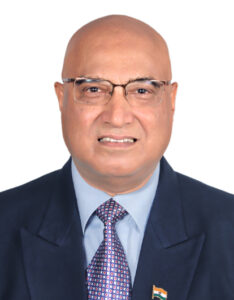 Dr. M M Goel | About the Author Propounder Needonomics, Professor Madan Mohan Goel is a superannuated Professor of Kurukshetra University. He is former Vice-Chancellor, Starex University, Gurugram, Jagannath University Jaipur, RGNIYD (GOI), Pro Vice-Chancellor VKSU Ara, Dean of Colleges & Social Sciences, Chairman, Dept. of Economics & Dept. of Journalism KUK He was the first ICCR Chair Professor in South Korea. Presently he is an Adjunct Professor at the Institute of Advanced Sciences Dartmouth, USA. He is honoured with the London Organization of Skill Development (LOSD) Excellence Award 2023, Professor J.K. Mehta Academic Excellence Award 2023, Rashtrapita Rashtriya Samman 2023 for propounding Needonomics and Gurukul Gyanjyoti Award (2024). His area of research is Economics of HRD & Indian Economy. He has 483 publications and guided 25 PhD and 25 MPhil Scholars. |
If you would like to get connected to Dr M M Goel write to editor@acadnews.com.