







The principle of Needonomics (economics of needs) gains particular significance in today’s world, where materialism, consumerism, and excessive desires and wants (greed) have deeply penetrated the economic thinking and behavior of both individuals and institutions. For teachers and researchers in the field of economics, the concept of Needonomics offers a path to reorient the focus of economic discourse from “wants” and “excess” ( greed) to “needs” and “balance,” drawing inspiration from the timeless teachings of Bhagavad Gita. Specifically, verse 9.22 of the Gita, also adopted by the Life Insurance Corporation (LIC) of India in its logo, serves as the philosophical underpinning for this framework:“Ananyāśchintayanto māṁ ye janāḥ paryupāsate | Teṣhāṁ nityābhiyuktānāṁ yoga-kṣhemaṁ vahāmyaham ||”(Gita 9.22).This verse translates to the promise that for those who focus on their needs and live in alignment with higher purpose, their sustenance (needs) will be provided, and their welfare will be ensured. The principle of Needonomics can be applied as a moral foundation for economists, guiding them toward more holistic and balanced economic practices that prioritize needs over greed.
Needonomics: A Practical Approach for Education of Economics based on Needs
The role of economics as a discipline is not merely to study the behavior of markets, production, and consumption but also to address fundamental human needs within a societal context. Needonomics shifts the traditional focus of economics from the relentless pursuit of endless wants (greed) to the satisfaction of essential needs, aiming to create an economy that fosters well-being, equity, and sustainability.
For teachers and researchers, this paradigm implies several responsibilities:
- Curricular Realignment: Educators should focus on integrating Needonomics into economics curricula, helping students differentiate between needs and greed. Curricular realignment in economics education is essential to promote a mindset shift towards more sustainable and ethical economic practices. The integration of Needonomics into economics curricula provides an opportunity to fundamentally reshape how students understand economics, moving away from a framework that has long prioritized unlimited growth and excessive consumption. This approach shifts the focus from the traditional concept of satisfying unlimited wants (a hallmark of Greedonomics) to a more balanced, needs-based approach that emphasizes the sustainability and well-being of both individuals and society as a whole.
1. Shifting the Core Premise of Economics:
Traditional economics is often built on the assumption that individuals act out of self-interest to maximize utility or satisfaction, which typically equates to acquiring more goods and services. This concept forms the backbone of Greedonomics, where economic success is measured by growth in production, consumption, and accumulation of wealth. However, Needonomics challenges this paradigm by asking: Do we really need to fulfill unlimited wants, or should we focus on meeting essential needs in a sustainable manner? The curriculum should help students understand that while wants are infinite, needs are limited and that a focus on fulfilling needs over wants can lead to better resource allocation and social well-being.
2. Redefining Economic Success:
Courses within the economics curriculum must redefine what constitutes success in both individual and national contexts. Instead of defining success by GDP growth or increasing consumer spending (as Greedonomics does), students should learn to measure success by indicators that reflect the well-being of society and the environment. Concepts like the Economic Happiness Index (EHI), quality of life, social equity, and ecological sustainability should be prioritized. Teaching students to differentiate between needs (food, shelter, health, education) and greed (excessive wealth accumulation, over-consumption) can help foster more responsible future economic leaders.
3. Integrating Sustainable Development:
One of the key areas of focus in this curricular realignment should be the principles of sustainable development. This entails teaching students how to balance economic growth with environmental protection and social welfare. Instead of the current emphasis on exploiting resources to fuel growth, courses can introduce students to the concept of living within planetary boundaries and the idea of sufficiency—using what we need without depleting resources for future generations. The curriculum should explore the circular economy, resource efficiency, and renewable energy as practical applications of Needonomics in addressing global challenges such as climate change and resource scarcity.
4. Needonomics in Welfare Economics and Resource Management:
Courses in welfare economics should incorporate the idea that real welfare comes from meeting essential needs equitably rather than promoting excessive consumption. The pursuit of wealth and economic growth at the expense of equity and sustainability is a flawed paradigm. By embedding Needonomics into welfare economics, students can be taught that societal well-being is maximized not when everyone has more, but when everyone has enough. In resource management, students should learn that managing natural resources sustainably requires limiting consumption to what is necessary, promoting the idea of need-based resource allocation rather than resource exploitation for profit and growth.
5. Economics of Excess and Its Consequences:
The curriculum can also explore the disasters caused by excess, linking it to the real-world consequences of Greedonomics. Economic crises, environmental degradation, and social inequality often stem from unbridled greed and over-consumption. Case studies of financial collapses, climate disasters, and widening wealth gaps can be analyzed through the lens of Greedonomics to show the unsustainable nature of greed-driven economics. This will help students grasp the long-term benefits of ethical consumption, moderation, and need-based economic planning.
6. Creating a New Economic Mindset:
The ultimate goal of integrating Needonomics into economics curricula is to foster a generation of economists, policymakers, and business leaders who are driven by the principles of sufficiency, sustainability, and well-being. By teaching students to adopt a need-based approach to economic decision-making, the curriculum can produce leaders who are more likely to prioritize ethical business practices, social justice, and environmental stewardship over profits and growth. This mindset realignment can help reverse the damaging effects of Greedonomics and create a more equitable and sustainable world.
7. Policy Applications and Future Careers:
Students should also be exposed to the practical applications of Needonomics in public policy and business. They can explore how governments can design policies that prioritize the needs of the population over the demands of corporations and markets. Universal basic services, progressive taxation, green energy subsidies, and social safety nets are examples of policies grounded in Needonomics. In addition, future careers in economics, business, and public service should reflect a commitment to the common good, teaching students to advocate for responsible corporate governance, ethical consumption, and policies that address climate change, poverty, and inequality.
By aligning economics curricula with the principles of Needonomics, educators can cultivate an ethical and sustainable economic outlook in students. This shift from Greedonomics to Needonomics not only addresses the pressing global challenges of resource depletion and inequality but also fosters a more compassionate and responsible future workforce that prioritizes sufficiency over excess.
References
- M. M. Goel, Lessons of Needonomics for Service Sector in Present Times, ( with audio podcast) October 02,2024
- M. M. Goel, Revitalizing Indian Manufacturing with Needonomics: Leveraging Labor for Viksit Bharat (with audio podcast), September 18,2024
- M. M. Goel, Needonomics: Implications for Agriculture, (with audio podcast) September 07,2024.
- M. M. Goel, Needonomics: Balancing “How” and “Why” in an era of Greedonomics and AI, August 17, 2024
- M. M. Goel, Needonomics and Its Implications for the Indian Systems of Medicine: A Path to Sustainable Health, August 17,2024
- M. M. Goel, Needonomics: Implications for the 16th Finance Commission of India, ( with audio podcast), August 05,2024
- M. M. Goel, Needonomics: Implications for Needo-Governance in a Democratic World, (audio podcast), July 18,2024
- M. M. Goel, Needonomics: The Key to Thriving in a Knowledge-Based Economy,(audio podcast) July 08, 2024.
- M. M. Goel, Needonomics: Implications for Traders and Exporters in a Changing Economic Scenario (with audio podcast) June 19, 2024.
- M. M. Goel, Needonomics: Implications for Distributors in Changing Economic Scenario, (with audio podcast) June 04, 2024
- M. M. Goel, Needonomics: Implications for Producers in Changing Economic Scenario, (with audio podcast) May 14,2024
- M. M. Goel, Needo-Consumption: Implications for Global Consumers, April 22,2024
- M. M. Goel, Needonomics: SWOC ANALYSIS (with audio podcast) April 9, 2024.
- M. M. Goel, Unveiling the Perils of Greedonomics, (with audio podcast) March 11, 2024.
- M. M. Goel, Needonomics: Queen of Social Sciences for Global Economy, (with audio podcast) February 26, 2024.
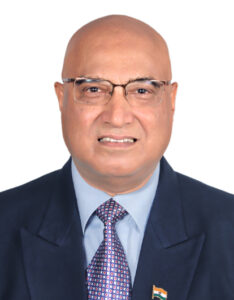 Dr. M M Goel | About the Author Propounder Needonomics, Professor Madan Mohan Goel is a superannuated Professor of Kurukshetra University. He is former Vice-Chancellor, Starex University, Gurugram, Jagannath University Jaipur, RGNIYD (GOI), Pro Vice-Chancellor VKSU Ara, Dean of Colleges & Social Sciences, Chairman, Dept. of Economics & Dept. of Journalism KUK He was the first ICCR Chair Professor in South Korea. Presently he is an Adjunct Professor at the Institute of Advanced Sciences Dartmouth, USA. He is honoured with the London Organization of Skill Development (LOSD) Excellence Award 2023, Professor J.K. Mehta Academic Excellence Award 2023, Rashtrapita Rashtriya Samman 2023 for propounding Needonomics and Gurukul Gyanjyoti Award (2024). His area of research is Economics of HRD & Indian Economy. He has 483 publications and guided 25 PhD and 25 MPhil Scholars. |
If you would like to get connected to Dr M M Goel write to editor@acadnews.com.