








Pedagogical Leadership – Need for a Paradigm Shift

Scores of theories have been enunciated over several centuries on the relationship between the learner and the teacher. Styles and methods of delivering knowledge packages have been prescribed from the early days of Gurukul in India and from the days of heuristic pedagogy practised by Aristotle and Socrates. Each one of them were born out of the contemporary needs and experiences. They were also sensitive to the local geography, culture, and political needs. Moving from the agrarian model to the industrial model of mass structures, with focus on printed packages of knowledge, the pedagogical systems have undergone a monumental change tuned to mass treatment of learners in learning systems.

With the emergence of technology, the learning culture, and the delivery systems of information, rather than knowledge, re-positioned themselves to the technological platforms to provide a pre-ordained parallel learning experiences than individualized learning experiences.

Generational changes in technology further impacted the entire spectrum of learning systems. In all these Edu-ventures, the role of the teacher has been quite critical and central to any debate. As a facilitator and key functionary in the knowledge universe, the teachers took several avatars fashioning themselves to all the needs and demands of the educational systems and their dependent commercials.

Two important influencers of the pedagogical leadership currently appears to be our better understanding of the function of the brain as reported through the portals of neuro-cognitive researches and secondly by the impact of Artificial Intelligence to synergize and synthesize knowledge across its universe, Its reverse osmosis leading to dissection of knowledge to its minuscules cannot also be ignored.

However, the fact remains that these existing transaction models will also undergo a sea-change with newer technologies manifesting in an unimaginable speed with progressive interaction and collaboration between human intelligence and machine intelligence. The current taxonomies that structure pedagogies inclusive of Bloom, will have to review their constructs over a period.

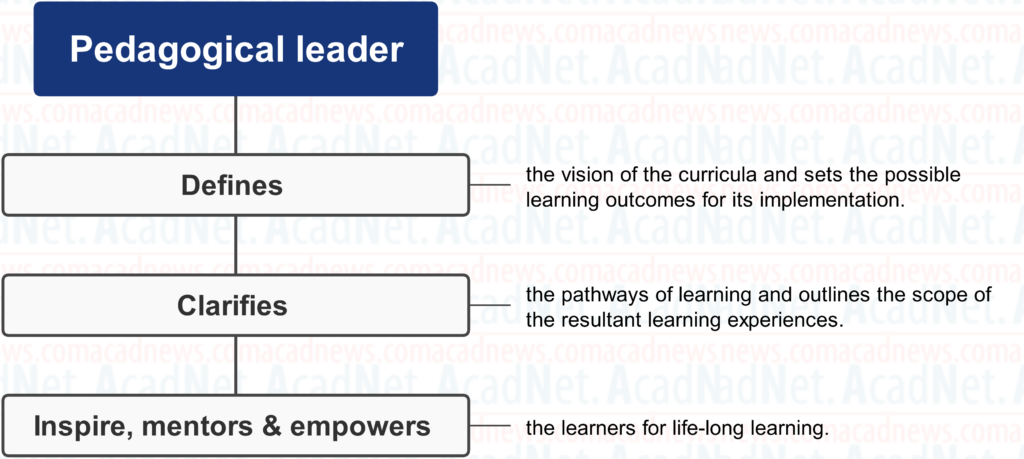
In this context, the role of the pedagogical leaders will undergo a paradigm shift. What does a pedagogical leader do?

  1. A pedagogical leader defines the vision of the curricula and sets the possible learning outcomes for its implementation.
  2. A pedagogical leader articulates the design and the direction of the pedagogical processes.
  3. A pedagogical leader clarifies the pathways of learning and outlines the scope of the resultant learning experiences.
  4. A pedagogical leader inspires and mentors the learners and empowers them for life-long learning.

THE PARADIGM SHIFTS

1. Building a positive learning environment

There is huge evidence to show that the universe of knowledge is exponentially expanding. The emergence of new knowledge, new skills, and inter-disciplinary approaches in managing the information systems appear to impact the way humans think and deal with the content and dynamics of knowledge. The learners are required to sift the information at their knowledge gateways, not only based on their need and relevance, but the appropriacy to the context in which they would use and progress. Further, it also calls for practice of effective learning management skills to be on the learning curve continuously and progressively. This puts pressure on the design of effective and positive learning environment in the institutions of learning.

The pedagogues would have to design an array of learning baskets that would provide not only learning choices but learning contexts to the futuristic learners. The construct of such a model should ensure a stress-free learning environment which is neither judgmental nor self-defeating.

Learning, for an individual learner and a cohort of learners is becoming both a unique as well as a collaborative activity in the emerging social context.

With increasing focus on social construction of knowledge through equal and unrestrained participation, the ownership of knowledge constructs is progressively becoming a social wealth. Further, with the shelf-life knowledge becoming shorter and shorter, the learning cultures are significantly impacted with sharper choices and flexible opportunities both for transaction as well as inheritance of knowledge for future investments. Celebration of knowledge is becoming more relevant to their investment prospects rather than their treasury values. This, impacting the learning cultures of the emerging communities, the pedagogical leadership is required to be conscious and thoughtful navigators for mentoring the learners. Creation of new learning cultures will be on the anvil, and they too would suffocate with short lifespans.

The intrinsic academic value of any learning is slowly getting rated lower as compared to their extrinsic utility value. Though education is considered as an empowerment of human resources in a broader sense and at its philosophical levels, in the absence of its ability to position the relevant skills as their value proposition, it lacks appreciation. Further enrichment of the learning values leading to talents and competencies is gaining currency and are seen as better negotiable outputs of learning by the vibrant community. The focus, therefore, is shifting towards articulating knowledge systems and transaction methodologies as instruments to empower the latent talents and to nurture the marketable competencies. In the context of competitive knowledge profiles describing differentiated performances, the pedagogical leadership is called upon to ensure on the integrity and ethical aspects of handling knowledge. 

In the emerging scenario of AI intervention to knowledge management and processing, the ‘deep fake’ challenges have further created on critical examination of the credibility of information and the basis of their structures. 

Talents and competencies would again seek constant and fresh approvals from the consumerist community. With newer process strategies embedded on new knowledge systems, the pedagogical leaders would have to join hands for updating their curricula and pedagogy to stay relevant. Cohabitation of academic talents and competencies with those of market requirements would pose a continuous challenge.

The speed of change would not in any way demand or compel the leaders in different fields to apply either a brake or put a full stop to their learning process. 

With the pressure of being a continuous learner, the leaders must engage. with ‘learning as they lead.” 

This bifocal approach demands a privy mindset to be developed from the early years of schooling. Learning and leading are becoming interdependent, the intercourse between multiple knowledge systems would need appropriate learning platforms at all levels of human existence and growth. This would indeed mean ‘the pedagogical philosophies” to extend their operational domains from structured institutional learning to a much wider universe where billions of independent learners would be waiting to learn both out of compulsion as well as need.

The pedagogical leadership should be able to see both greener as well adventurous pastures for their future. This goes concurrent with the recommendations of the National Education policy prescribing ‘self-learning’ and ‘self-directed learning’ as emerging models.

The celebration of the power of pedagogy as tools of imparting knowledge and its related values is slowly giving way to its power in triggering the construct of new knowledge. With the sources and resources of knowledge getting encapsulated and delivered at nanoseconds, the role and relevance of pedagogy as a facilitator of new knowledge constructs is being widely discussed. The idea of the instruments of pedagogy as ‘causing’ learning has been already questioned by the research in neuro-cognitive sciences defining learning a natural neural activity. 

The ‘learnability’ of the learner being recognized as an issue to be addressed, the pedagogical models should be able to support and fire curiosity in learning so that the learner travels to unknown vistas of the unfathomed oceans of knowledge, to discover and construct new knowledge structures and models. The role of pedagogy as a positive force for learning rather than a tool of judgment must change.

The future of pedagogy would require periodic reviews for their structures, positive contributions and as a tool for pursuit of human excellence amid immense changes that happen in a twinkle.


Dr G Balasubramnian
G. Balasubramanian was born at Tirunelveli, Tamilnadu on 17th February, 1946. He had his initial schooling at Madurai and graduated in Chemistry from Presidency college, Chennai. He obtained a  Post-graduation in Analytical & Inorganic Chemistry from Madras University, Post-graduation in Hindi from Sri Venkateswara University and Post-graduation in Education from Annamalai University.

He obtained a Diploma in German from University of Madras, a Certificate in Project Technology from Trent College of Education, Nottingham U.K and a Certificate in Computer Education from Leeds University, U.K

Starting his career as a Post-graduate Teacher in Chemistry in a public school, he took over as a Principal of Hindu Senior secondary School, Triplicane, Chennai. He joined the Central Board of Secondary Education as a Joint Secretary in 1984 and has worked in several capacities in Academics, Examination, Confidential and Administration branches of CBSE.

Elevated to the Post of Director (Academic) in 1997, he held the additional charge of the Chief Vigilance Officer of the Board. He retired from the services of the Board on 28th Feb, 2006.

He was associated with several Boards of education and leading organizations like Quality Council of India, NABET, National Institute of Open Schooling, Global Indian international Schools in Singapore, Malaysia and Japan. He is the current chairperson of the international council for school leadership. He was the Chief Editor of the magazines – ‘The Progressive School’ and ‘The Progressive Teacher’ published by S. Chand group of companies. He is currently Advisor to the following companies – “Knowledge Tribe” and “Teacher Tribe” at Bengaluru.

His interests include philosophy, psychology, poetry and Literature. He has widely traveled to many countries and participated in several national and international conferences and presented papers on a wide variety of academic interests. Post retirement he has conducted over 7000 training programs for teachers and Principals covering over 85000 teachers.

His publications are:

  1. Mindscaping Education
  2. Case Studies in classrooms
  3. Quality Spectrum – A school’s Bandwidth
  4. Safety in schools – Issues and concerns
  5. Academic Leadership – ebook
  6. Schooling the kid – learning form K to 12
  7. Creativity in classrooms – eBook
  8. Unlearning Learning – eBook
  9. A Happy Journey (Poetry)
  10. Apologies to an Existence (Poetry)

His latest book “Walk with Viswa”- a journey to Leadership along the Farmlands is due for publication.

Awards won:

  1. Vocational Excellence Award from Rotary Club, Chennai
  2. Seva Rathna in Education from The Centenarian Trust, Chennai
  3. Lifetime Achievement Award from VIMHANS (Vidyasagar Institute of Mental Health and Neuro Sciences) Delhi

He has been a member of the High-Power committee constituted by the Government of Tamilnadu for School Education and has also been the chairperson of the Curriculum Reforms Committee and the Examination Reforms Committee for School Education in the Government of Tamilnadu.

If you would like to get connected to Dr G Balasubramanian write to editor@acadnews.com.

One thought on “Pedagogical Leadership – Need for a Paradigm Shift

  1. This article provides a thought-provoking analysis of the evolving role of pedagogical leadership amidst changing educational landscapes. It skillfully navigates complex topics such as nurturing talents, addressing ethical challenges in knowledge management, and adapting to advancements in AI intervention. The insightful exploration of practical skills and competencies valued in real-world contexts is particularly commendable. The emphasis on continuous learning, innovation, and adaptability resonates strongly, underscoring the importance of staying relevant in today’s dynamic educational environment. Overall, the article’s forward-looking perspective offers valuable insights and inspiration for pedagogical leaders striving to shape the future of education.

Comments are closed.