





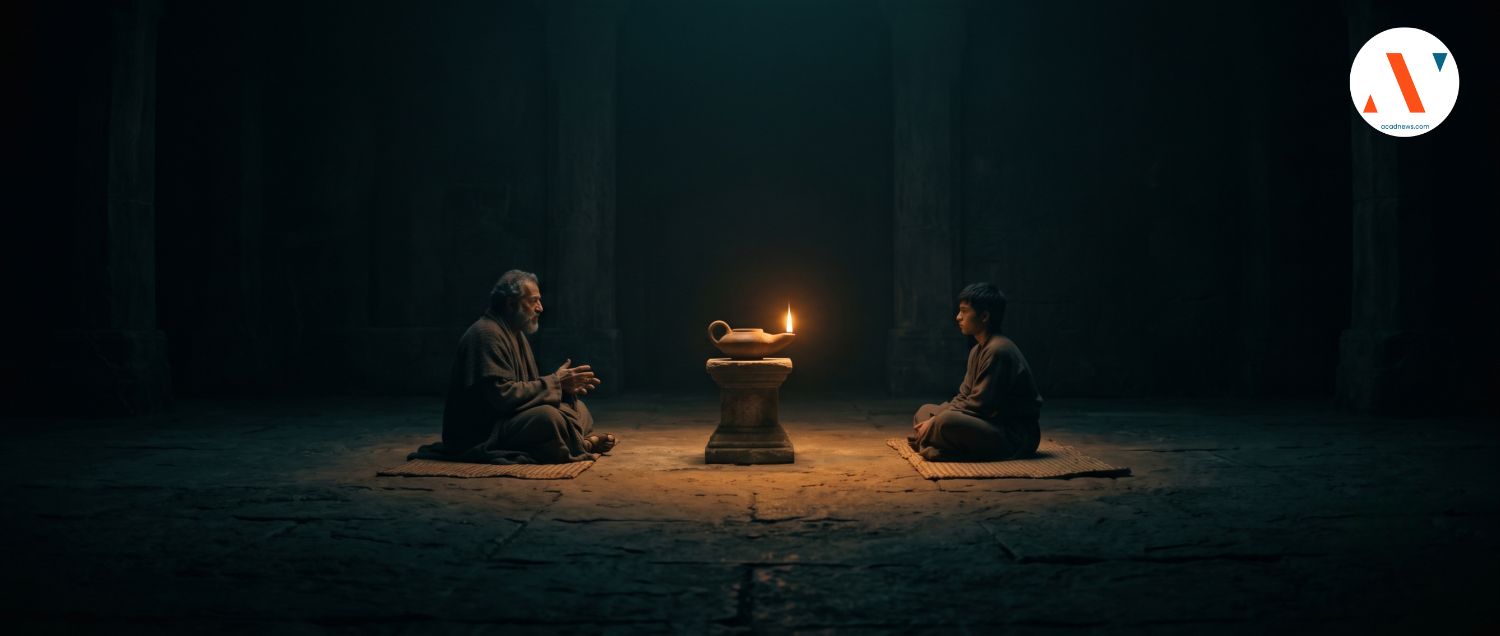
Why Your Guru Is Called the Remover of Darkness
From a single Sanskrit syllable to the nature of Truth itself. A clear, step-by-step journey through one of Indian philosophy’s most luminous ideas.
Most of us have grown up using the word Guru freely. A yoga teacher, a startup mentor, an inspiring professor. But what if the word itself held a complete philosophy of knowledge, light, and liberation? What if unpacking those two syllables could tell you something profound about why you struggle to see the truth in your own life?
That is exactly what an ancient Sanskrit text does. In a single verse.
A 2,000-year-old definition that still holds
The Advayatāraka Upaniṣad, one of the minor Upaniṣads of the Vedantic canon, breaks the word Guru into its two root syllables and assigns each a precise meaning. This is not poetic licence. It is a form of scriptural analysis called nirukta, interpretive etymology, designed to reveal the inner function of a word rather than merely its linguistic history.
गुशब्दस्त्वन्धकारः स्यात् रुशब्दस्तन्निरोधकः ।
अन्धकारनिरोधित्वात् गुरुरित्यभिधीयते ॥
guśabdas tv andhakāraḥ syāt ruśabdas tan-nirodhakaḥ |
andhakāra-nirodhitvāt gurur ity abhidhīyate ||
“The syllable gu signifies darkness. The syllable ru signifies its remover. Because of the quality of removing darkness, one is called a Guru.”
| Sanskrit | Word Type | Meaning |
|---|---|---|
| gu-śabdaḥ | noun (nom. sg.) | the syllable gu |
| andhakāraḥ | noun (nom. sg.) | darkness, ignorance |
| syāt | verb (optative 3rd sg.) | signifies / let it be / means |
| ru-śabdaḥ | noun (nom. sg.) | the syllable ru |
| tat-nirodhakaḥ | adjective (nom. sg.) | remover of that (darkness) |
| nirodhitvāt | ablative (abstract noun) | because of the quality of removing |
| abhidhīyate | verb (passive 3rd sg.) | is called / is known as |
Ignorance is darkness. Not a metaphor, but a logic.
Why do the Upaniṣads equate ignorance with darkness? Is this just poetry? It is not. There is a precise chain of reasoning, and it begins with the Sanskrit word for ignorance itself.
Reality and Truth are not the same thing
Here is where a crucial distinction opens up, one that most of us have never been taught to make. We tend to treat “real” and “true” as synonyms. Vedanta insists they are not.
- → Exists at this moment
- → Can change with time and space
- → Empirically verifiable
- ✗ Not necessarily permanent
- → Unchanging across all time
- → Unchanging across all space
- → Trikāla-abhādhita: uncontradicted across past, present, and future
- ✓ Cannot be negated by any circumstance
| What | Changes with Time? | Changes with Space? | Verdict |
|---|---|---|---|
| Body | Yes, ages and decays | Yes, local and finite | Real, not Truth |
| Thoughts | Yes, shift by moment | Yes, context-bound | Real, not Truth |
| World / Universe | Yes, creation and dissolution | Yes, finite and bounded | Real, not Truth |
| Atman · Pure Consciousness | Never | Never | Real AND Truth |
“Those who are unable to see the Truth are considered to be in darkness. Truth is defined as that which does not change with time or space. While what is real may change, what is Truth shall not.”
Consciousness sees Truth. The mind will not let you rest in it.
Here is the most honest, and perhaps most uncomfortable, observation in this entire discussion. There are moments. In sudden stillness. In deep love. In the instant after a long exhale. When you know, without words, that something vast and unchanging underlies everything. That is not imagination. That is Consciousness glimpsing itself.
But the mind rushes back in. Almost immediately. And it does something even more subtle than distraction. It wraps everything impermanent in a feeling of permanence.
Covers the light of pure Consciousness. Like clouds covering the sun. The sun has not moved, but you cannot see it.
Projects the impermanent world as real and lasting. Like a film projector throwing an image onto the screen. You watch it and mistake it for what is actually there.
The mind is not your enemy. But it is made of the same fabric as the illusion. You cannot use the mind to see through itself. This is why no amount of thinking alone can produce liberation.
Why a single lamp is enough
If ignorance were a substance, a poison or a disease, you would need enormous effort to remove it. But ignorance is not a substance. It is an absence. It has no weight, no form, no power of its own.
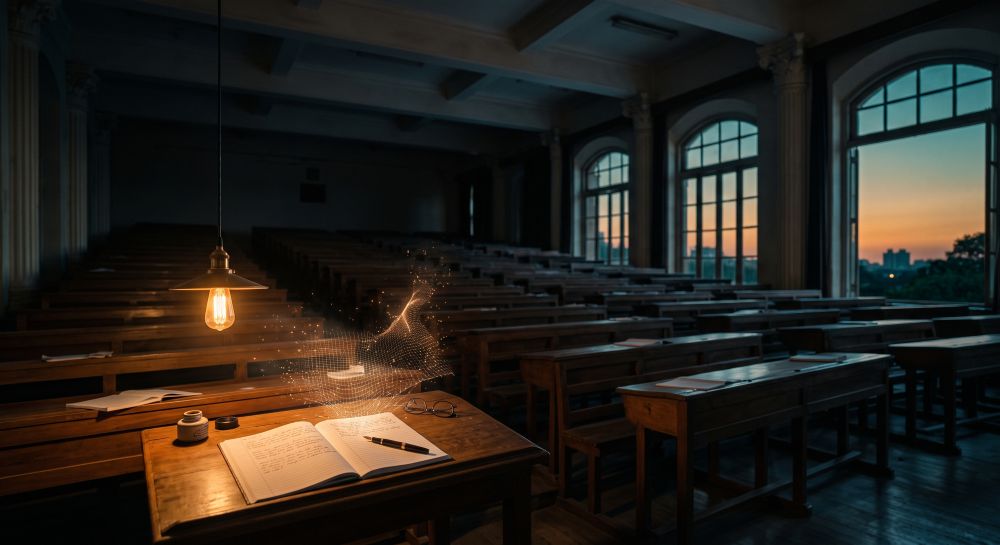
You do not fight darkness. You do not study it, negotiate with it, or gradually push it out. You simply bring a lamp. And it vanishes. Completely. Instantly. Without residue.
“A room that has been dark for a thousand years is fully lit the instant a lamp is brought in. The past duration of the darkness is irrelevant.”
This is why the Guru’s presence, word, or grace can dissolve lifetimes of ignorance in a single moment. Lifetimes of darkness cannot resist even one moment of light.
Hearing the Truth from a qualified teacher. Plants the seed of correct knowing in the mind.
Deeply reflecting on what was heard. Weakens the mind’s habit of counter-argument and doubt.
Sustained, unbroken meditation on Truth. Trains the mind to rest in what it knows, rather than flee from it back to the impermanent world.
गुरुर्ब्रह्मा गुरुर्विष्णुः गुरुर्देवो महेश्वरः ।
गुरुः साक्षात् परब्रह्म तस्मै श्रीगुरवे नमः ॥
Gurur Brahmā, Gurur Viṣṇuḥ, Gurur Devo Maheśvaraḥ |
Guruḥ sākṣāt Parabrahma tasmai śrī-gurave namaḥ ||
“The Guru is Brahmā, the Guru is Viṣṇu, the Guru is the great Lord Śiva. The Guru is verily the Supreme Brahman itself. To that Guru, I bow.”
Not because the Guru is a deity to be worshipped as an object of devotion. But because the Guru is the living presence of that light which removes all darkness. And in removing the darkness, the Guru reveals not something new, but what you always were.
AcadNews Editorial · Academic Network · acadnews.com · acadnet.net
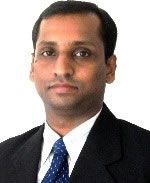 M Muruganant | About the Author Professor M. Muruganant is a distinguished academic and innovator who earned his Doctorate from the University of Cambridge, UK, through prestigious Commonwealth and DAAD fellowships. |
| Professor Muruganant, with extensive experience in academia and management, formerly served as the Director of Higher Education at Adani Group, where he established Adani University and served as its inaugural Provost. He founded the Global Education Forum, focusing on educational transformation and sustainability. Recognized as an institutional leader, he has initiated several centers to empower faculty and enhance student experiences. His contributions to materials science are notable, and he advocates for STEAM education while emphasizing value education and Bharatiya culture. As the youngest Ministry of Steel Chair Professor, he promotes academic initiatives and engages in significant policy discussions on India’s National Education Policy – 2020. | |
If you would like to get connected to Dr M Muruganant write to editor@acadnews.com.