Assessment, Impact and Transformation: Redefining Excellence in Education

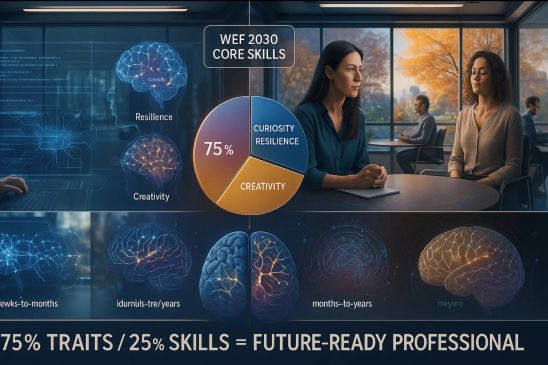
India’s higher education system assessed 13,892 student suicides in 2023 — and called it someone else’s problem. At Academic Network’s Technology Series webinar on 28 March 2026, Prof. Dr. M M Ananth asked the question institutions have avoided: What is assessment truly for? The IACT Framework — Interpersonal, Adaptability, Cognitive, Technical — reveals that 75% of professional effectiveness is determined by persona traits, yet our entire assessment architecture measures only the remaining 25%. With 1,329 registered participants, this was one of the most searching conversations Indian higher education has had about itself. Read the full report

Read More

Mental Wellness and the Future of Holistic Professionalism

One in seven young Indians carries a diagnosable mental health condition. Twelve billion work days are lost globally every year to mental health issues. And the single most important question in Indian education — are our students okay, as human beings? — has never once been asked in a board meeting.
Until now.
A psychiatrist, a university builder and a war veteran sat down to talk about what we have been measuring, what we have been ignoring, and what it would actually cost to change. The answers were uncomfortable, evidence-based and, in places, quietly devastating.

Read on.

Read More

Amodei Says Your Job Has 5 Years. Do You Know Your 75%?

Anthropic’s CEO says 50% of white-collar entry jobs vanish within 5 years. His survival advice? Focus on human-centred skills — empathy, adaptability, critical thinking.That’s literally what the IACT framework measures. 75% of your professional value isn’t technical. Most people have never had it mapped.Do you know your 75%?

Read More

The Architecture of Change: Neural Mechanisms of Skill Acquisition vs. Personality Transformation

Acquiring new skills and enacting personality change both invoke neurobiological adaptation, yet these processes differ substantially in terms of explicit resources, timescales, and intervention strategies. This paper synthesizes current neuroscientific evidence comparing skill learning—which involves formation and strengthening of specific neural circuits—with personality change, which touches deep-seated patterns of emotion, behavior, and cognition through extended, multifactorial approaches reshaping broader neural networks. We examine the neural mechanisms, resource requirements, temporal dynamics, and practical implications of these two transformational pathways, with particular attention to the IACT Assessment framework that operationalizes these distinctions for individual and institutional development.


Read More