










On 28 March 2026, Academic Network’s Technology Series convened 1,329 registered participants — educators, administrators, and examination controllers — for a searching conversation on assessment in Indian higher education — and whether the systems built over decades are serving students or merely recording their compliance.
The Question That Could Not Wait
Prof. Dr. M M Ananth opened his keynote not with answers but with data that made comfortable certainties uncomfortable. He placed before the audience the mental health toll of a system where 78% of students report significant distress in high-stakes examinations, and where 34.5% of Indian college-age students in reported suicide cases cite examination failure as a precipitating factor — 13,892 student suicides recorded in 2023 alone, representing 8.1% of all suicides in India. Against this backdrop, he asked the question that structured everything that followed: What is assessment truly for?
Before proceeding, he opened the first live poll — asking participants directly how confident they were in their own institution’s assessment practices. The results were telling.
Live Poll · K1 — Confidence in Current Assessment Practices
Over half acknowledged gaps they already knew about. Prof. Ananth took this as precisely the opening he needed — not to reproach, but to ask why, if the gaps are known, the system has not moved. The word “assessment” itself, he reminded the audience, derives from the Latin assidere — to sit beside, to reflect, to acknowledge. It was never designed to sort human beings by rank. “The drift from assidere to examination is not inevitable,” he said. “It is a choice. And choices can be changed.”
“If knowledge liberates, why does assessment confine? The student is measured but not transformed.”
— Prof. Dr. M M Ananth, FCS | Keynote Address
A World Demanding Different Graduates
Prof. Ananth situated Indian higher education inside what he called the BANI world — Brittle, Anxious, Nonlinear, Incomprehensible — where systems collapse without warning, uncertainty generates paralysis, and causes and effects are chronically disconnected. This is the world students already inhabit; it is also the world for which Industry 5.0 has defined three pillars: human centricity, resilience, and sustainability, each embedding adaptability and emotional intelligence as core requirements. The contrast with what institutions currently measure could not be sharper.
The World Economic Forum’s Future of Jobs Report 2025 projects 92 million roles displaced by 2030 while 170 million new roles emerge — a net gain of approximately 78 million jobs, but concentrated in locations and competency profiles that current education systems are not building toward. The disruption is already visible at sector level: administrative and data entry roles face up to 95% automation potential, legal support 94%, software development entry roles 71%. AI’s coding capability — as measured by SWE-Bench — surged from under 5% accuracy in 2023 to 85% projected in 2025, directly erasing the entry-level pathway through which most graduates once found their footing. Meanwhile, AI/ML roles are growing at 143% year-on-year, and healthcare, cybersecurity, and skilled trades remain areas of sustained human indispensability.
Of the eleven core skills identified by the WEF for 2030, eight are inherent persona traits — creative thinking, curiosity, resilience, empathy, analytical thinking, lifelong learning, social influence, and motivational self-awareness. Only three relate to technical or AI-specific competencies. The implication is precise: a trait changes with months to years of deliberate intervention; a skill can be onboarded in days or weeks. Yet the entire architecture of institutional assessment remains focused on the latter while ignoring the former. “None of our current assessment models measure who the student is becoming,” Prof. Ananth observed. “That is not a gap in our rubrics. It is a gap in what we are choosing to see.”
Current Models: What We Measure, What We Miss
Moving from the crisis to the classroom, Prof. Ananth asked participants what assessment was actually being used for in their institutions. The second live poll of the keynote revealed a split that he found both encouraging and instructive.
Live Poll · K2 — Assessment is Primarily Used For
Nearly half expressed the right intent — assessment for learning. Yet 41.6% acknowledged that in practice, assessment ends at certifying completion. Prof. Ananth moved immediately to the third poll, asking which types of assessment institutions were actually deploying.
Live Poll · K3 — Assessment Types in Use (Multiple Selection)
Multiple selection — percentages reflect share of total selections
Formative and summative dominated, as expected. But Prof. Ananth’s deeper point was not about which models were in use — it was about what all six models share in common: none of them measure who the student is becoming. He then tested understanding directly with K4, asking what participants understood to be the most important distinction between formative and summative assessment.
Live Poll · K4 — Formative vs Summative: The Key Difference
74.4% identified the correct distinction — formative informs while learning is happening; summative judges after it is done. But knowing the definition, Prof. Ananth observed, has not changed practice: summative assessment still dominates, still generates 78% student anxiety, and still captures a moment rather than a trajectory. He closed this section of the keynote with K5, probing how institutions understand the design logic of Outcome-Based Education.
Live Poll · K5 — In OBE, Assessment is Designed:
64.1% correctly identified OBE’s backwards design logic. Yet that same majority, Prof. Ananth noted, is operating a system where the lived experience of students — their capacity for adaptive thinking, their growth in empathy and resilience, their identity as emerging professionals — appears nowhere on the final grade sheet. Even well-understood frameworks carry a shared blind spot.
The IACT Framework: Completing What OBE Cannot See
Drawing on a Cambridge University Press white paper titled Fostering Future Leaders and Global Professionals: A Holistic Approach to Talent Development in Academia and Industry, Prof. Ananth introduced the IACT Meta-Intelligence Assessment Framework — a four-dimensional lens that maps professional effectiveness across Interpersonal, Adaptability, Cognitive, and Technical intelligence clusters.
IACT Framework · Four Intelligence Clusters
The research underpinning IACT mapped 27 parameters across thousands of alumni, training and placement officers, and Chief Human Resource Officers. A consistent finding: graduates are leaving institutions without ever receiving insight into their inherent strengths — sent into the professional world, as Prof. Ananth put it, “half-blind about their own potential.” IACT does not replace Outcome-Based Education; it completes it by adding the human dimension that OBE was never designed to capture.
To test the point, Prof. Ananth asked participants what they believed a student’s final mark sheet actually communicates to a recruiter.
Live Poll · K7 — What Does a Final Mark Sheet Tell a Recruiter?
82.2% of responses pointed to subject knowledge or knowledge combined with professional potential — yet only 11.3% believed the mark sheet actually signals professional readiness. A 70-point gap between what institutions issue and what recruiters need. Prof. Ananth followed this immediately with K8 — asking what institutions actually do with the assessment data they collect each semester.
Live Poll · K8 — After Collecting Assessment Data, What Typically Happens?
27.1% admitted the data either rarely changes anything or simply disappears into a filing system. A further 37% acknowledged it goes into IQAC reporting — compliance, not transformation. “We are collecting evidence of learning,” Prof. Ananth noted, “and then using it to write reports about ourselves.” He then turned to the core question of the IACT research — what participants actually believed about the role of technical skill in professional success.
The Panel: Three Institution Builders, One Honest Question
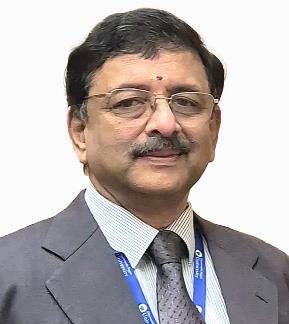
Moderated by Prof. Dr. Raghavendran Venugopal, Controller of Examinations at SGT University — himself a practitioner who has spent decades inside the machinery of evaluation — the panel discussion drew out dimensions of the problem that a keynote alone could not reach.
“Most institutions say they do continuous assessment, but it is all a modified summative — assessment of to-know. Even the student doesn’t care because he has his own attitude. We are truly invested now in making learning joyful without the stress that Prof. Ananth described.”
Prof. B.S. Satyanarayana · VC, Dayananda Sagar University · Karnataka Vidya Ratna 2025Prof. Satyanarayana described Dayananda Sagar University’s in-progress shift: correlating all subjects through multi-disciplinary immersive projects, removing internal tests in favour of a foundational summative at the beginning of the semester and a holistic application-linked summative at the end, and designing research-interest linkages so that faculty too find personal investment in what they assess. “We want every teacher to be looking forward to the student’s input,” he said. “Unbiased ideas from a new context.”
“So far, assessments and their results are connected to advertisements and admissions. So far, you name it — any model — it will not work. We need to address the problem where the problem actually lies: intent and honesty at the institutional level.”
Prof. Rajiv R. Thakur · VC, Mandsaur University · Former Dean, BIMTECH · Former Professor, IIM JammuProf. Thakur’s candour was matched by Prof. Ananth’s own self-examination. Asked to reflect on his two stints as Vice Chancellor, Prof. Ananth acknowledged: “I signed off on assessment reports without challenging their design — which meant I was endorsing a system that systematically ignored the most important part of what I was supposed to be developing in my students. The urgent always displaces the important. Assessment reform is never urgent until it is too late.”
Practitioner Challenge
“I have 3,500 students, 20 faculty, examination results due in six weeks, and a recall-based framework imposed by the university. How do I assess who the student is becoming — not just what they can reproduce on paper?”
Prof. Ananth’s response: introduce IACT assessment alongside — not instead of — the end-semester examination, beginning with one programme as a pilot. “Give the student an opportunity to know their professional blueprint. The transformation does not begin by replacing what you do. It begins by adding what you see.”
NAAC 2025 and the Closest We Have to a Holistic Framework
Prof. Ananth reviewed each major accreditation and ranking framework against the IACT lens. NAAC’s 2025 binary and maturity-based grading model emerged as the most comprehensive to date: ten attributes, 75% weight on process and output, explicit mention of mental health for the first time in Indian accreditation history, and recognition of portfolio-based and continuous evaluation. NBA’s CO-PO attainment criteria provide measurable anchors but still calculate attainment post-hoc with no room for emergent capacities. NIRF carries no direct assessment criterion. International rankings — QS, Times Higher Education, ABET — each share what Prof. Ananth called “one blind spot: the inner life of the student.”
IACT maps to 90% convergence with NAAC 2025 attributes and aligns with NEP 2020, offering institutions a ready bridge between regulatory compliance and genuine transformation — without requiring additional time or resources beyond a shift in attention.
The penultimate keynote poll — K9 — put the question of technical skill directly to the room, asking what percentage of professional success participants believed came from technical expertise alone.
Live Poll · K9 — Professional Success Driven by Technical Skill?
The contrast was stark: IACT research establishes that 75% of professional effectiveness is determined by Interpersonal, Adaptability, and Cognitive traits — yet 29.3% of participants still believed technical expertise alone drives the majority of professional success, and 54.9% assigned it equal weight. “That gap between what CHROs know and what institutions assess,” Prof. Ananth observed, “is exactly where graduates get lost.”
What Participants Said
Webinar participants · 28 March 2026 · All values normalised to percentage
Audience Composition · Primary Role
Assessment Data is Primarily Used For
Biggest Obstacle to Meaningful Assessment
Readiness to Adopt the IACT Model
99% of respondents expressed some level of openness to the IACT model
After Today’s Session — What Participants Will Do Next
The IACT Assessment Analyser: From Framework to Practice
In a live demonstration during the session, Prof. Ananth showcased the IACT Assessment Analyser — an AI-powered tool created by Academic Network that takes any course file or curriculum document as input and generates a complete set of IACT-aligned assessments for that course. The tool is designed to be discipline-agnostic: whether the course is engineering, management, health sciences, or the humanities, the Analyser produces assessments structured around all four IACT dimensions — Interpersonal, Adaptability, Cognitive, and Technical — along with detailed rubrics for evaluating student responses across three phases.
The practical significance was immediate: faculty do not need to redesign their curriculum or invest additional time to begin holistic assessment. They upload what they already have, and the tool does the translation. Prof. Ananth’s message to every participant was direct — this is an invitation, not an obligation. An invitation to begin transforming an assessment system that, in its current form, is built around employment as its sole destination rather than empowerment as its true purpose.
IACT Assessment Analyser · Academic Network Tool
Upload any course curriculum file → receive a complete IACT-mapped assessment with rubrics, three phases, and dimension-specific evaluation criteria. No new assignments. No additional faculty workload. Applicable across all disciplines.
iact.acadnet.net →A Shift in Consciousness, Not a Change in Compliance
Prof. Ananth closed his keynote with five words that became the session’s refrain: you just need to notice. A ten-minute seminar presentation already carries interpersonal, cognitive, and adaptability data. A group project already reveals how students navigate ambiguity together. The assessment transformation does not require new time, new money, or new courses. It requires only a shift in attention — to notice, name, document, and value what is already visible.
The final keynote poll — K10 — posed what may have been the session’s most honest question: if all external accreditation requirements were removed tomorrow, would your institution’s assessment practices change?
Live Poll · K10 — If Accreditation Requirements Were Removed Tomorrow…
45% said they would redesign assessment entirely around learning. 20% acknowledged that some of what they do exists only for compliance. Together, 70% of practitioners in the room effectively confirmed that the system is not fully aligned with what they believe education should be. That, Prof. Ananth said, is not a reason for despair. It is the opening.
Student A · GPA 9.2/10
- Excels at standardised tests
- Consistent academic performance
- Meets all rubric requirements
- Rarely challenges assumptions
- Struggles when rules disappear
- Dependent on external validation
Student B · High IACT Profile
- Recovers from failure with curiosity
- Listens deeply, communicates with care
- Adapts when the rulebook disappears
- Applies knowledge to unknown contexts
- Builds resilience through uncertainty
- Develops sustained self-knowledge
Which student thrives in an uncertain, nonlinear, BANI world?
Prof. Venugopal, closing the session, acknowledged the gap between the carefully constructed systems he maintains and the assumptions on which they rest: “Today’s conversation has reminded me that the system I maintained so carefully was built on assumptions about learning that nobody has seriously examined for a very long time.” He committed to three specific next steps and to co-developing, with Academic Network, a white paper drawing on the session’s insights.
Prof. Ananth’s recommendations span five levels — faculty and classroom, department and programme, institution and leadership, policy and government, and the wider learning community — unified by a single direction: move from measuring and ranking to reflecting and knowing; from asking “how do you compare?” to asking “who are you becoming?” The IACT Assessment Analyser makes the first step available today, to any institution, for any discipline, without waiting for policy mandate or systemic reform.
As he put it: “Our students don’t need more tests. They need more trust. More recognition. They need to be truly seen — not as GPAs, not as placement statistics, not as outcomes in a ranking table, but as whole, capable, growing human beings building resilience for an uncertain world.” Assessment for wellness is not a programme to adopt. It is a shift in consciousness.
Explore the IACT Framework
Institutions interested in piloting the IACT Meta-Intelligence Assessment Framework — and giving every graduate a holistic professional blueprint — may reach Academic Network through the Technology Series portal.
Partners of the Technology Series
Zoho Corporation
Technology Partner
Association of Indian Universities
Knowledge Partner
Association of Indian Principals
Knowledge Partner
Samskar Learning Academy
Academic Partner
MSME Academy
Academic Partner
Planet Harmony
Academic Partner
© 2026 AcadNews · Academic Network · acadnews.com · acadnet.net