






Beyond the Lexicon:
India’s Constructive Global Leadership
A satirical ‘dictionary of foreign policy’ recently published in a leading national newspaper opens with a jab at India’s LPG dependency. Scientists at CSIR-NCL, Pune have an answer ready. So does a decade of data.
A widely circulated satirical piece in one of India’s most prominent English-language newspapers chose to open its ‘foreign policy dictionary’ with a pointed reference to India’s LPG dependency — framing it as a symbol of strategic embarrassment. The implication: that India’s energy insecurity makes its geopolitical posturing inherently hollow.
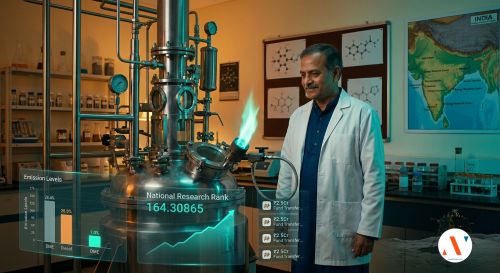
Scientists at the CSIR–National Chemical Laboratory in Pune have developed an indigenous technology to produce Dimethyl Ether (DME) — a clean-burning fuel that could serve as a direct alternative to LPG, produced domestically, stored in existing cylinders, and capable of saving India ₹9,500 crore annually in foreign exchange. The satirist chose LPG as India’s metaphor for dependency. Indian science chose it as the precise problem to solve.
This article does not dismiss the role of satire in public discourse. It offers, instead, a measured and evidence-based accounting of what India has constructed — scientifically, diplomatically, technologically, and institutionally — over the past decade. The record deserves to be read in full.
India’s Answer to LPG Dependency:
The DME Breakthrough from Pune
At the CSIR–National Chemical Laboratory in Pune, two decades of chemistry research have culminated in a patented, indigenous process to produce Dimethyl Ether — a clean-burning LPG substitute that can be stored and transported using India’s existing cylinder infrastructure, with minimal modifications.
Two decades ago, we started this kind of chemistry to attain DME in a cost-effective and legally sustainable way. With this lab, we made it all happen.
“While satire serves a legitimate function in public discourse, it is equally important that it be countered — not with defensiveness — but with data, evidence, and a sober accounting of what India has, in fact, built.”
Editorial Position · AcadNews
Ten Domains. One Decade. Measurable Results.
Strategic Autonomy: Doctrine, Not Deference
The same satirical commentary characterised India’s strategic autonomy as a doctrine of “serially grovelling” before whichever power holds leverage. India’s concurrent procurement decisions — made in the face of explicit external pressure — suggest a considerably different reading.
Economic Transformation: Numbers That Cannot Be Satirised
G20 Presidency 2023: Substance, Not Symbolism
Science & Space: Precision at Sovereign Scale
Technology Sovereignty: Building the Next Infrastructure Layer
No country was compelled to share its vaccine production capacity during the pandemic. India chose to — making this among the most consequential acts of voluntary global solidarity in the post-war era.
On 1 July 2024, India replaced three colonial-era criminal statutes governing its jurisprudence for over 160 years — with entirely new, justice-oriented legislation.
“Satire tells us what India is called.
Data tells us what India is doing.“
The satirical piece chose LPG as its opening metaphor for Indian dependency. Scientists in Pune — two decades into their research — have already built the answer. That is not irony. That is how nations actually progress: not through the elegance of their vocabulary, but through the patience of their laboratories.
A nation that ranks third in global research output, chairs the G20 to historic outcomes, lands on the Moon’s South Pole, exports vaccines to 99 countries, replaces 160-year-old colonial laws, and builds a clean-fuel alternative in its own laboratories is not managing optics. It is building the architecture of a multipolar world — domain by domain, mission by mission.
PIB India · Fair Observer 2025 · Atlantic Council · Vivekananda International Foundation