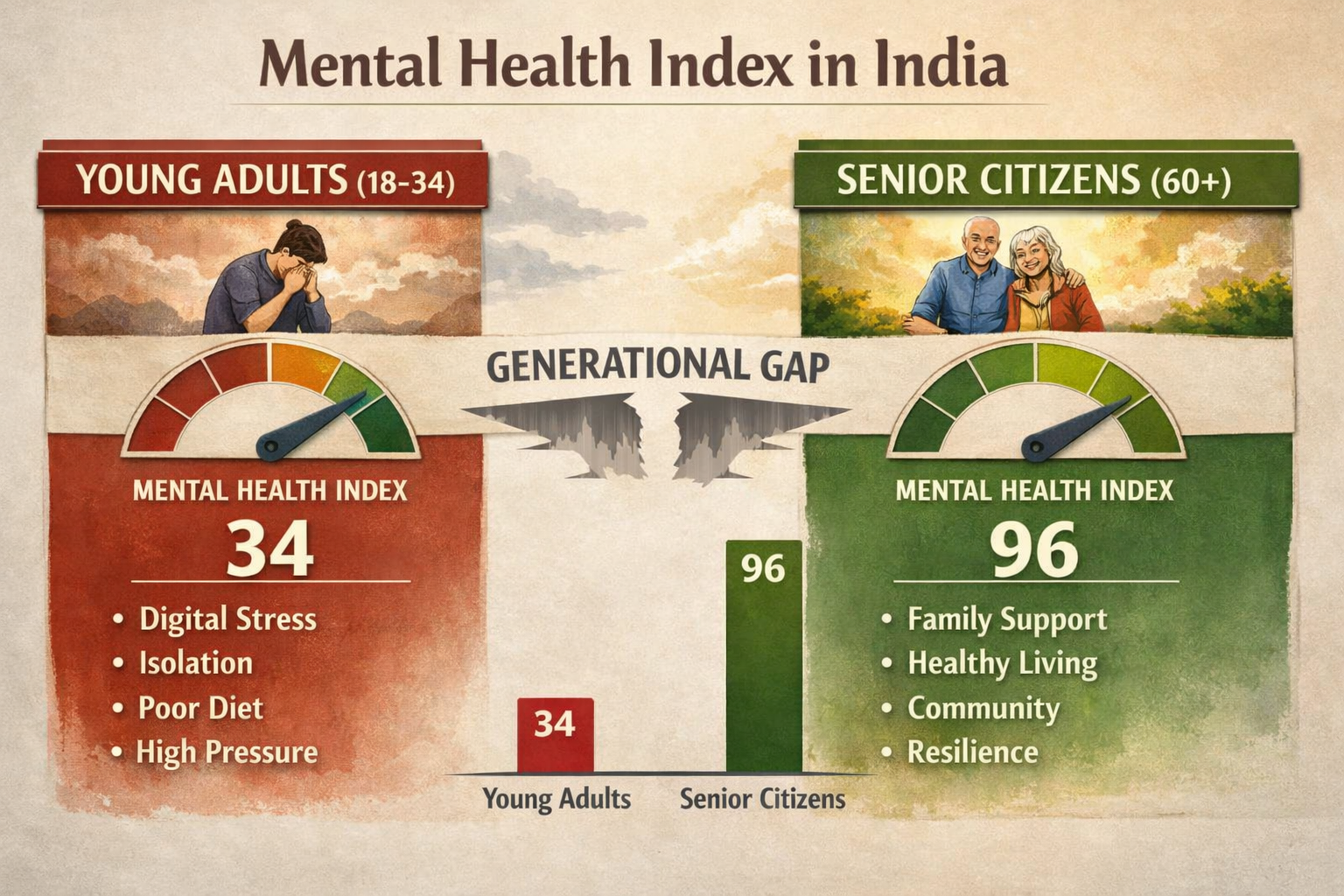
It appears unbelievable, yet it is true. Yes, the Mental Health Index of young adults as per the reports of an international agency reveals that it is thirty-four as against those of people in the age group is ninety-six. Indeed, the figures show a large gap between both the age groups. It really indicates the existing sense of anxiety, fear, gloom, pain, uncertainty, and distress in these young minds, while it shows some reasonable amount of happiness, satisfaction, contentment, acceptance, and wisdom on the other side. While progressive age does bestow certain amount of acceptance, contentment and wisdom among people, the low level of MH index in the young cannot and should not be ignored.
The report lists a variety of causes that attribute to this low MH index which includes – food habits, screen time, social isolation, poor family relationships, digital habits and changing lifestyles. Oftentimes, these MH issues lead to avoidable depression, self-pity, low performances, and suicidal tendencies. In short, it indicates lack of constructive collaboration and harmony in growth trends. As a society, it must be addressed to with the seriousness it deserves.
The following are some points which could be addressed-
1. Empowering family values
The Indian communities have always had enriched family values and living habits. Mutual support systems, empathy for all members in the family, sharing pain and pleasure, reaching out to the needs of others both physically and emotionally, celebrating togetherness and several other social attributes have held people high. This resulted in collective and collaborative learning, peer learning and in developing social empathy. Acceptance, tolerance, and patience facilitated accommodating the needs and values of others at one’s own costs. This helped the younger generation to have experiential learning inputs to lead their life with satisfaction and contentment.
2. Counselling on digital stress
The young adults are victims of a variety of inputs arising out of digital stress. The digital outcomes have psychologically impacted through speed, scale, and screens. The speed of resultant outputs having reduced the reception time has increased the anticipation levels and seeking gratification in milliseconds. Further, it has triggered achievement levels and an insatiable desire to further their speed, scale, and screen time. The resultant mental processes have aggravated their quality and quantity of achievement; in turn, this sets comparative and competitive notes with other peers leading to unhealthy comparisons and resultant mental stress. The multi-dimensional growth of the digital world has got interwoven with every activity and a life filled with mental stress.
3. Need for healthy nutritional habits
The young adults, according to the report have become victims of fast-food systems and food fads, leaving aside the much-desired nutritional requisites for a healthy living. Research appears to indicate that the ultra-modern food habits deprive them from adhering to healthy nutritional food habits. Absence of nutritional intakes has a direct impact on their health and their resultant behaviour.
4. Handling stress due to achievement syndromes
The young adults of the modern times have become victims of achievement syndromes driven by competitions, false and mythical definitions of success, lack of work-life balance and absence of purposeful time management techniques. Oftentimes they lack goal clarity, pursuit of multiple goals, diversified focus, and unhealthy competitions. It seems necessary to organize counselling gateways, though there is a negative belief that counselling is a taboo in a group of successful people.
1. Need for promoting counsellors.
The number of counsellors per unit of population in the country appears too low as compared to several other countries and as against international standards. It seems necessary to take adequate steps to improve the entry points to the domain of psychology and specialised counselling training to induct more professionals in the field.
2. Integrating counselling in educational institutions
Real time counselling must start at the school level. This must be integrated alongside the regular learning culture so that every learner starts feeling that an external support to their growth profile and some handholding to growth is not a threat to their individuality or their growth profile. Courses relating to counselling which is age-appropriate and issues- appropriate needs to be started so that specific issues can be addressed more purposefully.
3. Counselling at workstations
Young adults who are enrolled and who are driven by excessive professional outcomes need to be counselled to ensure that they understand the concept of work-life balance for their own betterment. Professional training programs to help them with life skills that bring the concepts of self-reliance, self-worth, self-esteem, values, integrity, compassion, empathy, teamwork, and pursuit of excellence need to be put in place periodically. Peer learning and Peer-counselling could also help them to have more open-ended learning and experiences.
4, Improved family relationships
Opportunities for greater family interaction must be promoted both through the direct intervention and informal interventions so that the adults do not sacrifice their relationship management at the cost of professional growth. Assured family times as a part of their professional growth dynamics, organization of community programs as a part of the institution’s corporate responsibility could also improve the situation.
4. Organizing Resilience Exercises
The concept of failure appears to impact the mental health of the young adults and the school going children as a threat from the competitive community. At the educational institutions, exercises to face and accept failures, to understand failure as a part of ongoing life process, to navigate through the challenges that lead to the failures, mental exercises to emerge from them like a phoenix through resilience would be necessary to develop a positive culture towards handling the self and its relationship with life. At workstations periodic training and interventions on alternate thinking, process navigation, quality pursuits, and collaborative functioning could be organized to have a free and frank discourse on failure management. Failure must be seen as a process problem rather than a personal misadventure. Intensive and interactive discussions on bridging the causes that lead to failure need to be put in place so that failure is seen as a mishap in conceptual clarity or process delivery. Inclusion of senior professionals with wit and wisdom who could engage in a friendly and professional manner with young adults in the professional environment would go a long way to reduce the large gap in the MH index.
Bridging the excessive gap in the MH index is essential and needs to be addressed sooner than later. Says Nido Qubein, President of the High-Point university and internationally known author- “Your present circumstances don’t determine where you can go; they merely determine where you start.”