







About a year ago, I had the privilege of participating in the panel discussion titled “Crafting Tomorrow’s Leaders: Developing Future-Ready Talent,” organized by Cambridge University Press (CUP), says Dr M Muruganant (also known as Dr Ananth), Cambridge Commonwealth Fellow and founder of AcadNet. This engaging event brought together distinguished panelists from across the nation put together by the team from CUP: Joshua Gnanakkan, T.K. Arunachalam, Padmaja Shivkumar, and James Dingle, to address critical issues surrounding talent development in today’s rapidly changing landscape.
The conference then featured four panels that were particularly meaningful and relevant to the current educational and professional climate:
- Crafting Tomorrow’s Leaders: Developing Future-Ready Talent
- Shaping Graduates for the Global Stage: Expectations from Employers
- Balancing Act: Soft and Hard Skills in Professional Success
- Campus Placements for the Future: Academia and Industry Collaboration
During the discussions, Dr Ananth says: I emphasized the necessity for future talent to embody key attributes: being:
“Sensitive and Solution-Centric,” “Creative and Curious with Effective Communication Skills,” “Resilient” to technological changes, “Adaptable,” and committed to “Continuous Learning.”
I coined the acronym SCRAL to encapsulate these essential qualities. As jobs increasingly shift to automation, it is crucial for humans to leverage their innate traits—such as empathy and innovation—to foster a sustainable future.
A recurring theme throughout the panels was the imperative for academia and industry to collaborate effectively. Academia often feels the weight of blame for producing unemployable graduates, and it must actively “Involve” industries, “Evolve” its collaborative models, and “Absolve” itself of guilt. Conversely, industries need to “Engage” with academia, “Empower” early-career professionals, and “Evolve” to maintain a competitive edge in an agile global environment.
While much emphasis has been placed on talent acquisition, the equally critical issue of talent retention has not received the attention it deserves. Tier 2 and Tier 3 institutions must uphold their placement commitments, and recruiting organizations need to treat recruits fairly, aligning compensation with current market rates. Organizations must nurture their employees in a way that fosters growth and ownership of their roles; without this foundational support, talent retention becomes increasingly challenging.
For early-career professionals, understanding the expectations of seniors and HR representatives is vital.
Dr Ananth further says:
I consistently highlight that while possessing skills in artificial intelligence (AI) is beneficial, the “bad AI”—arrogance coupled with ignorance—can be detrimental. A comprehensive ecosystem within educational institutions must be developed, as mere transactional skills are neither sustainable nor sufficient for long-term success.
It was the conference when Cambridge University Press & Assessment – South Asia and Academic Network (AcadNet) had agreed to collaborate further.

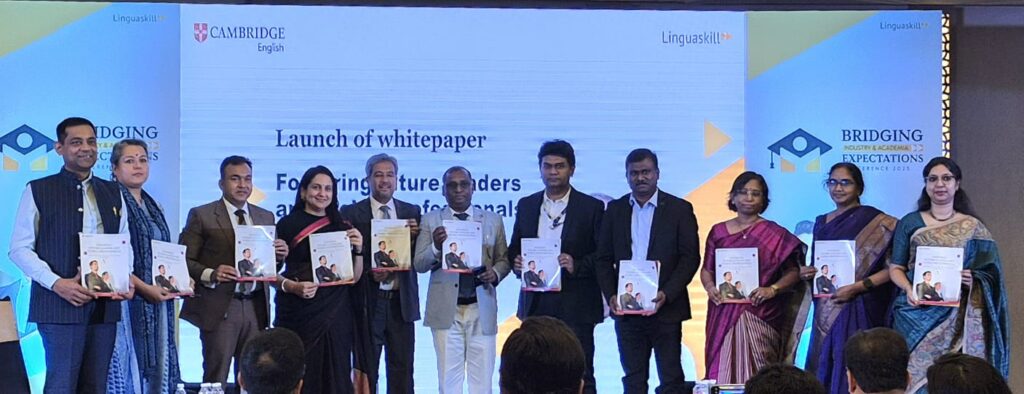
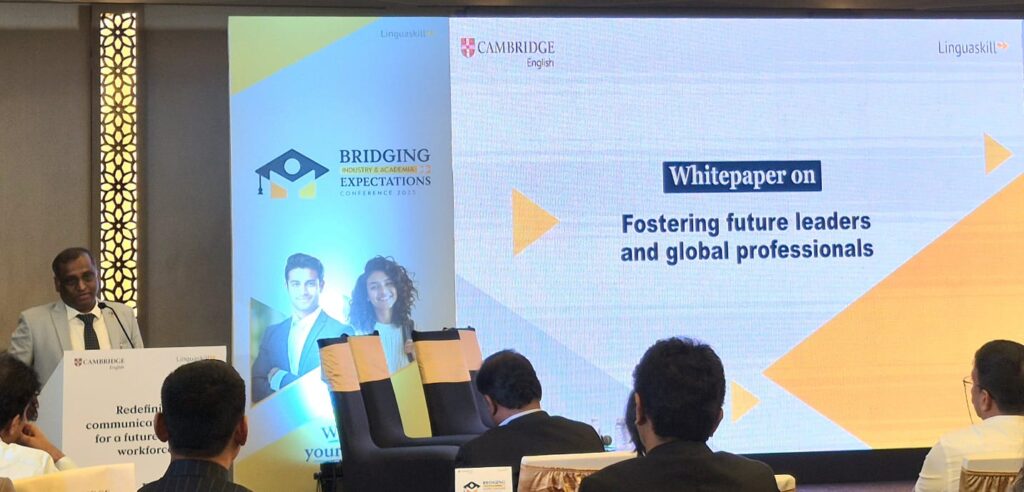
Fast forward to February 21, 2025, the white paper titled “Fostering Future Leaders and Global Professionals,” authored by Dr. M. Muruganant, was officially launched during a conference at the Marriott Bengaluru. This event, aptly named the “Bridging Industry & Academia Expectations Conference 2025,” gathered HR leaders, academic professionals, industry experts, and policymakers to explore the pressing need for a holistic approach to talent development.
The white paper’s release was a pivotal moment, with Dr. Muruganant presenting the findings and introducing the 4-cluster model, which challenges conventional thinking by equally prioritizing technical, adaptable, interpersonal, and cognitive skills. The Union Minister of Education, Government of India, emphasized the importance and timeliness of this model in his foreword to the paper.
 |
 |
|
The key insights from the white paper are derived from data-based evidence and are organized under a 4-cluster I-ACT model. A total of 27 parameters were quantified, and qualitative inputs were gathered from practitioners on the ground to provide a comprehensive understanding of the real-world scenario.
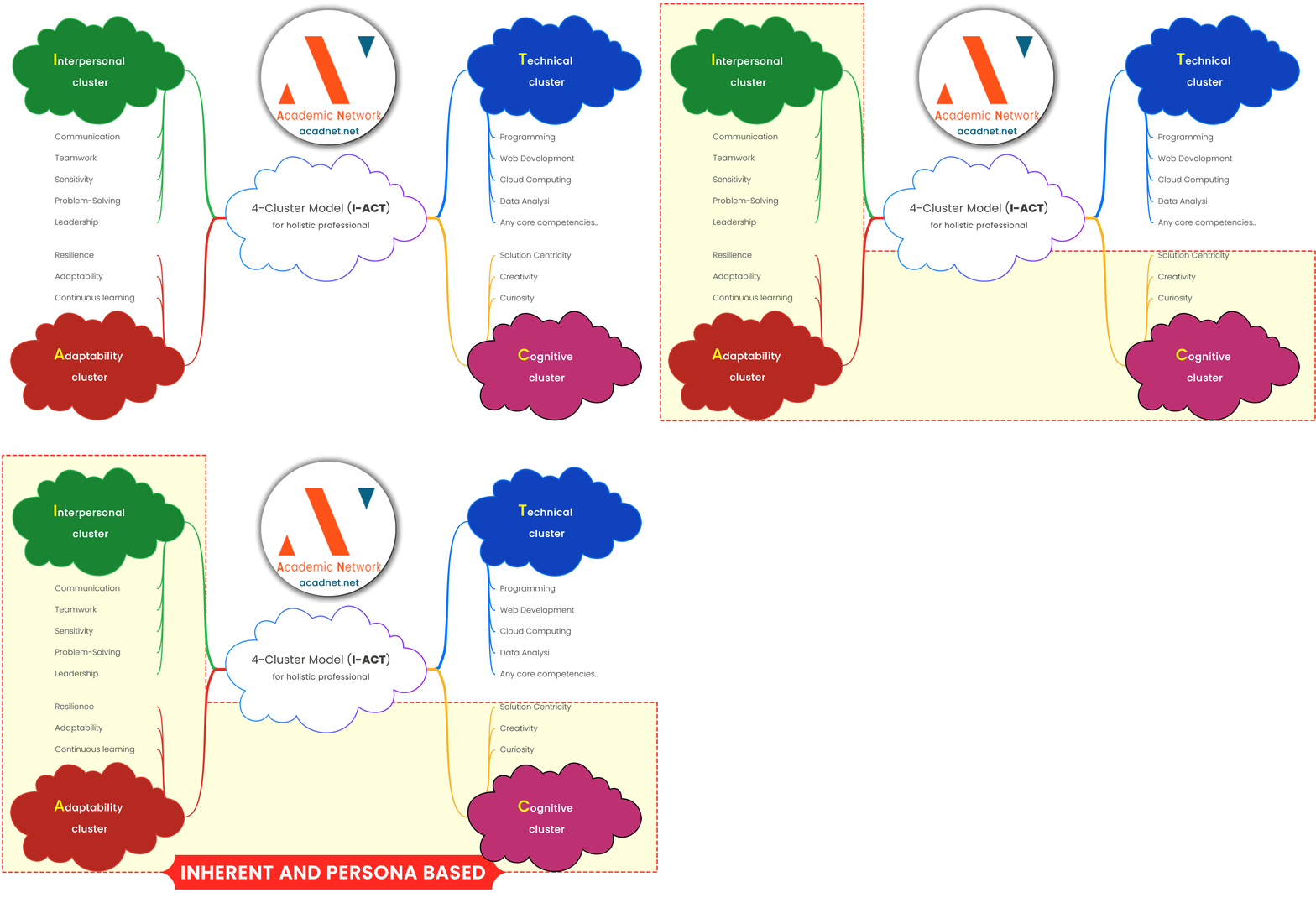
The findings indicate that attributes are inherent to a persona, while skills are accrued.
Notably, three-fourths (75%) of a holistic professional’s value is attributed to personal attributes, while only one-fourth (25%) is based on competencies.
This suggests that when professionals possess strong inherent traits, they can develop the necessary skills at an appropriate pace, deserving the designation of “HOLISTIC.”
Conversely, a conditioned mindset can hinder adaptability and resilience, leading professionals to give up when faced with challenges. This lack of resilience complicates talent retention efforts.
Dr. Muruganant, the chief author of the white paper and founder of AcadNet, stated, “This is only a start. The work starts now. Intent has been expressed; implementation must follow to see the impact. Unless intent creates impact through implementation, the real world will not transform. At AcadNet, we realize that implementation and impact assessment are crucial to growth.”
Arun Rajamani, Managing Director of Cambridge University Press & Assessment, South Asia, highlighted the growing gap between the skills required by employers and the abilities of the workforce. He noted that as this divide widens, it becomes imperative for industry and academia to collaborate to better align educational outcomes with the evolving demands of the workplace. “Through this advisory panel, our aim is to bridge the employability gap and ensure that the necessary skills and communication needs are enhanced to meet industry requirements,” he remarked.
The white paper offers actionable strategies for educational institutions, employers, and policymakers to bridge skill gaps. Recommendations include modernizing curricula to align with industry needs, implementing targeted training programs, fostering diversity and inclusion, and integrating technology to enhance learning and development. These insights aim to equip professionals with the skills needed to thrive in an evolving global economy.
Arunachalam T.K., Regional Director, English, South Asia, added, “With talent becoming more vibrant, there is an increasing need for holistic skills that put effective communication skills on par with technical expertise. Industry data underscores that strong English skills correlate with broader job opportunities and global employability. We recognize that English as a skill has a far-reaching impact on career prospects and overall workforce readiness. The Cambridge approach is forward-thinking, and our aim is to enhance the global employability of Indian youth.”
The conference also featured four additional panels that explored various aspects of talent development:
- Future Ready Communication: Adapting to Evolving Industry Expectations
- Evolving Communication Skills for the AI-driven, Hybrid Workforce
- Flexible Learning & Assessments: Building a Future-ready Workforce.
- Bridging the Gap: A Collaborative Roadmap for Industry-Academia Partnerships
Each panel provided valuable insights into the evolving landscape of professional skills and the critical need for collaboration between educational institutions and industry leaders. The discussions underscored the importance of adapting communication skills to meet contemporary industry expectations, particularly in an era defined by the hybrid workforce and AI-driven tools.
Panelists shared strategies for creating flexible learning environments and assessment methods that can cater to diverse learning styles and professional requirements, ultimately contributing to a future-ready workforce. Furthermore, discussions on the collaborative roadmap emphasized the necessity for sustained partnerships between academia and industries to address prevailing skill gaps and foster an ecosystem conducive to mutual growth and innovation.
As we look ahead, it is evident that alignment with the 4-cluster I-ACT model is essential for cultivating holistic professionals who can thrive in the current and future workforce—particularly in a society increasingly influenced by generative AI. The inherent traits developed through educational systems are crucial for complementing skills, enabling professionals to realize their full potential.
In summary, the insights gleaned from both the February conference and the earlier panel discussions highlight an urgent need for collective action from all stakeholders involved in talent development. It is imperative that the focus not only remains on talent acquisition but also shifts towards fostering a supportive environment that nurtures and retains skilled professionals.
With the foundation laid by the white paper and the active participation of various industry and academic leaders, we stand at the precipice of meaningful change. The intent to enhance professional preparedness and employability is clear, but now it falls upon the stakeholders to bring about impactful implementation.
The journey toward fostering future leaders and global professionals is underway, and continued collaboration will be critical to ensuring that the next generation is equipped with the skills and attributes necessary to succeed in an ever-evolving global landscape.
As we forge ahead, let us collectively embrace the vision articulated during these events, transforming our educational frameworks, industry engagement practices, and professional expectations in order to create a workforce that is adaptable, innovative, and poised for success.
Relevant social media content:
- https://www.linkedin.com/posts/cupa-south-asia_cambridge-cambridgeenglish-cambridgelinguaskill-activity-7298743751932358657-GiqJ?utm_source=social_share_send&utm_medium=member_desktop_web&rcm=ACoAAADesysB3GN21zHFOTVRtFwMM6DE9h9fZIQ
- https://www.linkedin.com/feed/update/urn:li:activity:7302418039050776577/
- https://www.linkedin.com/feed/update/urn:li:activity:7299820396315336705/