







New Academic Network Analysis Reveals Fundamental Shifts in NIRF and QS Methodologies, Creating Strategic Challenges for Higher Education Institutions Worldwide
A comprehensive analysis of global and national university ranking systems has revealed unprecedented methodological transformations that are reshaping how academic excellence is defined and measured, according to a landmark study released today by Academic Network.
The research, which examined ranking evolution from 2018-2026 across both India’s National Institutional Ranking Framework (NIRF) and the QS World University Rankings, uncovered what researchers are calling a “ranking revolution” that has profound implications for higher education strategy worldwide.
The Great Divergence: NIRF’s Internal Contradiction
Perhaps the most startling discovery involves NIRF’s development of what Academic Network researchers term “fundamentally opposite assessment philosophies” within the same framework. While NIRF Overall university rankings have seen teaching quality increase dramatically in importance (from 0.3 to 0.7 correlation) post-2021, college rankings show teaching decreasing significantly (from 0.8 to 0.4) since 2019.
“We’re witnessing two completely different evaluation systems masquerading as a unified framework,” the analysis notes. “Universities are being rewarded for research-integrated teaching excellence, while colleges are increasingly judged on reputation and stakeholder perception.”
This divergence occurred at different times — college rankings shifted in 2019, while university rankings transformed in 2021 — suggesting independent methodological evolution rather than coordinated policy changes.
QS’s Sustainability Revolution Reshapes Global Competition
Meanwhile, the QS World University Rankings has undergone what the report characterizes as a “three-era evolution” culminating in an unprecedented emphasis on sustainability and international collaboration.
The analysis identifies three distinct periods:
- Research Excellence Era (2018): Citations and faculty-student ratios dominated
- Reputation Pivot Era (2019-2020): Academic and employer reputation became primary drivers
- Global Sustainability Era (2024-2026): International research collaboration and environmental leadership emerged as dominant factors
Most dramatically, sustainability went from having zero impact on rankings to becoming a co-dominant factor with 35% correlation strength in just two years (2025-2026). Simultaneously, traditional academic reputation declined by 90% in its ranking influence.
“The speed of this transformation is unprecedented in ranking history,” the report states. “Universities that fail to develop sustainability leadership and international research networks will find themselves increasingly marginalized in global rankings.”
The Reputation Cartel and Gaming Detection
Both ranking systems show evidence of sophisticated gaming detection and response mechanisms. QS’s faculty-student ratio correlation collapsed from 0.7 to 0.07 after the system detected widespread manipulation tactics. Meanwhile, NIRF’s independent evolution suggests built-in safeguards against coordinated gaming attempts.
The research also reveals what it terms a “reputation cartel effect” in QS rankings, where the correlation between academic and employer reputation has strengthened to 0.86, creating a self-reinforcing elite circle that makes it increasingly difficult for newcomers to break into top rankings.
Strategic Implications for Indian Higher Education
The analysis presents a unique challenge for Indian institutions, which must now navigate between “contextual domestic excellence and universal global standards.” The research identifies specific strategic priorities:
For Indian Universities:
- Integrated research excellence with international collaboration networks
- Teaching-research synergy leveraging NIRF’s growing teaching emphasis
- Rapid sustainability leadership development for QS competitiveness
- Global-local balance maintaining domestic relevance while attracting international talent
For Indian Colleges:
- Focus on reputation and stakeholder perception as NIRF college rankings emphasize
- Efficient teaching resource optimization given diminishing correlation returns
- Industry integration building employer connections for future global positioning
- Strategic research development for potential international aspirations
Global Trends Signal Broader Transformation
The research identifies several meta-trends reshaping university assessment globally:
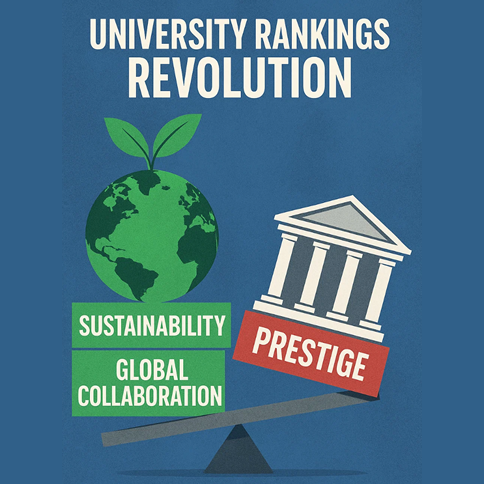
From Prestige to Performance: Both systems are moving away from traditional reputation metrics toward measurable outcomes and demonstrated excellence.
Sustainability as Meta-Metric: Environmental leadership is becoming a factor that drives success across multiple ranking dimensions, correlating strongly with research excellence, international collaboration, and employment outcomes.
International Integration Imperative: Global research collaboration has become essential for top-tier rankings, with QS showing international research growing from zero to 39% correlation in just three years.
Expert Recommendations and Future Outlook
The Academic Network analysis concludes with specific recommendations for institutional leaders:
“Universities must develop dual excellence capabilities,” the report advises. “Success requires mastering different games simultaneously — excelling in domestic contexts while building global competitiveness.”
The research predicts continued divergence between national and international ranking systems, with sustainability likely becoming a requirement rather than advantage. Institutions are advised to begin environmental initiatives immediately to prepare for “inevitable inclusion in both systems.”
Warning Signs and Opportunities
The analysis identifies critical warning signs for universities:
- Reputation Dependency Risk: Institutions relying primarily on historical prestige face declining ranking influence
- Isolated Excellence Risk: Strong performance in single metrics is insufficient; synergistic excellence across multiple dimensions is required
- Gaming Detection Risk: Both ranking systems have become sophisticated at identifying and penalizing manipulation
Conversely, the research highlights strategic opportunities:
- First-Mover Advantage in Sustainability: Early environmental leadership positions institutions for continued trend growth
- Global South Partnerships: International research collaboration opportunities with emerging markets
- Cross-Sector Innovation: Industry partnerships combining sustainability research with practical applications
Methodology and Data Sources
The comprehensive analysis examined correlation patterns, parameter evolution, and strategic implications across both ranking systems using data from 2018-2026. The research methodology included examination of parameter importance changes, institutional performance patterns, and regional excellence variations.
The complete analysis, including interactive dashboards and detailed strategic recommendations, is available through Academic Network’s ranking intelligence platform at acadnet.net/ranking.
About Academic Network
Academic Network is a leading provider of higher education intelligence and strategic analysis, specializing in university ranking systems, institutional performance metrics, and global education trends. The organization’s research platform provides data-driven insights to universities, policymakers, and education stakeholders worldwide. website: https://acadnet.net/
For more information about this research or to access the complete analysis, visit acadnet.net/ranking. Individual detailed reports are available for NIRF rankings and QS rankings.