






What Ancient Wisdom Teaches Modern Learners
“True knowledge comes not from the accumulation of facts, but from the cultivation of wisdom through humility.”
In the digital age of instant gratification and quick fixes, an ancient story from the Mahabharata offers profound insights into the true nature of learning and teaching. The tale of Dronacharya, his son Ashwathama, and his most devoted disciple Arjuna reveals why humility remains the cornerstone of genuine education, even in our modern classrooms and corporate training programs.
The Ancient Paradox: A Father’s Difficult Choice
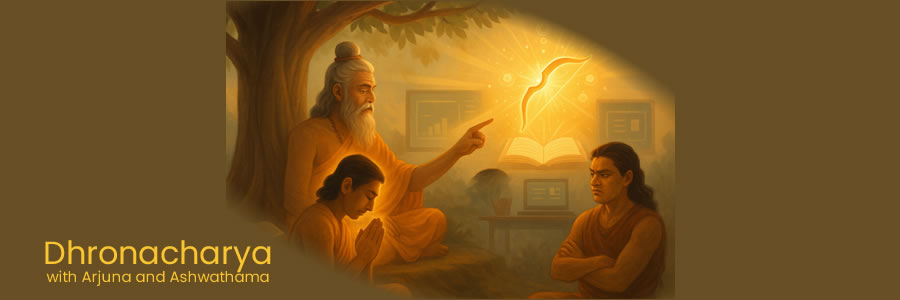
Dronacharya, the legendary teacher of warfare, faced a dilemma that resonates with educators today. When teaching the powerful Brahmastra—a weapon of immense destructive capability—he made a startling decision. To his own son Ashwathama, he taught only how to launch this celestial weapon. But to Arjuna, he imparted complete knowledge: both how to deploy it and, crucially, how to withdraw it.
This wasn’t favoritism or discrimination. It was a master teacher recognizing something fundamental about the learning process itself.
Arjuna’s humility, his genuine respect for knowledge, and his understanding that true power comes with responsibility made him worthy of complete wisdom. Ashwathama, despite being the teacher’s own flesh and blood, lacked this essential quality.
The Humility Gap in Modern Learning
Today’s learners often approach education with a sense of entitlement rather than reverence. We live in an era where information is abundant, but wisdom is scarce. Students frequently ask “When will I use this?” before even attempting to understand the deeper principles being taught. This attitude creates what we might call a “humility gap”—the space between wanting to know and being truly ready to learn.
“The fastest way to learn is to acknowledge ignorance honestly rather than pretending to knowledge you don’t possess.”
Consider the modern workplace learning environment. Employees often rush through training modules, checking boxes rather than absorbing knowledge. They want the certification, the promotion, the immediate benefit—but they resist the transformative process that genuine learning requires. Like Ashwathama, they seek the power without embracing the responsibility that comes with it.
The Guru-Acharya Distinction: A Framework for Modern Education
The ancient distinction between a Guru and an Acharya offers valuable insight for contemporary educators and learners:
The Acharya
Focuses on skill empowerment—teaching specific techniques, methods, and competencies. This is the realm of most formal education today: coding bootcamps, professional certifications, technical training programs. The Acharya says, “Here’s how you do it.”
The Guru
Facilitates transformation—fostering deep understanding, wisdom, and character development. The Guru doesn’t just teach what to think, but how to think. They don’t just impart skills, but shape the learner’s relationship with knowledge itself.
Modern education systems excel at producing Acharyas but struggle to cultivate Gurus. We have countless instructors who can teach the mechanics of their subjects, but fewer who can inspire the kind of humility and reverence for learning that creates truly wise individuals.
The Humility Advantage: Why Modest Learners Excel
Research in educational psychology supports what Dronacharya understood intuitively: humble learners consistently outperform their more arrogant peers. They ask better questions, admit their mistakes more readily, and remain open to feedback. Most importantly, they understand that learning is not about acquiring information to wield power, but about developing wisdom to serve others.
In our current educational landscape, we see this principle playing out repeatedly:
The Retrieval Principle: Complete Knowledge for the Worthy
The most striking aspect of Dronacharya’s teaching decision was his recognition that true mastery includes not just the ability to act, but the wisdom to know when not to act. Teaching Arjuna to withdraw the Brahmastra was perhaps more important than teaching him to launch it.
“Complete knowledge includes not just the ability to execute, but the wisdom to know when execution is appropriate.”
This “retrieval principle” is desperately needed in our current educational approach. We teach students to analyze but not to synthesize, to criticize but not to create, to compete but not to collaborate. We give them powerful tools—from social media platforms to AI technologies—without teaching them the wisdom to use these tools responsibly.
🎯 Modern Assessment Revolution
Modern assessment frameworks are beginning to recognize this need for holistic evaluation. The IACT Assessment platform exemplifies this evolution by measuring not just technical competency, but the complete professional blueprint that includes Interpersonal, Adaptability, Cognitive, and Technical dimensions.
This groundbreaking approach acknowledges that approximately three-quarters of professional success depends on inherent traits—the very qualities that determine whether someone is ready for “complete knowledge” like Arjuna was.
The IACT framework mirrors Dronacharya’s wisdom in recognizing that technical skills alone are insufficient. Just as the master teacher evaluated Arjuna’s character before imparting complete knowledge of the Brahmastra, modern educational institutions need comprehensive assessments that evaluate whether learners possess the interpersonal intelligence to collaborate responsibly, the adaptability to navigate complex situations, and the cognitive maturity to understand consequences—not just the technical ability to execute tasks.
Modern learners need to understand that complete knowledge includes:
Cultivating Humility in the Digital Age
For today’s learners, developing humility requires conscious effort in an environment that often rewards the opposite. Here are practical approaches:
🧠 Embrace the Beginner’s Mind
Approach each new subject with genuine curiosity rather than trying to quickly demonstrate competence. Ask questions that reveal understanding rather than ones designed to impress.
👥 Seek Mentors, Not Just Instructors
Look for educators who challenge you to grow as a person, not just as a professional. The best teachers will push you to examine your motivations and assumptions.
💡 Practice Intellectual Vulnerability
Admit when you don’t understand something. The fastest way to learn is to acknowledge ignorance honestly rather than pretending to knowledge you don’t possess.
🤝 Focus on Service Over Success
Ask how your learning can benefit others, not just yourself. This shift in perspective naturally cultivates the humility that makes deep learning possible.
The Teacher’s Responsibility: Creating Conditions for Humility
Educators, too, must examine their role in fostering or hindering humility. The best teachers create environments where intellectual vulnerability is safe, where questions are valued over answers, and where the learning process is respected as much as the learning outcome.
This means moving beyond standardized metrics and grade-based motivations toward more holistic approaches that honor the complexity of human development. It means recognizing that some students, like Arjuna, are ready for deeper wisdom, while others may need more time to develop the character necessary for such trust.
The Timeless Relevance of Ancient Wisdom
The story of Dronacharya, Ashwathama, and Arjuna reminds us that the fundamental dynamics of learning haven’t changed, even as our tools and contexts have evolved dramatically. The student who approaches knowledge with humility, respect, and genuine desire for wisdom will always be the one worthy of the deepest teachings.
“The most powerful knowledge—like the Brahmastra—comes not just with the ability to deploy it, but with the wisdom to know when to hold back.”
In our fast-paced, achievement-oriented world, we would do well to remember that the most powerful knowledge—like the Brahmastra—comes not just with the ability to deploy it, but with the wisdom to know when to hold back. The learner who understands this paradox becomes not just competent, but truly wise.
The Ultimate Lesson
The ancient archer’s humility earned him complete knowledge. In our modern quest for learning, the same principle applies: those who approach education with genuine reverence for wisdom will find themselves trusted with the most profound teachings. The question for each learner is not whether they can handle the power of knowledge, but whether they have cultivated the humility to wield it wisely.
 M Muruganant | About the Author Professor M. Muruganant is a distinguished academic and innovator who earned his Doctorate from the University of Cambridge, UK, through prestigious Commonwealth and DAAD fellowships. |
| Professor Muruganant, with extensive experience in academia and management, formerly served as the Director of Higher Education at Adani Group, where he established Adani University and served as its inaugural Provost. He founded the Global Education Forum, focusing on educational transformation and sustainability. Recognized as an institutional leader, he has initiated several centers to empower faculty and enhance student experiences. His contributions to materials science are notable, and he advocates for STEAM education while emphasizing value education and Bharatiya culture. As the youngest Ministry of Steel Chair Professor, he promotes academic initiatives and engages in significant policy discussions on India’s National Education Policy – 2020. | |
If you would like to get connected to Dr M Muruganant write to editor@acadnews.com.