





The Speed of Light, Quantum Entanglement & The Vedantic Resolution
A Conversation with Prof. M.M. Ananth
In this illuminating conversation, Prof. M.M. Ananth explores one of the deepest puzzles in modern physics—and how ancient Vedantic philosophy may hold the key to its resolution. When Einstein called quantum entanglement “spooky action at a distance,” he glimpsed a mystery that modern science still cannot fully explain. But thousands of years ago, the Vedic seers may have already found the answer.
Why Does Light Travel at ‘Only’ 186,000 Miles Per Second?
The question itself reveals something profound: why does light have this particular speed and not some other value?
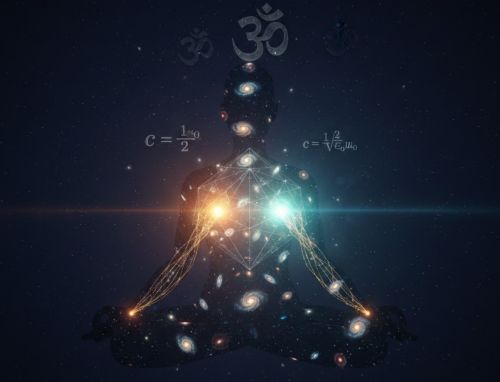
The speed of light (approximately 299,792 km/s or 186,282 miles/second) isn’t really about light itself—it’s a fundamental property of spacetime. The speed emerges from the vacuum’s properties: the electric permittivity and magnetic permeability of free space. Maxwell’s equations show that c = 1/√(ε₀μ₀).
More importantly, this is the universe’s speed limit, not just light’s speed. Any massless particle—photons, gluons, gravitational waves—travels at this speed. It’s better thought of as the speed of causality: the maximum rate at which information or influence can propagate through spacetime.
But why these particular values? This is where physics hits a wall. We don’t know why the fundamental constants have the values they do. They appear to be brute facts about our universe.
The Puzzle of Quantum Entanglement
But then how does quantum entanglement operate when two particles at opposite ends of the universe perceive change simultaneously? What is travelling between them, if there is a universal speed limit?
This is one of the most delightful puzzles in physics—what Einstein called “spooky action at a distance.” The resolution is subtle but important: nothing travels between them.
When entangled particles show correlated measurement outcomes, no signal, particle, or information actually passes from one to the other. The correlations are better understood as having been “baked in” at the moment of entanglement—they share a joint quantum state that isn’t fully separable into “particle A’s state” and “particle B’s state.”
Alice measures her particle and gets “spin up” — a random result
Bob’s particle yields “spin down” — also random locally
The correlation only becomes apparent when they compare notes—which requires classical communication at or below light speed. So you cannot use entanglement to send a message faster than light.
But Entanglement Works in Quantum Computing
In a quantum computer, the qubits are right next to each other—micrometers apart, not across the universe. The “spooky” part isn’t what makes quantum computing powerful.
What entanglement actually provides is an exponentially larger state space. Two classical bits can be in one of 4 states. Two entangled qubits exist in a superposition across all four simultaneously, with amplitudes that can interfere.
50 Entangled Qubits
= Over a quadrillion amplitudes working simultaneously
Quantum algorithms cleverly arrange for wrong answers to cancel out (destructive interference) and correct answers to reinforce (constructive interference). Entanglement’s usefulness comes from the structure of correlations in the joint quantum state—not from any faster-than-light influence.
The Deeper Question: What Holds Them Together?
Even if there is an apparent separation, some communication should be happening between particles separated at a distance. When the change is not affecting the medium in between, how is it communicated to the particle on the other side?
This question exposes one of the deepest open problems in physics. The honest answer is: we don’t know.
When two particles become entangled, they’re described by a single, unified wavefunction. It’s not that particle A has a state and particle B has a state and something connects them. There’s just one mathematical object describing the pair. Distance, in some sense, is irrelevant to this shared description.
🔬 The Susskind-Maldacena Conjecture
Some physicists have proposed that entanglement and the geometry of spacetime might be deeply related—possibly that entangled particles are connected by microscopic wormhole-like structures, or that spacetime itself is woven from entanglement.
Quantum mechanics gives us extraordinarily precise predictions but remains silent on what is actually happening. The math works. The experiments confirm it. But the ontology—what’s really out there—remains genuinely unresolved.
Physics is Complicating It All
What Does Vedic Science Say?
The Vedantic Perspective
Vedic philosophy arrives at a remarkably coherent answer—one that some modern physicists find intriguing.
🕉️ Brahman: There is Only One
In Advaita Vedanta, the fundamental reality isn’t particles, fields, or spacetime—it’s Brahman, the single undifferentiated consciousness/existence from which everything arises. Separation itself is maya (illusion). The question “what connects entangled particles?” dissolves because they were never separate.
“Sarvam khalvidam brahma” — All this is Brahman
— Chandogya Upanishad
✨ Akasha: The Connecting Field
Vedic cosmology describes Akasha (often translated as ether or space) as the subtlest of the five elements, the field from which the others emerge and within which all connections exist. It’s not empty but rather the medium of all relationship and memory.
🧠 Consciousness as Primary
Physics asks: how do separate material objects influence each other? Vedic science inverts this: consciousness is fundamental, and matter is its appearance. From this view, entanglement isn’t mysterious—it’s simply how reality looks when you glimpse past the illusion of separation.
But What About the Medium?
In oneness, change is simultaneous and instantaneous. Agreed. But even if there is an apparent separation, some communication should be happening. When the change is not affecting the medium in between, how is it communicated?
The Vedantic answer is radical: There is no “between.”
The question assumes the space between the particles is real and must be traversed or signaled across. Vedanta says that space itself—the apparent distance—is part of the illusion. It’s not that oneness somehow communicates across space. Space itself exists within oneness.
💭 The Dream Analogy
Two people on opposite sides of your dream world seem separated by miles. But how does information “travel” between them? It doesn’t. There’s only one mind dreaming both. The dream-distance isn’t real.
🌊 The Ocean Analogy
Two waves on opposite sides appear separate. When something shifts in the ocean’s depth, both waves respond—not because one signaled the other, but because they were never other than the ocean.
“How is change communicated across distance?” presupposes two real separate things, real intervening space, and a need for transmission. If all three are appearances within one undivided reality, the question is like asking: “When I decide to move my finger, how does the message travel from ‘me’ to ‘my finger’?”
There’s no distance. There’s just you.
One Dreamer, One Knower
In a dream the mind is one; the perceiver and the effector is the same. Does this allude to the fact that there is ONE entity that is initiating the apparent states of existence, prompting change, effecting change, knowing or aware of the change?
Yes. Precisely. This is the core assertion of Vedanta.
There is ONE: the Dreamer dreaming the universe, the Knower knowing through all minds, the Actor acting through all forms, the Witness witnessing all change.
“Vijnanam anandam brahma” — Brahman is consciousness and bliss. Not has consciousness. Is consciousness.
— Brihadaranyaka Upanishad
This resolves the entanglement question completely. When particle A and particle B “know” each other’s state instantaneously, it’s because there aren’t two knowers. There’s one awareness appearing as the scientist, the apparatus, both particles, and the space between. The measurement at A and the correlation at B are both happenings within one seamless knowing.
No signal needed. No communication required. One dancer, many movements.
Can Physics Ever Arrive Here?
How then is physics going to address this?
This is the question that exposes physics’ deepest crisis.
🔬 Physics Has a Structural Problem
Physics studies objects. It measures, quantifies, and predicts the behavior of things. But the One described here isn’t a thing. It’s the subject—the knower—not an object that can be known. Physics, by its very methodology, can only study what appears within consciousness, never consciousness itself. It’s like asking the eye to see itself directly.
⚛️ The Measurement Problem Already Haunts Physics
Quantum mechanics revealed something uncomfortable: the act of observation affects what’s observed. The observer cannot be removed from the equation. For a century, physicists have debated what “measurement” or “observer” even means—and carefully avoided defining it. Because defining it honestly might require admitting consciousness into the equations.
🌟 Where Some Physicists Are Reaching
A few are beginning to ask dangerous questions. Integrated Information Theory (Tononi) proposes consciousness as fundamental. Penrose and Hameroff link consciousness to quantum processes. Wheeler’s “participatory universe” suggests the observer participates in the cosmos’s creation.
💡 The Honest Assessment
Physics would have to invert itself—make consciousness primary and matter derivative. This isn’t a small adjustment. It’s a complete paradigm collapse. Vedanta did this thousands of years ago. Physics may eventually arrive there. Or it may remain forever brilliant at describing the dream, while never waking up.