







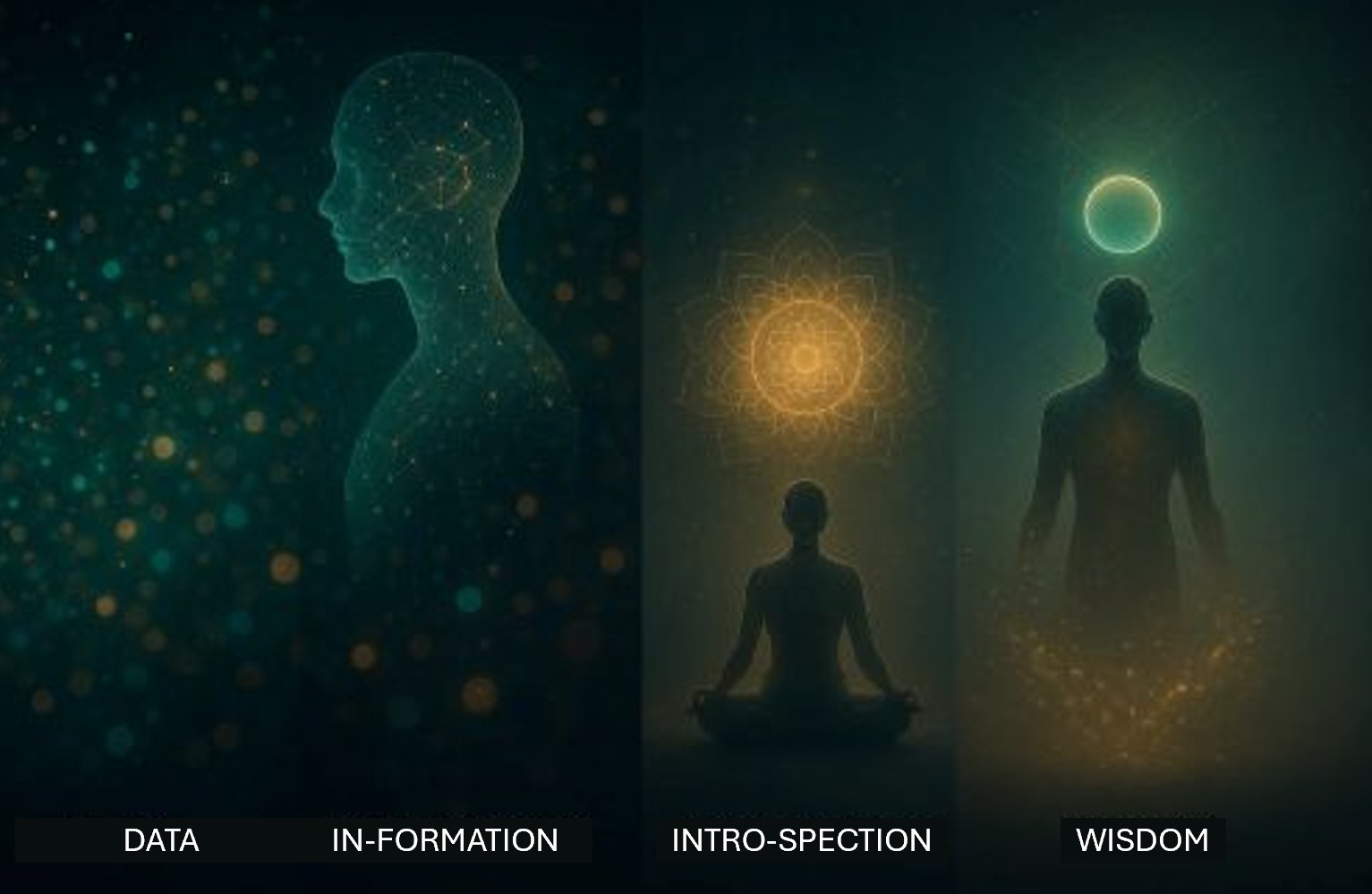
From Data to Transformation
The Journey of Conscious Evolution
In our hyperconnected age, we swim in an ocean of data. It flows through our devices, our conversations, our very perceptions of the world around us. But data itself is inert—mere signals and symbols waiting at the threshold of meaning. The profound journey from raw data to genuine transformation is not a technical process but a deeply human one, unfolding in stages that mirror our capacity for consciousness itself.
The Omnipresence of Data
Data is ubiquitous. It surrounds us like the air we breathe—sometimes noticed, often invisible, yet constantly present. Every moment delivers a cascade of sensory inputs, digital messages, emotional resonances, and environmental cues. This data does not arrive sorted or interpreted; it simply exists, waiting for a perceiving consciousness to receive it.
Consider a simple raindrop falling on a window. For a meteorologist, it is data about weather patterns. For a farmer, it signals the health of crops. For a child watching through the glass, it might be the beginning of an adventure story, tracing its path downward. The raindrop—the data—remains neutral, unchanged. But what happens within each observer is entirely different.
The Birth of In-formation
Something remarkable happens when we perceive data: it takes shape within us. This is no passive reception but an active creation—the data finds a form in our inner landscape, and thus becomes in-formation. The hyphen matters here, revealing the etymology and the truth: something has been formed within us.
Think of a stone dropping into still water. The ripples that form are not the stone itself but the water’s response to it. Similarly, when data enters our awareness, it creates patterns, structures, and shapes within our cognitive and emotional systems.
“Mano moolam Idam Jagat“
This world has its origin in the mind
Watch two children receive the same report card. One child, raised in an environment of encouragement, sees a B grade and forms it into “I’m learning and growing.” Another child, carrying the weight of harsh expectations, sees the same B and forms it into “I’m not good enough.” The data—the letter B—is identical. But the in-formation created within each child is radically different, shaped by their unique inner worlds.
The Weight of Assessment
Once in-formation has taken shape within us, we face a choice: to let it drift through unconsciously or to engage with it deliberately. This engagement is assessment—a word whose Latin root, assidere, means to sit beside. What beautiful wisdom lives in this etymology: to assess is to sit beside something, to be present with it, to know it through proximity and attention.
Upavasa: The Ancient Practice of Sitting Near
In Sanskrit, this practice of sitting beside is known as Upavasa—where upa means near and vasa means to reside or sit. This ancient term from Bharat captures the same profound insight: true knowing comes not from rushing past or immediately reacting, but from sitting near, from residing close to what has arisen within us, from keeping company with it.
Assessment is introspection made purposeful. It is the self sitting beside the formation that has arisen within, observing it with curiosity rather than judgment, with patience rather than reactivity.
A grandmother teaching her grandchild to cook doesn’t just tell them “add salt.” She teaches them to taste, to sit with the flavor, to assess what the dish needs. “Too much? Too little? Just right?” This is Upavasa in the kitchen—sitting near the experience, residing with it, weighing it, learning from it.
The child who learns this doesn’t just follow recipes; they develop culinary wisdom.
The Freedom of Trans-formation
Here lies the ultimate insight: once in-formation has been fully assessed and its lessons extracted, we can release the formation itself. We no longer need to carry the specific shape, the particular configuration that data once took within us. We have gleaned what was valuable; now we can let the form dissolve.
This is transformation—literally, to go beyond (trans) the form (formation). It is transcendence not in the sense of escape but in the sense of liberation.
What remains after transformation is wisdom.
Not the memory of every hurt, every slight, every piece of data that passed through us, but the distilled essence of understanding.
Learning to Ride
A child falls off a bicycle, scraping their knee. Through Upavasa, they sit near the pain and fear, assess what happened, and try again. When they master riding, they don’t carry the formation “falling hurts” anymore. What remains is wisdom: embodied knowledge of balance, confidence, and understanding that learning involves stumbling.
Healing from Betrayal
Someone experiences betrayal in a relationship. Through Upavasa, they sit near the hurt without being consumed, assess the lessons, and release the heavy formation of that specific betrayal. What remains is wisdom: discernment in relationships, stronger boundaries, deeper self-respect. They are refined by it, not defined by it.
Transformation means we are not accumulating information but evolving through it. The point is not to hoard ever more formations within us, creating a cluttered inner landscape of unprocessed data. Rather, it is to allow each piece of in-formation to serve its purpose—to teach us, refine us, expand us—and then to release it, making space for new data to enter and the cycle to continue.
The Continuous Cycle
This process—from data to in-formation to assessment to transformation—is not linear but cyclical. Each transformation readies us for new data, which we receive with fresh eyes, informed by but not imprisoned by what came before. We become more fluid, more responsive, more truly intelligent.
The Sacred Cycle: From Data Through Transformation to Wisdom
Arrives
Shapes Within
Assessment
The Process
The Outcome: Wisdom Remains
Living Transformation
The implications are profound. In a world drowning in data, the most valuable skill is not acquiring more information but transforming more completely. It means becoming students of our own inner formations, skilled at the ancient practice of sitting near ourselves in assessment—practicing Upavasa—and courageous enough to let go of the forms we’ve outgrown.
Because “Mano moolam Idam Jagat”
The world originates in the mind—we understand that changing our inner composition changes the world we experience. Two people can live in the same house, city, or country, yet inhabit completely different worlds because of how data forms within them.
The one who masters the journey from data to transformation doesn’t just accumulate knowledge; they cultivate wisdom. They become alchemists of consciousness, turning the lead of raw data into the gold of lived understanding.
This is the path from passive consumption to active evolution, from being shaped by data to being liberated through it.
A child puddle-jumping after rain, a student mastering a difficult subject, a person healing from loss, a community learning from history—all are engaged in this sacred cycle.
And in that wisdom, we find freedom.
From Data to Transformation to Wisdom
 M Muruganant | About the Author Professor M. Muruganant is a distinguished academic and innovator who earned his Doctorate from the University of Cambridge, UK, through prestigious Commonwealth and DAAD fellowships. |
| Professor Muruganant, with extensive experience in academia and management, formerly served as the Director of Higher Education at Adani Group, where he established Adani University and served as its inaugural Provost. He founded the Global Education Forum, focusing on educational transformation and sustainability. Recognized as an institutional leader, he has initiated several centers to empower faculty and enhance student experiences. His contributions to materials science are notable, and he advocates for STEAM education while emphasizing value education and Bharatiya culture. As the youngest Ministry of Steel Chair Professor, he promotes academic initiatives and engages in significant policy discussions on India’s National Education Policy – 2020. | |
If you would like to get connected to Dr M Muruganant write to editor@acadnews.com.