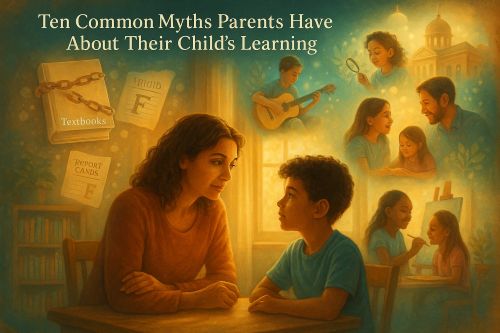
Ten Common Myths Parents Have About Their Child’s Learning
Breaking Through Educational Misconceptions for Better Parenting
In recent times, the concept of schooling is undergoing tremendous change. As social status determinants, market-driven competition, and technology-based learning resources reshape education, parents face increasing pressure to navigate their child’s academic journey. With over fifty years in the field of education, I’ve observed critical misconceptions that often hinder rather than help children’s learning.
Brian Herbert wisely stated: “The capacity to learn is a gift; The ability to learn is a skill; The willingness to learn is a choice.”
Myth #1: Learning Can Be Caused
Many believe that given the right input, learning can be caused. Brain scientists have proved beyond doubt that learning cannot be caused; it can only be facilitated. Learning depends on the personal learning profile of each learner—their interests, aptitudes, focus, and psychological motivation in each discipline.
Khalil Gibran’s profound words remind us: “Your children are not your children. They are the sons and daughters of Life’s longing for itself. They come through you but not from you… You may give them your love but not your thoughts, for they have their own thoughts.”
Myth #2: More Textbook Time Equals Better Learning
While books have played a significant role for centuries, their role has dramatically changed. Textbooks have become harbingers of information, not necessarily knowledge or wisdom. Psychologists emphasize that informal learning from the external world plays a major and powerful role.
Constructive collaboration is required between textbook learning and learning from family, environment, and society. Parents should spend time establishing positive, loving communication that promotes trust and confidence.
Albert Einstein wisely noted: “Education is what remains after one has forgotten what one has learned in school.”
Myth #3: Achievements Can Be Forced Without Aptitude
Parents must understand through psychological consultation whether children have aptitudes for certain subjects or pursuits. Forcing children to perform in areas where they have no interest or aptitude may make them psychological wrecks.
Critical Reality: There is no child without aptitudes, but their field of aptitude might significantly vary from what parents dream. Forced compliance has led to depression, low self-esteem, anxiety disorders, and even suicidal tendencies.
Myth #4: Good Marks Equal Intelligence
Good marks are indicators of learning profile, but often result from stress, rote learning, or exam-handling ability. They are not necessarily proof of intelligence, thinking ability, analytical skills, innovation, or creativity.
Studies show students who scored 100% in public examinations sometimes failed the same subject in subsequent higher institutions. Marks can be celebrated but don’t qualify as the most correct tools for determining intelligence.
Myth #5: Teachers Are Solely Responsible
While teachers significantly contribute to learning profiles, they cannot impact learning quality and quantity alone without parental assistance. An old theosophical statement says, “When the student is ready, the teacher appears.”
Parents making negative remarks about teachers or reaching schools with aggressive postures undermines learning. Neither schools nor teachers can assume exclusive responsibility if parents don’t offer adequate interest and support. Only shared responsibility bears fruit.
Myth #6: My Child Can Never Be Wrong
A Japanese proverb says: “A father’s goodness is higher than the mountain; and a mother’s goodness is deeper than the sea.”
While parental belief and trust are natural, children face peer pressure and social connections parents may not be fully aware of. Over-confidence can lead to ignoring aberrations until things spiral out of control.
Parents should stay connected, mentor, monitor, and engage children in discussions about values, ethics, and discipline. Schools have the right and responsibility to discipline children, and parents need to support these efforts.
Myth #7: High-Profile Schools Guarantee Success
The term “high-profile” school is a misnomer. A school’s profile doesn’t lie in its name, brand, infrastructure, or fee structure. True profile is evaluated by deliverables—developing confident, competent, and contributive citizens.
Cozy lifestyles are no guarantee of better learning environments. Learning happens even in challenging circumstances when the learner’s fire for knowledge remains alive. Children thrive when they feel loved, cared for, heard, and acknowledged—when they see hope and opportunity.
Myth #8: Social Status Impacts School Profile
Parents demonstrating social status, official power, or financial glory at schools send wrong signals to children. Some children have gone astray, relying on what parents can “do for them.” Parental behavior has caused stress and disrepute among peers.
Schools are social systems where every parent is equal. Parents should demonstrate simplicity, humility, and respect to the education system—this has long-term impact on their children’s minds and adds value to their own status.
Myth #9: Tuitions Enhance Learning Quality
Many families boast about extensive tuition schedules, claiming children have no personal time. Tuitions are not magic wands, and tuition experts are not angels. While they offer practice and regularity, the belief that success requires tuition in all subjects is a misconception.
This is particularly tragic for primary-age children. Time should be used by parents to extend life skills, value systems, social beliefs, and encourage extended reading.
Myth #10: We Don’t Need Counseling
Parents or children may need professional counseling—not because of medical or psychological challenges, but to address latent problems professionally with care, comfort, and conviction. Counseling is not suggestive of deficiency or disorder.
Professional guidance helps promote understanding of situations and appropriate responses. Parental inability to accept school or teacher suggestions due to ego or social status has harmed children. In a world of immediate gratification and emotional disconnects, avoiding counseling can create long-term impacts.
“To be in your children’s lives tomorrow, you must be in their lives today.”
Committed parenting is indeed the best investment in a child’s future.
An article based on fifty years of educational experience, exploring the misconceptions that shape modern parenting approaches to learning.