







In the dynamic landscape of global economics, the concept of “Needonomics” (economics of needs) has emerged as a guiding principle, particularly for traders and exporters navigating the complexities of modern markets. Derived from the philosophy of focusing on essential needs rather than excessive wants (greed), Needonomics emphasizes sustainability, resource efficiency, and value-driven growth. This approach is becoming increasingly relevant as businesses confront environmental challenges, shifting consumer preferences, and evolving regulatory frameworks. For traders and exporters, embracing needonomics can lead to significant strategic advantages and resilience in an ever-changing economic environment.
Needonomics
The domain of ‘Needonomics’ based on the logo of Life Insurance Corporation (LIC)of India ‘Yogakshemam Vahamyaham’(Your welfare is our responsibility) flowing from Bhagvad Gita sloka number 22 of Chapter 09 is spiritual, nonviolent, environmental friendly and ethical in nature. It says no to greed authenticating economic thoughts of Mahatma Gandhi. ABC of Needonomics to be understood, analyzed, interpreted and adopted for the solution of economic and non- economic problems in the global society including traders and exporters. We need to research and rethink out of the box solutions for the problems of the global economy in present times of recession in the global economy. Needonomics is necessary for:
Sustainability: Prioritizing long-term ecological balance over short-term gains. Efficiency: Maximizing resource use and minimizing waste. Value Creation: Focusing on delivering genuine value to consumers, thereby fostering trust and loyalty.
These principles align closely with the growing global emphasis on sustainable development and responsible business practices. For traders and exporters, integrating these principles into their operations can not only enhance their market position but also ensure compliance with increasingly stringent environmental and ethical standards.
Implications for Traders
Market Adaptation: Traders who adopt Needonomics can better align with shifting consumer preferences towards sustainable and ethically produced goods. This adaptation is crucial in markets where consumers are becoming more conscious of the environmental and social impacts of their purchases.
Cost Efficiency: By optimizing resource use and reducing waste, traders can lower operational costs. This efficiency not only boosts profitability but also positions them as responsible and forward-thinking businesses in the eyes of partners and customers.
Regulatory Compliance: As governments worldwide implement stricter environmental regulations, adhering to Needonomics can ensure that traders remain compliant. This proactivity can prevent costly penalties and enhance their reputation.
Supply Chain Resilience: Needonomics encourages robust and transparent supply chains. Traders who foster strong relationships with sustainable suppliers can mitigate risks related to supply chain disruptions and ensure continuity in their operations.
Implications for Exporters
Competitive Advantage: Exporters who emphasize need-based production can differentiate themselves in global markets. By offering products that meet essential needs and adhere to high sustainability standards, they can capture the growing segment of conscientious consumers.
Market Access: Many international markets now have stringent regulations regarding sustainability. Exporters who integrate Needonomics into their practices can gain easier access to these markets and avoid potential trade barriers.
Brand Loyalty: Exporters who commit to delivering high-value, sustainable products can build strong brand loyalty. Consumers and businesses alike are more likely to remain loyal to brands that demonstrate a genuine commitment to ethical and sustainable practices.
Innovation and Growth: The principles of Needonomics encourage continuous improvement and innovation. Exporters who focus on creating products that fulfill essential needs can explore new technologies and processes that enhance product quality and sustainability, driving long-term growth.
Strategic Implementation
For traders and exporters looking to adopt Needonomics, the following strategies can be effective:
- Sustainable Sourcing: Establish partnerships with suppliers who prioritize sustainability. This not only ensures a steady supply of high-quality materials but also aligns the supply chain with environmental goals.
- Efficiency Audits: Regularly assess operations to identify areas where resources can be used more efficiently. Implementing energy-saving technologies and waste reduction practices can yield significant benefits.
- Consumer Engagement: Educate consumers about the benefits of need-based products. Transparent communication about the sustainability efforts and value propositions of products can build trust and drive demand.
- Regulatory Awareness: Stay informed about relevant regulations in target markets. Proactive compliance with international standards on sustainability can prevent disruptions and open new opportunities.
To understand and adopt needonomics, the traders and exporters must use Edgeworth Box Diagram as under:
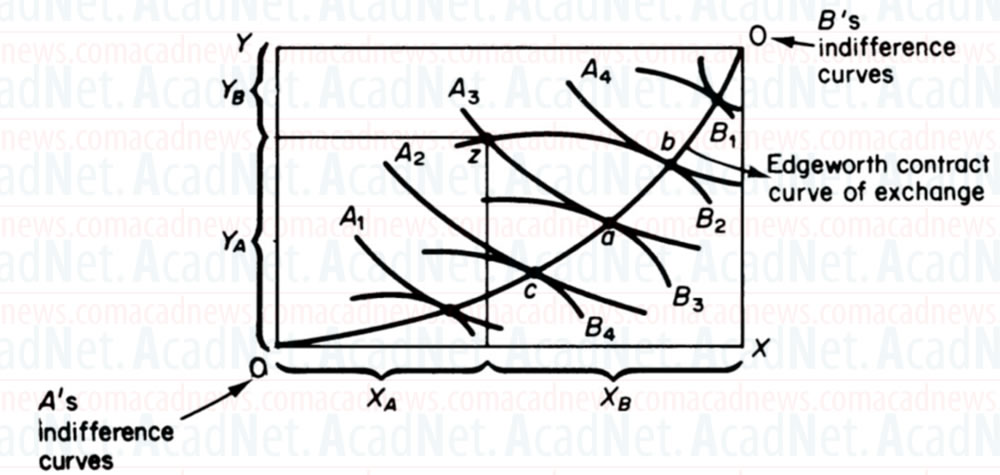
We can understand the optimum distribution of the given quantities of x and y between A and B, we superimpose indifference map of B over that of A to get a box like structure shown below.
Edgeworth box , named after F.Y. Edgeworth, is a powerful tool of economic analysis used for representing various distributions of resources. In its elementary form it was presented by Edgeworth in 1881, improved upon by Pareto and Bowley. The modern version is referred to as Edgeworth- Bowley box. This tool is used in general equilibrium analysis and also is an indicator of Pareto optimal distribution of resources, showing the level of social welfare. Here the explanation is in terms of a simple case of exchange of given quantities of the two commodities, X and Y between two individuals as traders and exporters, A and B. The analysis can be extended to two groups and two countries too. Any point of the Edgeworth box shows a certain distribution of the two commodities between the two individuals. The indifference curves of A and B are of opposite curvature and thus are tangential to each other. The locus of these points of tangency is Edgeworth contract curve, shown as OA OB in the figure above. Any point on the contract curve shows the equality of marginal rate of substitution between the two commodities for the two individuals (if it is not true for certain distribution then the indifferences curves tangency does not occur, as can be seen in certain cases).
The traders and exporters must adopt NAW (need to be created, affordability be ensured and pricing be worth of the product) approach of marketing with optimism of needo-consumption and avoid injustice with inequalities in consumption levels as needo-lifestyle be understood and adopted.

Conclusion
In a world increasingly focused on sustainability and responsible consumption, Needonomics offers a viable framework for traders and exporters to thrive. By embracing this approach, businesses can not only enhance their operational efficiency and market competitiveness but also contribute to a more sustainable and equitable global economy. As economic scenarios continue to evolve, those who prioritize essential needs, value creation, and sustainability will be best positioned to navigate the challenges and seize the opportunities that lie ahead.
References
- M.M. Goel, Needonomics: Implications for Distributors in Changing Economic Scenario, (with audio podcast) June 04, 2024
- M. M. Goel, Needonomics: Implications for Producers in Changing Economic Scenario, (with audio podcast) May 14,2024
- M. M. Goel, Needo-Consumption: Implications for Global Consumers, April 22,2024
- M. M. Goel, Needonomics: SWOC ANALYSIS (with audio podcast) April 9, 2024.
- M. M. Goel, Unveiling the Perils of Greedonomics, (with audio podcast) March 11, 2024.
- M. M. Goel, Needonomics: Queen of Social Sciences for Global Economy, (with audio podcast) February 26, 2024.
![]() Dr. M M Goel | About the Author Propounder Needonomics, Professor Madan Mohan Goel is a superannuated Professor of Kurukshetra University. He is former Vice-Chancellor, Starex University, Gurugram, Jagannath University Jaipur, RGNIYD (GOI), Pro Vice-Chancellor VKSU Ara, Dean of Colleges & Social Sciences, Chairman, Dept. of Economics & Dept. of Journalism KUK He was the first ICCR Chair Professor in South Korea. Presently he is an Adjunct Professor at the Institute of Advanced Sciences Dartmouth, USA. He is honoured with the London Organization of Skill Development (LOSD) Excellence Award 2023, Professor J.K. Mehta Academic Excellence Award 2023, Rashtrapita Rashtriya Samman 2023 for propounding Needonomics and Gurukul Gyanjyoti Award (2024). His area of research is Economics of HRD & Indian Economy. He has 483 publications and guided 25 PhD and 25 MPhil Scholars. |
If you would like to get connected to Dr M M Goel write to editor@acadnews.com.