A Journey Beyond the Mind’s Three States
The sacred thread ceremony, known as Upanayana in Sanskrit, is far more than a religious ritual—it’s a profound spiritual initiation that maps the journey of human consciousness toward its highest potential. To understand its deeper meaning, we need to explore the ancient wisdom of the three fundamental qualities that govern all existence.
Understanding the Three Gunas
According to Vedantic philosophy, everything in creation operates through three basic qualities called gunas:
Sattva
Represents purity, harmony, and clarity—like the calm surface of a still lake reflecting the sky perfectly. When sattva dominates our mind, we experience peace, wisdom, and contentment.
Rajas
Embodies activity, passion, and restlessness—like a river rushing toward the ocean. It drives us to action but also creates desires, ambitions, and constant movement of thoughts.
Tamas
Signifies inertia, darkness, and ignorance—like a thick fog that obscures our vision. It manifests as laziness, confusion, and the tendency to avoid growth or change.
Every human being experiences all three states throughout their day. We might feel sattvic during meditation, rajasic while working passionately on a project, and tamasic when we’re lethargic or confused.
The Sacred Thread as a Spiritual Map
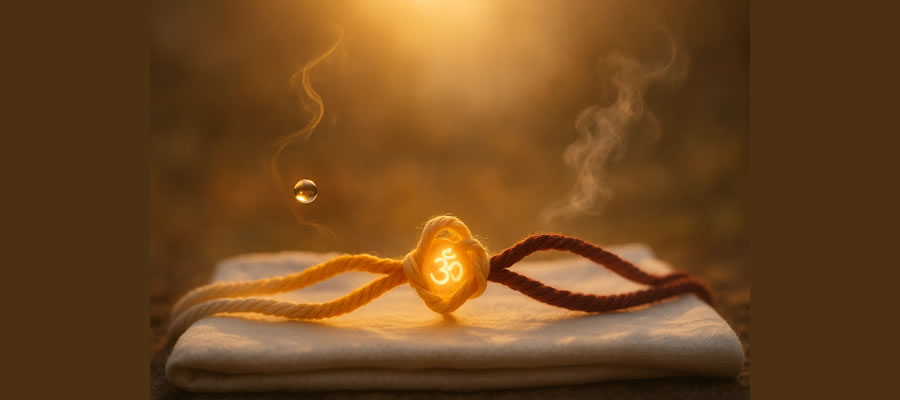
The three threads of the sacred thread represent these three gunas, serving as a constant reminder worn close to the heart. But there’s a deeper layer: the knot that binds these threads together represents Turya—the fourth state of consciousness that transcends all three gunas.
This knot embodies the sacred sound AUM, which in Hindu tradition represents the ultimate reality. Just as AUM contains three sounds (A-U-M) plus the silence that follows, human consciousness has three active states plus a fourth transcendent state.
The Spiritual Practice (Sadhana)
When someone receives the sacred thread, they’re not just participating in a ceremony—they’re accepting a lifelong spiritual practice. The thread becomes a daily reminder that the goal isn’t to eliminate the gunas (which is impossible while living) but to transcend them.
This transcendence happens through constant awareness. Every time the wearer touches or sees the thread, they remember: “I am more than my changing moods, desires, and states of mind. There is something unchanging within me.”
The Gayatri Mantra, traditionally given during this ceremony, serves as the vehicle for this journey. This ancient prayer doesn’t ask for material benefits—it asks for illumination of the intellect, the awakening of wisdom that can see beyond the temporary fluctuations of the mind.
The Journey to Inner Victory (Siddhi)
Through consistent practice and awareness, the spiritual seeker (sadhaka) gradually achieves victory over the turbulence created by the three gunas. This doesn’t mean becoming emotionless or inactive. Rather, it means maintaining an inner witness—a part of consciousness that remains stable whether experiencing joy or sorrow, success or failure, clarity or confusion.
This stable awareness leads to what the tradition calls bliss—not temporary happiness dependent on external circumstances, but a deep, unshakeable contentment that comes from knowing one’s true nature.
The True Meaning of Brahmin
In its original spiritual context, the term “Brahmin” doesn’t refer to birth or social status—it describes someone whose mind has become established in Brahman, the unchanging, all-encompassing consciousness that underlies all existence.
Such a person has realized that the same consciousness that animates their individual life also pervades the entire universe. They see unity beneath apparent diversity, permanence beneath constant change.
The Protection of Raksha Bandhan
The festival of Raksha Bandhan, where threads are tied for protection, connects to this deeper understanding. The ultimate protection isn’t from external dangers but from the suffering caused by identifying completely with our changing mental and emotional states.
When we’re bound to the ultimate reality (represented by the sacred thread and its knot), we find a protection that no external circumstance can breach—the protection of knowing our true, unchanging nature.
A Living Philosophy
The sacred thread tradition offers a practical philosophy for daily life. It suggests that while we must engage with the world (rajas), seek purity and clarity (sattva), and sometimes rest (tamas), we need not be completely identified with any of these states.
There’s a deeper “you” that observes all these changes—like the sky that remains unaffected whether clouds are calm, stormy, or absent altogether. The sacred thread, worn close to the heart, serves as a constant invitation to remember and return to this deeper identity.
In this understanding, every person wearing the sacred thread becomes a spiritual practitioner, engaged in the most fundamental human journey: the discovery of who we truly are beyond our temporary thoughts, emotions, and circumstances.
॥ OM सह नावावतु सह नौ भुनक्तु सह वीर्यं करवावहै ॥
May we be protected together, may we be nourished together, may we work together with great energy