This article is about how dance and movement became a medium to communicate and express in the evolution of humankind and the human mind.
Human beings have been expressing their complex and abstract feelings or emotions through non-verbal forms of communication. Dance being a special form of non-verbal communication, using the human body as a medium or instrument transforming movement into meaningful sequences.
Expressing with gestures
As mentioned by Krauss Nicole, in his book ‘The History of Love’, There is nothing that we say now that could not be said in the endless array of movements possible with the fine bones of the fingers and wrists (Nicole, 2006).
Through evolution, people communicated more, not less. Basic survival demanded that the hands were almost never still, and so it was only during sleep (and sometimes not even then) that people were not saying something or the other to each other.
Gestures like clapping, pointing, giving the thumbs-up, or nodding in agreement, enlarging the eye pupil in fright were basic human reactions to emotions that were experienced on a day today basis. Narrating with gestures and using the art of mime is how naturally man came to sustain. Every movement of the hand, extended limbs, eyes, face, etc. conveyed a meaning to the observer. Therefore, narration with gestures is as old as human creation itself.
Pictorial narration came into existence in the Paleolithic age (Jain, 1998) ,[1] in the form of painting, figurative arts. In the sense that even when people did not know about sounds emulated in the form of language, they felt the need to express themselves to each other in some way.
The Invent of Dance for expression
The Cognitive Revolution was enhanced when evolving humans communicated at a higher level with each other, gave cues of cohabitation, forging relationships and expressing themselves. The creative thoughts and ideas of Homo sapiens allowed them to bond and collaborate faster than other species (Harrari, 2015), and Dance and Drama became a medium to foster these enhanced creative thoughts during evolution.
Dance being the medium to communicate
Dance and Drama were two aspects that were both entertaining and at the same time educating to the masses from ancient times. The need for a narrative form of fine art was felt very early in the creation of communities.
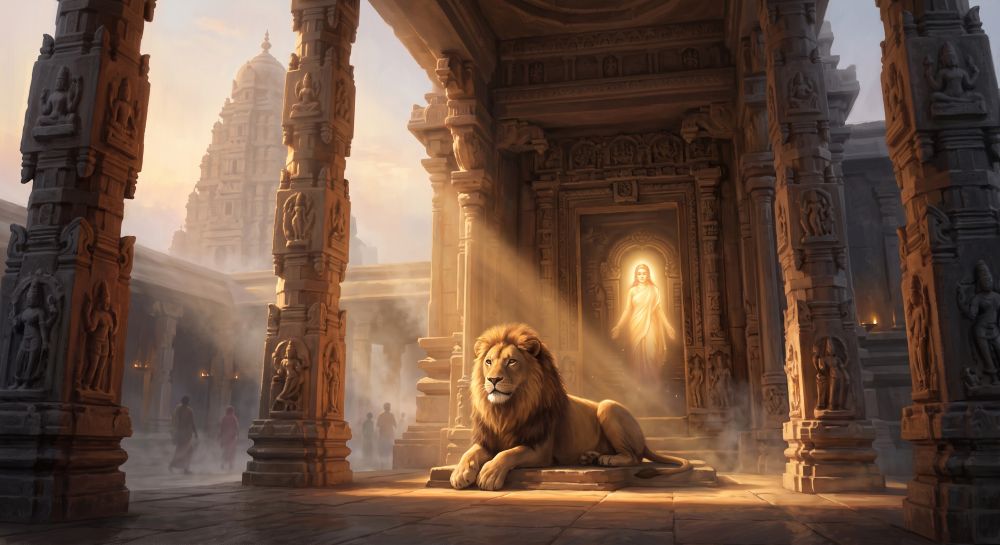
An interesting mythological story on the creation of a 5th Veda, goes thus—
“Gods and Goddesses pleaded with Lord Brahma for another Veda to be created that would be simple for the common man to understand, which was particularly important in Kali Yuga. Granting their wish, Lord Brahma created the Panchamaveda, the Natyaveda, an essence of the main four Vedas. Brahma took padya (words) from the Rigveda, abhinaya (communicative elements of body movements, mime) from the Yajurveda, geet (music and chant) from Samaveda, and rasa (aesthetic element) from Atharvaveda to form the fifth Veda, Natyaveda. After creating this Veda, Lord Brahma bestowed it to the sage Bharata, and asked him to propagate it on earth. Sage Bharata wrote the Natyashastra. It became the most authoritative text on the artistic technique of classical Indian dances. It is also possible that the term Bharatanatyam derives its name from sage Bharata.”
In an interview renowned Indian Dancer, Anita Ratnam shares “Classical art is narrative based, and very often the dancer, be it a man or a woman, becomes what the story needs him or her to be. So, you become a man, a woman, a tree, a creature or an animal. At the same time, there is that suspension of belief; the audience knows this is a woman, but in this story, she plays a man. You have to cross gender a lot… but, there would not have been issues of sexuality, the way we understand it today, impinging on classical dance practice… In that way, the stories we tell have passed through our modern lenses and are modern interpretations.” (Krishnan interviewing Ratnam, Dances of Desire)
From dance and music to abstract art, the concept of life is interpreted. We use art as a means of touching that part of us that we cannot reach with Physical Science, Social Science, or any of the other Humanities. Art plays a valued role in creating cultures and developing and documenting civilizations; it teaches us how to communicate through creative expression.
Any art is undefined, which makes it one of the best ways to communicate, to express without using complex language processing. This is to say that non-verbal and expressive communication is more authentic and, in a way, easy on the human body where complex feelings and many times unaddressed emotions can be expressed easily.

Reference list
- Krauss Nicole, The History of Love, (W. W. Norton & Company, May 17, 2006) p. 2
- Jyotindra Jain, Ed. Picture Showmen, Insights into the Narrative Tradition in Indian Art, (Mumbai: Marg Publications, 1998) p. 18
- Harari, Yuval Noah. Sapiens: A Brief History of Humankind. New York: Harper Perennial, 2015
- Anita Ratnam, Personal Interview by Shweta Krishnan “Dances of Desire- from Devadasis to Modern Storytellers.” (Retrieved from www.Tarshi.com)
SMITA RAJAN |
About the Author
Smita Rajan a certified Dance and Movement Therapist and Mental Health Practitioner is a Co-founder (Programs and Outreach) at Thunai Trust (www.thunai.org) – An organization working in Trauma-Resilience building and Maternal Mental Health. She also teaches Bharathanatyam and Movement classes at her institution, Parampara—Dance for wellbeing. |

SMITA RAJAN