






Old alchemists dreamed of turning cheap metals into gold, a symbol of deep change. Today, we face a similar, but more important, challenge: how do we turn the basic parts of tech changes and global uncertainty into the gold of human success by 2030? The World Economic Forum’s latest report on future skills shows us this path. It highlights how fast AI and data skills are growing, and how much we also need deeply human traits like “toughness, flexibility, and quickness to change.”
This isn’t just about different job titles; it’s a call for a magical change within each person. And importantly, the IACT Assessment is already the proven tool for this change. It’s not just a solution; it’s the full assessment that already measures all parts of a professional’s intelligence—how they interact with others (interpersonal), how well they adjust (adaptable), how they think and solve problems (cognitive), and their practical skills (technical). This makes it uniquely ready for future skill needs.
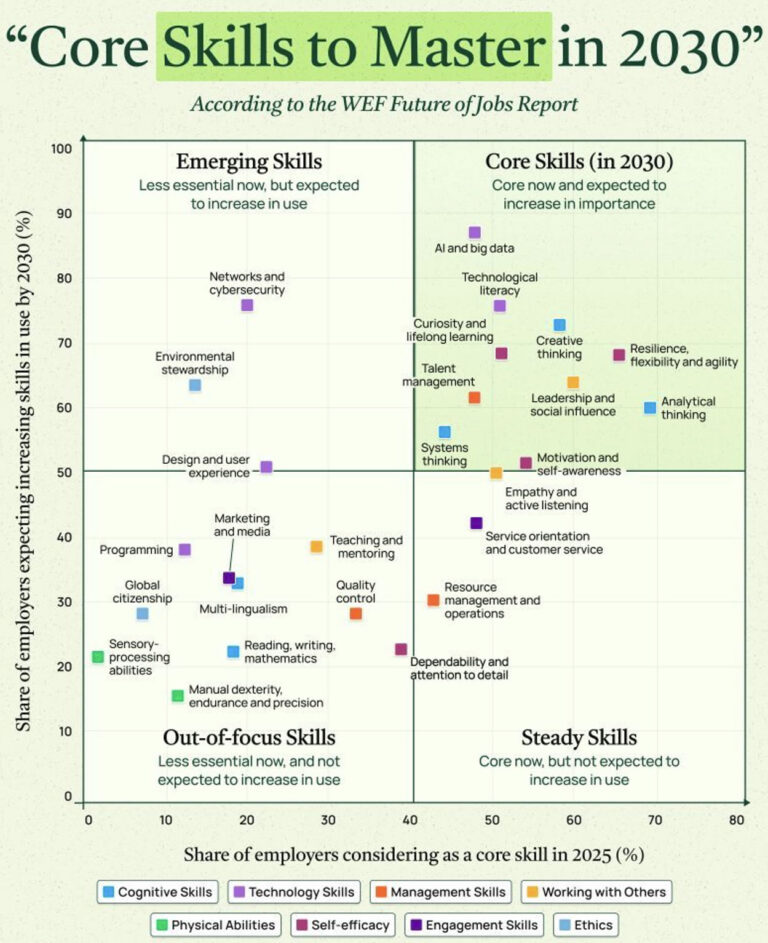
People often see AI as a threat, a big machine taking away jobs. While it’s true that machines are doing more routine tasks, the WEF report points out something key: the skills that really make humans stand out are those involving complex thinking, creativity, and social smarts. “Creative thinking” is a top skill because machines, by their nature, can’t truly create new ideas from gut feeling or imagination. This is where the magic begins—using AI not to replace us, but to make our unique human strengths even stronger. And this is exactly where the IACT Assessment shows its special foresight, because it already fully measures the very human aspects the WEF says are most important.
Let’s look at this through the “4Cs of Transformation”: Clarity, Creativity, Collaboration, and Conscience. The WEF’s focus on “analytical thinking” relates to Clarity—being able to break down tough problems. “Creative thinking” is obvious. “Leadership and social influence” show the huge need for Collaboration in our connected world. But it’s the often-unsaid, yet key part of Conscience that supports true flexibility. How do we make sure our smart thinking and creative solutions serve a bigger good, instead of just making existing problems worse or creating new ones? The IACT Assessment is strong because it fully understands these layers. By carefully checking interpersonal intelligence, it shows how well someone can work with others ethically and lead. By measuring adaptability, it sees the toughness needed to turn problems into chances. And by looking at cognitive and technical intelligence, it makes sure people have the thinking and practical skills to create new things with clear purpose. It measures not just what you can do, but why you do it, and how you engage with the world, making it the most future-ready tool we have.
The global impact of this magical shift is huge. Countries and companies that focus on growing their people completely, creating places where constant learning and ethical new ideas are celebrated, will be the ones that succeed. IACT gives the key insights and a plan for this. For individuals, this means having a “liquid learning” mindset, where knowledge flows, and skills are always being sharpened. It means leaving what’s comfortable and stepping into the fertile ground of always growing. The fear of becoming old-fashioned can turn into the excitement of inventing yourself again, exactly because a tool like IACT shows you your natural ability for constant change.
This time in history asks us to strongly commit to human potential, using the right information. It challenges us to see AI not as an enemy, but as a tool where our best human traits can be made even better and brought forward. Education must become a lifelong journey of self-discovery and skill learning, guided by good self-assessment. Businesses must become learning organizations, valuing curiosity and the bravery to try new things, pushed forward by a clear understanding of their people.
The promise of 2030 isn’t just about surviving the tech revolution, but about coming out of it more human, more connected, and more capable than ever. It’s about a magic that turns the lead of fear and uncertainty into the gold of a purpose-driven, flexible, and successful global workforce. The IACT Assessment isn’t just a helper for this magic; it is the very tool that measures, shows, and powers this deep human change, standing alone in its readiness to meet the future’s demands.