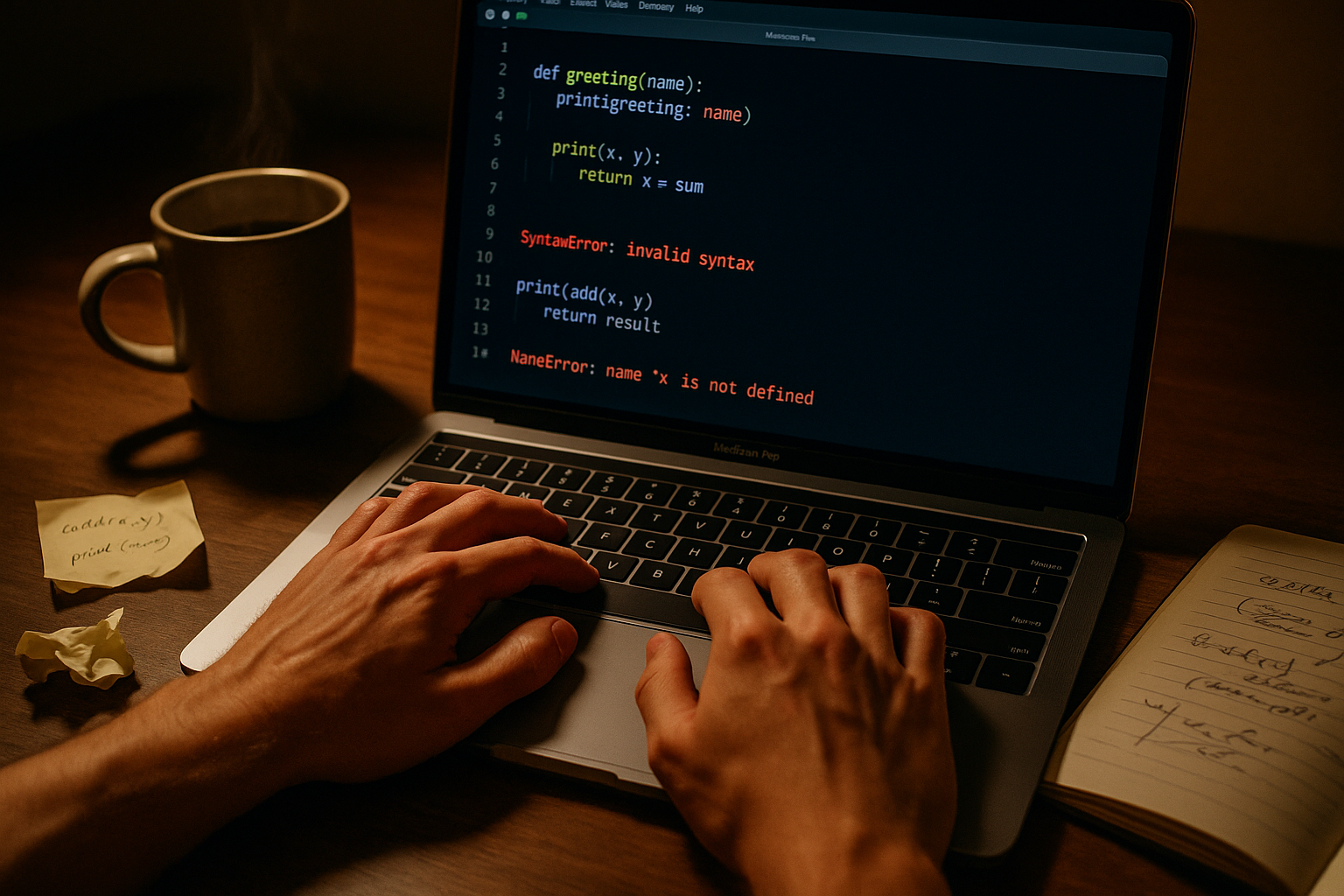
Beginning your first programming class often feels like entering a new world where everybody seems to understand the language fluently — but you do not. It is common to look around and think: “Why do others understand this but I don’t?”
You are not dumb. You are learning.
From my own experience, these are some of the approaches that helped me push through those early feelings of inadequacy in programming class — and they might help you too.
1. Understand that Feeling Confused Means You Are Learning
Difficulty in understanding the concepts is not an indication of inability but rather a natural part of the learning process. Programming requires you to rewire your thinking in problem-solving, which cannot be achieved instantly.
Learning programming is like learning to play an instrument: no one expects a beginner to perform expertly from the start. Yet, many believe they should code perfectly immediately, which is unrealistic.
2. Proceed Slowly and Deliberately
Moving fast does not equate to understanding better. Rushing often results in more mistakes, confusion, and exhaustion.
Take your time:
•
Carefully read the instructions multiple times
•
Divide problems into smaller parts
•
Write comments before coding (this helps keep your code organized and easier to follow)
Being clear about the problem always surpasses trying to code fast.
3. Do Not Hesitate to Ask Questions
Those who seem confident in class often ask many questions privately or seek help through other resources.
You are not expected to know everything; learning involves asking:
•
“Could you please explain that again?”
•
“Why is a loop necessary here?”
•
“What distinguishes a list from a tuple?”
If something is unclear to you, likely many others are confused too.
4. Repeat and Master the Basics
Things like loops, if statements, variables, and functions might seem simple, but they are fundamental.
Create simple programs to:
•
Count numbers
•
Sort lists
•
Display output
•
Perform arithmetic operations
Mastery of these basics facilitates understanding of more complex topics.
5. Focus on Problem-Solving Rather Than Just Coding
Programming is more about solving problems than merely writing code. Learn how to:
•
Break down problems logically
•
Plan your approach before coding
•
Debug step-by-step
Sometimes the most effective coders plan extensively before typing any code.
6. Utilize Available Tools
You do not need to do everything manually. Use tools such as:
•
Integrated Development Environments (IDEs) like VS Code or PyCharm
•
Visualization tools like Python Tutor
•
Interactive platforms such as Replit or Jupyter Notebooks
•
AI assistants (e.g., ChatGPT) for help and debugging
These tools assist professionals and learners alike.
7. Avoid Comparing Yourself to Others
Some classmates may have prior experience or support from family members. Others might be repeating the course.
Your progress is unique to you. Programming is not a competition; learning deeply is more important than speed.
8. Accept that Errors are Inevitable
Writing incorrect code is part of learning. Every skilled programmer encounters:
•
Syntax errors
•
Infinite loops
•
Typographical mistakes
The important part is to learn how to resolve issues calmly and systematically.
9. Celebrate Small Achievements
Successfully running your code for the first time — even if it’s just printing “Hello, World” — is still a win worth celebrating. Fixing a bug by yourself or figuring out how something works are important milestones in your learning journey.
Although programming may seem difficult at first, staying consistent and patient will eventually lead to mastery.
Conclusion
To summarize:
•
Feeling lost is normal
•
Everyone faces challenges when learning
•
Consistent and deliberate effort leads to progress
•
Use tools and ask questions freely
•
Do not compare yourself with others
You are not expected to be perfect at the start but to gradually develop the mindset of a proficient programmer.
Be patient and compassionate with yourself throughout this journey.
“The expert in anything was once a beginner.”
— Helen Hayes