


The idea of experiential learning is fundamental to the human learning process since time immemorial. Though conceptualized as an educational theory during the last century, it has existed in its operational form in most of the activities of the Homosapiens from the days when they were hunters.
It would indeed mean that experience, reflection, conceptualization, analysis, review, and formulation of knowledge have been a part of all human activities, of course, in a limited and unorganized form.
The processes were not encaged in the structure of words. From the time the humans started using fire as a purposeful tool, the wheel as an accessory for productive work, the machines as an instrument for mass production, and for enhanced and standardized quality, experiences have been both central and continual to growth and for the design of a better future. With increased social cohesion, experiences, both at the individual level and at the societal level have facilitated and empowered human learning creating both value and conflict. Experiential learning has been a powerful tool to question the existing customs, practices, dogmas, and hypotheses; and has forced reconsideration and re-engineering of the contemporary thought edifices. They founded a mindset for research and innovation.
In the absence of formal school systems in the early centuries, learning has been more through exploration, adventure, experience, and experimentation and through social interactions. The informal gateways to learning including the family structures, workstations, farming practices and animal care have yielded experiences which have over a period gained documentary values. They enhanced human curiosity to unravel the mysteries of the unfathomed oceans of knowledge. In the Indian context, many of the knowledge systems like astronomy, ayurveda, yoga, Siddha and other health care systems, art forms-both performing arts and fine arts, evolved through experimentation, observation, and conformation. Their enrichment largely happened through accrued experiences and social response systems.
The pursuit and the dominance of informal learning systems though have had limited influence in the human knowledge pursuits, after the formal knowledge delivery systems started making their impacts, they have not been put to rest. They continue to empower the formal knowledge systems and have become integral to all learning styles and pursuits. The experiential learning from the informal learning systems have been continuously enriching the formal learning contents and pedagogies.
Experiential learning, according to developmental biologists, starts from the pre-natal experiences and those that are derived from the experiences in the womb. The role of experiential learning at the formative stage in a systematic manner has been a subject of study by neuro-cognitive psychologists.
Says David Chamberlain, an expert in foetal learning in his book “Foetal learning -ground zero for parenting and society”
The true foundations of civilization and chaos, health and illness of both individuals and societies are laid during the days we spend in the wombs of our mothers. What happens there eventually determines what happens in the world. Womb ecology becomes world ecology.
During the 266 days of human gestation, we receive our operating equipment for life: we become embodied, take form. This includes the physical structures of body and brain, our emotional settings, and our mental patterns, habits, and momentum. These become the “default settings” or “templates” for living. They are difficult—in some ways impossible—to change after birth. We do not have the luxury of going back to do this construction over again.” He adds “Babies are like us in having clearly manifested feelings in their reactions to assaults, injuries, irritations, or medically inflicted pain. They smile, cry, and kick in protest, manifest fear, anger, grief, pleasure, or displeasure in ways which seem entirely appropriate in relation to their circumstances. Babies are cognitive beings, thinking their own thoughts, dreaming their own dreams, learning from their own experiences, and remembering their own experiences.”
Though advanced research in neuro-cognition have brought several new dimensions to this view, it is still important to understand that experiences impact learning right from the birth. The role of sensory inputs both at their individual level as well as at multi-sensory level have been a subject of intense study both by the psychologists as well as cognitive neurologists.
The credit of formulating an educational philosophy on ‘Experiential learning’ goes to David A Kolbe “There are two goals in the experiential learning process. One is to learn the specifics of a particular subject, and the other is to learn about one’s own learning process.”
Detailing a strategy for purposeful experiential learning, Kolbe puts in place a cycle of pursuits consisting of – “Experiencing, Reflecting, Thinking and Acting.” However, the inputs to experiences are manifold. And they impact and define the styles of learning. It leaves learners with their preferred choices and the gateways to learn, and sometimes a synthesis of diverse experiences leading to construction of new knowledge. Inherently, experiential learning is a constructive learning process unique to every individual and to every experience that leads to constructivist learning. “Reflecting” on the experience is more critical to the manifestation of an experience.
We do not learn from experience. We learn from reflecting on experience: says John Dewey.
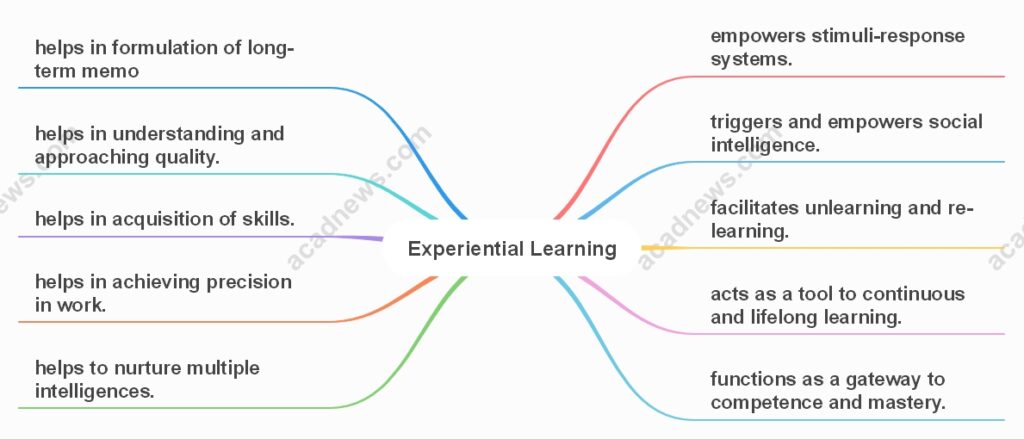
As such, any pedagogical process that distances itself from providing the relevant concrete experiences appropriate to the concepts under dialogue and discussion, does not result in effective learning. Oftentimes, it restrains itself only to information assimilation. It facilitates only a volatile memory and does not lead to establishing a long-term memory. It does not even support empowered construction of knowledge, leave alone its inability to help in skill formation or acquisition of competency.
Emotions have a direct impact on experiences and possibly, the converse is also true. The role of Endorphin, Dopamine, Serotinin and Oxytocin, in impacting learning in distinct stages and their role in memory formulation, responses to stimuli and retention leading to application have been adequately researched by the neurocognitive researchers across the world. Their findings are yet to impact the pedagogical designs and delivery systems adequately.
It needs to be understood that experiences are not constrained to any experimental practices in a laboratory atmosphere, but they extend their domain to emotional, psychological, cultural, and social experiences. Teachers and schools, therefore, need to have a broader understanding and perspective of the idea of ‘experiential learning’ so that the inputs are provided that would help in assimilating and constructing experiences relating to various domains in the learning universe. As such multi-sensory experiences engage with the brain’s capacity for ‘synaesthesia’ to nurture creativity and innovation.
With innumerable number of inputs available to provide experiences to trigger and facilitate learning, both through specific senses and through multi-sensory interventions, learning can be more holistic and empowering. It would provide gateways to deep learning, consolidation of skills.
Says Albert Einstein “”I never teach my pupils; I only provide the conditions in which they can learn.”
The inputs to facilitate experiential learning are innumerable and diverse. Teachers need to seek such resources from the happening world and contextualize them to the concepts that are under discussion. Strategies of pedagogy that would help in empowering experience at all levels -cognitive, affective, psychomotor – must be designed appropriately before the teachers engage with the delivery of their learning content. The processes that are exclusively monologues in a classroom curb experiential learning and are as such detrimental to the curiosity of the learner. The role of a teacher as a co-learner in seeking experiences is one possible method which brings participative learning and encourages the learner to be an active participant. Case studies, reviews, project-based approaches apart from informal learning situations help in expanding the universe of extended learning.
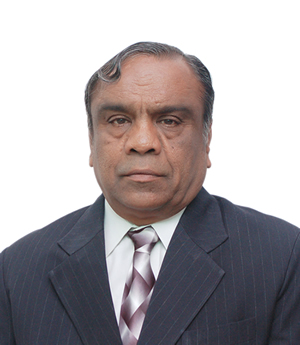
![]() Dr G Balasubramnian | G. Balasubramanian was born at Tirunelveli, Tamilnadu on 17th February, 1946. He had his initial schooling at Madurai and graduated in Chemistry from Presidency college, Chennai. He obtained a Post-graduation in Analytical & Inorganic Chemistry from Madras University, Post-graduation in Hindi from Sri Venkateswara University and Post-graduation in Education from Annamalai University. |
He obtained a Diploma in German from University of Madras, a Certificate in Project Technology from Trent College of Education, Nottingham U.K and a Certificate in Computer Education from Leeds University, U.K
Starting his career as a Post-graduate Teacher in Chemistry in a public school, he took over as a Principal of Hindu Senior secondary School, Triplicane, Chennai. He joined the Central Board of Secondary Education as a Joint Secretary in 1984 and has worked in several capacities in Academics, Examination, Confidential and Administration branches of CBSE.
Elevated to the Post of Director (Academic) in 1997, he held the additional charge of the Chief Vigilance Officer of the Board. He retired from the services of the Board on 28th Feb, 2006.
He was associated with several Boards of education and leading organizations like Quality Council of India, NABET, National Institute of Open Schooling, Global Indian international Schools in Singapore, Malaysia and Japan. He is the current chairperson of the international council for school leadership. He was the Chief Editor of the magazines – ‘The Progressive School’ and ‘The Progressive Teacher’ published by S. Chand group of companies. He is currently Advisor to the following companies – “Knowledge Tribe” and “Teacher Tribe” at Bengaluru.
His interests include philosophy, psychology, poetry and Literature. He has widely traveled to many countries and participated in several national and international conferences and presented papers on a wide variety of academic interests. Post retirement he has conducted over 7000 training programs for teachers and Principals covering over 85000 teachers.
His publications are:
- Mindscaping Education
- Case Studies in classrooms
- Quality Spectrum – A school’s Bandwidth
- Safety in schools – Issues and concerns
- Academic Leadership – ebook
- Schooling the kid – learning form K to 12
- Creativity in classrooms – eBook
- Unlearning Learning – eBook
- A Happy Journey (Poetry)
- Apologies to an Existence (Poetry)
His latest book “Walk with Viswa”- a journey to Leadership along the Farmlands is due for publication.
Awards won:
- Vocational Excellence Award from Rotary Club, Chennai
- Seva Rathna in Education from The Centenarian Trust, Chennai
- Lifetime Achievement Award from VIMHANS (Vidyasagar Institute of Mental Health and Neuro Sciences) Delhi
He has been a member of the High-Power committee constituted by the Government of Tamilnadu for School Education and has also been the chairperson of the Curriculum Reforms Committee and the Examination Reforms Committee for School Education in the Government of Tamilnadu.
If you would like to get connected to Dr G Balasubramanian write to editor@acadnews.com.