

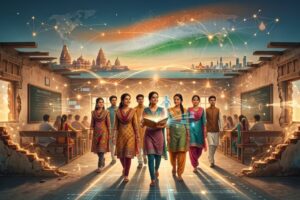

This article is about how Dance, movement and therapy draws therapeutic aspects from Indian Dancing traditions.
The Abhinaya Darpana tells us:
Whither the hand goes, the glance follows,
Whither the glances lead, the mind follows,
Whither the mind goes, there the mood follows,
Whither the mood goes, there is real flavour born
(Sarabhai, 1981).
Flavour here is to be understood as the essence or beauty of life and not as the prerogative of the dancer alone.
The therapeutic potential of Indian movement forms dates way back to our ancient history and beginnings of framing civilised societies. This dance is a form of communication that brings out the innermost feelings and at the same time depicts the cultural aspects of a civilization (Sudhakar, 1994).
As a discipline, dance and movement therapy is a congregation of thoughts and philosophies from many specialised fields like physiology, modern dance, psychotherapy and other body-oriented therapies.
Like a melting pot that is infused with movement ideologies from varied cultural flavours, to practice dance and movement therapy in the Indian scenario it is imperative to be aware of the physical traditions and movement practices available in our own cultural context (Kashyap, 2005).
Looking at Indian dances with a therapeutic eye to use it in the facilitating process has only recently gained momentum as a matter of study. The therapeutic approaches with various forms of dances are a new entrant to dance literature (Chatterjee, 2013).
This research paper aims at drawing out such therapeutic elements from different movement traditions of India—the classical dance forms, and the folk dance or social dance forms. As facilitators of dance movement therapy, the idea is to use specific elements of the forms, rather than the entire form. For example, from the Natyashastra, the classical dance, music and drama scripture we could pick up the use of dramatic or expressive acting from concepts. Or, the use of hands, external limbs and body positions to express an aspect of our thinking or behaviour.
 SMITA RAJAN
 |
About the Author Smita Rajan a certified Dance and Movement Therapist and Mental Health Practitioner is a Co-founder (Programs and Outreach) at Thunai Trust (www.thunai.org) – An organization working in Trauma-Resilience building and Maternal Mental Health. She also teaches Bharathanatyam and Movement classes at her institution, Parampara—Dance for wellbeing. |
This is a contributed article. If you would like to get connected to Ms Smita Rajan write to editor@acadnews.com.
Therapeutic elements from Classical dance forms
The nine classical dances of India are all rooted in varying degrees to the Natyashastra, and therefore they all share common principles of body positioning, conditioning, dramatic expressions and so on. The classical dances in itself present mystical experiences to the dancer where he or she goes beyond technique and spoken language in the outer form of communication. There is a complete identification, attunement and creative interpretation with the portrayal, that shows the hidden depths of the dancer’s consciousness, this is the rasa or the essence of movement in classical dances. An intertwined concept with Movement being therapeutic.
A variety of hand gestures (hastas) can be used and introduced in the sessions. Movements that work on the fine motor neurons can be done as part of warm-ups, as part of movement articulation for chair-bound patients (Clippenger, 1997).
The opening and closing of palms in front of the chest to a Namaste elongates the torso. When combined with breath and allowing the body to move it engages the body into a state of awareness and /or heightened consciousness.
To add on more examples of using Bharathanatyam poses, using the single and double hand gestures to create isolated movements of the hands alone, known as isolating movement in DMT, is another aspect that can be used. This movement experience can also be improvised to a sequence creating a memory dance for young learners.
In persons with vision and hearing impairment, using isolated hands and legs movement creates a sort of sign language. This can be easily improvised for therapeutic experiences for them.
In Bharatnatyam dance form the dancers make considerable use of hand-and-eye movements to express different emotions (Kilger, 1993). The use of the eyes-face-hands-legs-body, the ability to move them all at the same time to complex rhythmic patterns, gives the sense of multi-tasking with your body. This is deep body-mind coordination that can be a therapeutic experience for the mover.
With time and history, Kathak has developed into a highly refined system of rhythm and movement, capable of communicating complex human dynamics as well as abstract form and composition (Dutt, 2008a). Used appropriately in Dance therapy, it affects the body in its entirety. The fast footwork, the strong striking of the feet can help in safely expressing and regulating pent-up emotions such as anger, tension and frustration.
Chhau is a dance technique from Orissa that is completely based on body balance and mind coordination with focus. Here the dancer balances his or her body on one leg while moving the entire upper body in slow motion. The movement pattern brings forth a sort of meditative calmness to movement. This aspect could be used with children with hyperactivity, where it could help centre their body and mind. Moving through space in slow movements also creates focus and awareness of the body in motion.
Therapeutic elements from Folk dance forms
Most Folk dances are social dances in India. People gather together and create rhythms generated from the body parts, like the sound of clapping, stomping, fingers snapping, etc. Folk dances are a communal practice during which people get together, share their traditions, and express joy in their festive ceremonies (Kashyap, 2005).
We are fortunate to have huge cultural diversity in India. Each type of folk movement form contributes immensely to our heritage and our healing resources. The pattern of rhythms that are generated and used in folk traditions are catchy and involve the whole-body movement, making it engaging and high on effort.
For example, Bihu is the folk dance of Assam and it is an aggressive dance performed by both boys and girls. The powerful dance form of Punjab Bhangra also needs good health and proper body movements. Gair and Geendad are folk dance forms of Rajasthan with almost military precision. Karagam is a folk dance of Tamilnadu and it needs proper body balance (Ponmelil, n.d.). Bengali folk dance like Chou, Rayabese, Dhali also needs proper body movement and strength. Any unfit posture in these or other dances can cause hazards to the dancers. The practice of these powerful dance forms of Bhangra (Punjab), Karagam (Tamilnadu), Chou, Rayabese, Dhali (Bengal) gives good physical health, strength, power and mental support.
The folk movement patterns are done by people who are not professionals, in the sense they are not classically inclined. This makes folk movement patterns easy and approachable for any target group audience.
For an example, in a group synchrony, the clapping sound and the heavy footwork can be combined with vocal sounds to improvise and create rhythmic sequences. Or, like in Dollu-Kunita, a folk dance from Karnataka, movers use the drums tied to their bodies to beat while moving to rhythm created by their bodies (Chatterjee, 2013b).
In a therapeutic setting this experience can be used for non-movers or people showing resistance to move. It is not too far to say folk music and dance was a safe and preventive community health practice – both physical and mental.
Aspects from the indigenous Modern dances
In India, like the revolution of Modern dancing in the West, there were many influencers who thought of deviating from the hardcore classical dance forms and making movement expressive, rather than performative. In India such a type of dance was first initiated by the great Rabindranath Tagore. He did not consider the bound regulation of classical dances, and by different dance styles he established his own style, which is popularly known as Rabindra Nritya (Ganapathy, n.d.).
Another pioneer was Udayshankar, who modified modern dance and traditional music to create a glorified free movement of the body (Courtney, n.d.). Though unknowingly he used all aspect of dance therapy of modern days in his dance forms created long ago. His all production had the history of psychological effect on the spectators, which in now-a-days psychologists consider a form of psycho-therapy or dance therapy (Dutt, 2008b).
The innovative dances used many aspects of Indian dance forms and put them forth with a healing ideology (Shastri, 1931). For dance and movement therapy in India, the idea of using free movement, working the body for healing, innovative dance gave solid foundation.
Today, dancers and movers in India are conscious about the therapeutic benefits of our indigenous artforms and improvise on them.
Conclusion
At the core, Dance and movement therapy and all of dancing thrive on the premise that—the mind moves the body and the body moves the mind. There is a symbiotic relationship between the body-mind-soul through movement, controlled breathing, muscle coordination, exploring various levels are a few to name. Indian dancing methods embody this expression and exploration.
In a one-on-one session, the facilitator could use movements akin to one’s cultural identity, for example a simple clapping can be used to make a connection with your client during a session.
By understanding these aspects, as facilitators, it becomes easier and therefore imperative to lead the participants through uncharted territories of mind and body awareness, emotional expression and regulation, creative exploration and working with a team/other dancers. These are all therapeutic in good measure. More importantly, there is potentially something to the liking of everyone.
Needless to say, Indian movement traditions lay utmost importance to dance and various forms of movements. This can act as the base, broadening the scope for further research in this area.
‘Vina Tu Nritya Shathrain Chitrasootrum SuduVridum’ meaning —without the knowledge of the science of dance, we cannot comprehend other forms of expressions —Vishnudharmottara Purana.
References
- Chatterjee, Arpita. “An analytical discussion on the folk and tribal dance forms of Bengal in relation to their effect on health.” Indian Journal of Arts, Vol. 1. No. 3, (2013a), pp.29-32.
- Chatterjee, Arpita. “Improved health status through prolonged practice of dance as a therapy – a case study.” International Journal of Basic and Applied Medical Sciences, Vol. 3, No. 1, (2013b), pp. 180-183.
- Clippenger, K. “Fitness, dance, and health.” Journal of Dance Medicine & Science, Vol. 1, No. 1, (1997), pp. 27-29.
- Courtney, D. (n.d.). Overview of Indian dance. Retrieved from http//Chandrakantha.com/articles/india_music/nritya.html
- Dutt, Amita. “Some Indian Dance Forms: Kathaka, Bharata Natyam, Kucipudi.” History of Science, Philosophy and Culture in Indian Civilization, vol.VI (Part I): Aesthetic Theories and Forms in Indian Tradition. Eds. Kapila Vatsyayan and D.P. Chattopadhyaya. New Delhi: PHISPC, Centre for Studies in Civilizations, 2008a, pp. 427-489.
- Dutt, Amita. “Some Indian Dance Forms: Kathaka, Bharata Natyam, Kucipudi.” History of Science, Philosophy and Culture in Indian Civilization, vol.VI (Part I): Aesthetic Theories and Forms in Indian Tradition. Eds. Kapila Vatsyayan and D.P. Chattopadhyaya. New Delhi: PHISPC, Centre for Studies in Civilizations, 2008, p. 201.
- Ganapathy, L. (n.d.). Spiritual dance: Traditional Indian dance. Global Oneness. Retrieved from http://www.experiencefestival.com/a/Spiritual_Dance/id/3254
- Kashyap, T. (2005). My body my wisdom: A handbook of creative dance therapy. New Delhi, India: Penguin Group.
- Kilger, G. Bharata Natyam in Cultural Perspective. New Delhi: Manohar American Institute of Indian Studies, India, 1993.
- Mrinalini Sarabhai, Understanding Bharatanatyam, The Darpana Academy of Performing Arts, Ahmedabad, Gujarat, India, fourth edition,1981 chapter1, pg3.
- Ponmelil, V. (n.d.). Introduction to folk dance forms of India. Retrieved from http://www.newkerala.com/india/Dance-Forms-of-India/Introduction-to-FolkDance-of-India.html
- Shastri, H. A Descriptive Catalogue of the Sanskrit Manuscripts in the Collections of the Asiatic Society of Bengal. Calcutta: Asiatic Society of Bengal, India, 1931.
- Sudhakar, Kanaka. Indian classical dancing: The therapeutic advantages. New Delhi: Sterling Publishers, 1994.