







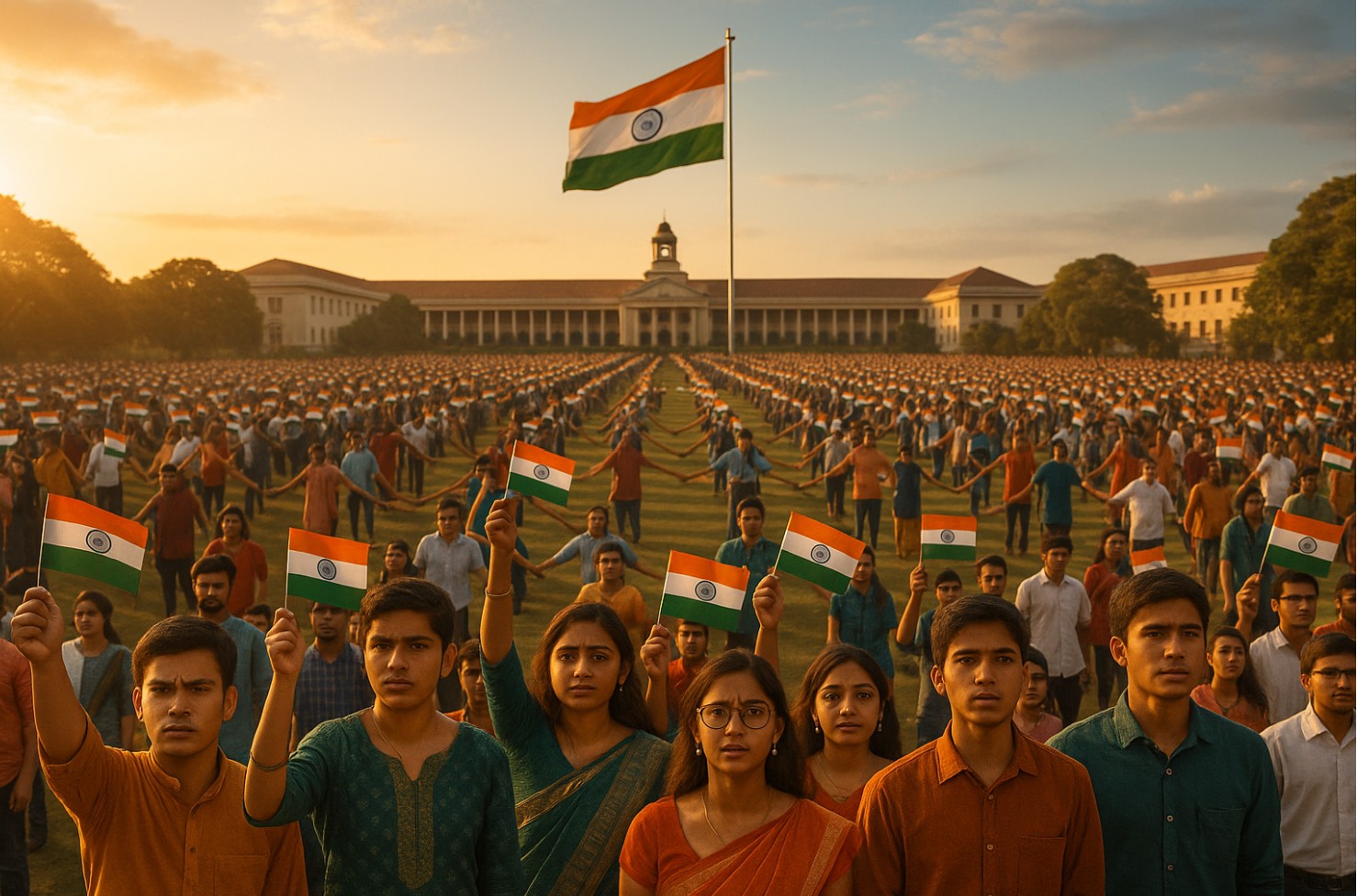
Building a Nation Through Collective Action
The Science Behind UGC’s Vision for Youth-Led Transformation
Dr. Vineet Joshi’s recent meeting with heads of Higher Educational Institutions marks a pivotal moment in harnessing India’s greatest asset—its youth—for nation-building through the Har Ghar Tiranga and Nasha Mukt Bharat Abhiyan campaigns.
Why This Matters
🎓 Educational Institutions as Change Catalysts
Our HEIs aren’t just centers of learning; they’re incubators of national consciousness. With over 4 crore students across Indian universities and colleges, these campaigns can create an unprecedented ripple effect across households and communities.
🇮🇳 Tiranga as a Unifying Symbol: The Neuroscience of Collective Identity
The Har Ghar Tiranga initiative transcends regional, linguistic, and socio-economic boundaries. Neuroscience research shows that collective rituals and symbolic displays trigger oxytocin release—the “bonding hormone”—strengthening social cohesion and trust.
Studies in social psychology demonstrate that visible public commitments leverage the “consistency principle”—once people publicly align with a value, they’re neurologically and socially motivated to maintain that alignment. This transforms abstract patriotism into concrete behavioral commitment.
💪 Addressing Our Silent Epidemic: Neuroplasticity and Prevention Science
As Nasha Mukt Bharat completes 5 impactful years, involving youth in storytelling sessions and testimonial sharing creates peer-to-peer influence—the most powerful form of prevention.
The Critical Window:
Ages 18-25 represent peak neuroplasticity when the prefrontal cortex is still developing. Early intervention during this window has exponential protective effects against addiction susceptibility.
Social Proof & Behavioral Economics:
Research by Robert Cialdini demonstrates that peer behavior is the strongest predictor of individual choices. When young people see their peers rejecting substance abuse, it creates powerful “descriptive norms” that shape behavior more effectively than fear-based messaging.
The Testimonial Effect:
Narrative transportation theory shows that real-life stories activate multiple brain regions, creating deeper engagement than statistical warnings. Survivors’ stories build empathy while demonstrating that recovery is possible.
The Transformation Potential
This dual-campaign approach brilliantly addresses both our aspirational and existential challenges through evidence-based behavioral science:
Network Effects & Critical Mass Theory
When millions of students take the nationwide mass pledge on 13 August 2025, they create what sociologists call a “critical mass”—once 10-15% of a population adopts a behavior, it can cascade through social networks to achieve majority adoption.
Cognitive Dissonance & Identity Formation
Publicly pledging to be drug-free while hoisting the Tricolour creates cognitive alignment between national identity and personal behavior, making participants more likely to maintain drug-free lifestyles.
Collective Efficacy
Albert Bandura’s research shows that when communities witness collective action, they develop stronger beliefs in their shared capacity to effect change—predicting sustained civic engagement and prosocial behavior.
The Real Innovation
The genius lies in making students active participants rather than passive recipients—a principle grounded in the “protégé effect” and active learning research. When students become Tiranga Volunteers and addiction awareness advocates, they internalize messages more deeply than they would as audience members.
Dopamine and Purpose:
Participating in meaningful collective action triggers dopamine release associated with purpose and accomplishment. This neurochemical reward creates positive associations with civic engagement, potentially establishing lifelong patterns of community participation.
The Longitudinal Impact
Developmental psychology research shows that identity-forming experiences during higher education have lasting effects spanning decades. Students who participate in these campaigns during formative college years are more likely to:
✓ Maintain civic engagement throughout life
✓ Transmit values to their children
✓ Resist substance abuse through life transitions
✓ Demonstrate higher organizational citizenship
Independent India’s greatest achievements have always emerged when we united for a common constructive cause. These campaigns represent that same spirit, now amplified by behavioral science: youth-led, digitally amplified, peer-influenced, and neurologically optimized for maximum impact.
What’s your institution doing to support these initiatives?
Let’s share evidence-based practices and amplify the impact.
Scientific Rationale for Transformative Impact
This represents a scientifically-grounded transforming step because it:
1. Leverages developmental neuroscience by intervening during peak neuroplasticity (ages 18-25)
2. Applies social contagion theory to create positive behavioral cascades through 40 million+ interconnected student networks
3. Utilizes commitment and consistency principles—public pledges increase follow-through by 65-70%
4. Employs narrative medicine approaches where storytelling activates brain regions unreachable by statistical data
5. Creates identity-based motivation by linking national pride with personal responsibility during critical identity-formation years
6. Harnesses the “helper’s high” phenomenon—volunteering releases endorphins and reduces stress hormones
7. Builds collective efficacy through visible action—seeing peers participate increases individual self-efficacy
8. Generates “social proof” at scale—substance-free behavior becoming the visible norm reduces experimentation rates by up to 40%
The true transformation occurs when these scientifically-designed campaigns become embedded in institutional culture—creating neurologically-wired, socially-reinforced patterns of patriotic engagement and personal responsibility that graduating cohorts carry forward into every sector of society. This is evidence-based nation-building that works with, not against, human psychology and social dynamics.