






Waste to Wealth Begins in the Mind

▼ ACADNEWS · SUSTAINABILITY AND LEADERSHIP

Waste to Wealth Begins in the Mind

The United Nations has the numbers. Classrooms have the cure. Between them sits one idea: a circular economy works only when people change what they want, what they waste and how they lead.

By AcadNews Editorial · AN
THE LINEAR HABIT
EXTRACT MAKE USE DUMP
THE CIRCULAR WAY
Waste = Wealth REDUCE REUSE REPAIR RECYCLE REGEN
▼ THE FRAMEWORK BEHIND THIS ARTICLE

Design for Sustainability: the circular economy, aligned to all 17 SDGs

The circular economy is not a recycling target. It is a design choice, and design starts in the mind. In 2022, Prof. M.M. Ananth, working with fellow academics, conceived Design for Sustainability to treat it that way: to address the circular economy through education and leadership and to align it with each of the UN’s 17 Sustainable Development Goals, not only the ones that mention waste.

Everything that follows in this article is read through that lens. The UN data shows the cost of the linear habit. The classroom practice shows what a changed mindset looks like. Need over greed is the principle that connects them.

ALL 17 GOALS, ONE CIRCULAR DESIGN (GOAL 12 HIGHLIGHTED)
1
2
3
4
5
6
7
8
9
10
11
12
13
14
15
16
17
A SHORT TIMELINE OF THE IDEA
1976
THE LOOP IDEA
Dr. Walter Stahel and a co-author set out the case for an economy that keeps goods in use, in a report for the European Commission.
2015
THE UN OUTLOOK
The UN Environment Programme calls for a shift from take-make-use-waste to reduce-reuse-recycle.
2018 to 2021
THE UN NUMBERS
World Bank, UN plastics and UN food-waste data show how much value is lost, and who wastes it.
2022
DESIGN FOR SUSTAINABILITY
Prof. M.M. Ananth, with fellow academics, conceived Design for Sustainability, a framework to address the circular economy and align it to all 17 SDGs, starting with how people think. This is AcadNet’s account of the work.
2026
THE CLASSROOM, AT SCALE
A global online training for teachers brings school-level circular practice to educators.
▼ 01 · THE STRAIGHT LINE IS RUNNING OUT

We still run the economy in a straight line

Take it. Make it. Use it. Throw it. For a century that loop of convenience felt free. It was never free. It was billed to the soil, the sea and the next generation.

The World Bank counted 2.01 billion tonnes of municipal solid waste in 2016. It expects 3.40 billion tonnes by 2050, a rise of 70% if nothing changes. At least one third is dumped or burned in the open. The United Nations Environment Programme (UNEP) adds a sharper line: three billion people still lack controlled waste disposal, and doing nothing costs five to ten times more than doing it properly.

2.01 → 3.40
BILLION TONNES, 2016 TO 2050
Annual municipal solid waste, if current habits hold. World Bank, 2018.
931 million
TONNES OF FOOD WASTED, 2019
About 17% of food available to consumers, or 121 kg per person. UNEP, 2021.
US$57 bn
IN E-WASTE MATERIALS, 2019
Gold, silver, copper and more, mostly dumped or burned. Global E-waste Monitor, 2020.
9%
OF ALL PLASTIC EVER MADE RECYCLED
79% sits in landfills, dumps or nature. UNEP, 2018.
▼ 02 · THE UN NUMBERS, SIDE BY SIDE

Where the wealth leaks out

Put the UN-system figures next to each other and a pattern appears. The streams with the most value are the ones we recover least. Waste is not poor in worth. It is poor in attention.

SHARE RECOVERED THROUGH RECYCLING OR COMPOSTING (%)
Plastic, all ever made E-waste, 2019 All municipal waste, 2016 High-income countries 9%17.4%about 19%36% Orange = lowest recovery. Teal = broader waste streams. Full bar = 100%.
Plastic: cumulative to 2015 (UNEP, 2018). E-waste: documented collection and recycling (Global E-waste Monitor, 2020). Municipal waste: 13.5% recycled plus 5.5% composted; high-income countries recover 36% (World Bank, 2018).
WHO WASTES THE FOOD? (2019)
931 MILLION T Homes 61% Food service 26% Retail 13%
The biggest leak is not industry. It is the household plate. UNEP also found per-person household waste is broadly similar across rich and poor countries, so this is a habit problem, not only a wealth problem.
COST OF ACTING VS DOING NOTHING
Investing in proper waste management
1x
Doing nothing (UNEP and ISWA estimate)
5x to 10x
Source: Global Waste Management Outlook, 2015. The same report says holistic waste management could cut annual greenhouse gas (GHG) emissions by up to 20%.
FOOD
8% to 10% of global GHG emissions are tied to food that is never eaten. In the same year, 690 million people went hungry. If food loss were a country, it would rank third for emissions, behind China and the United States.
E-WASTE
53.6 million tonnes in 2019, up 21% in five years, heading to 74 million tonnes by 2030. Only 17.4% was documented as recycled. Improper handling of old fridges and air conditioners alone released 98 million tonnes of CO₂ equivalent.
PLASTIC
About 300 million tonnes of plastic waste every year. Of the 9 billion tonnes ever made, 9% was recycled, 12% burned and 79% left to landfills, dumps or the environment.
MONEY
One Southeast Asian study put the cost of each badly managed tonne at about US$375. In low-income countries, waste can eat roughly 20% of a municipal budget.
▼ AND YET, IT CAN BE REVERSED
0 → 70%+
FLANDERS, 1980S TO 2013
Waste diversion rose from nearly nothing to over 70% through reuse centres, education and a pay-as-you-throw rule.
1,200 t a day
BOGOTA
Diverted from landfill, with about 8,250 people employed in the scheme.
443 jobs
BOLIVIA
Bringing informal recyclers into the system treated 29,000 tonnes and created 443 green jobs.
10x the jobs
RECYCLING VS LANDFILL
UNEP’s 2011 Green Economy work found sorting and processing recyclables sustains ten times more jobs per tonne than landfilling or burning. The global waste market was valued at about US$410 billion a year.

Read the two halves together. The leak is large, and so is the prize. What separates the places that turned waste into work from the places that did not is rarely technology. It is a shift in how people think about a thing once it is no longer wanted.

▼ 03 · REDUCE, REUSE, RECYCLE AND BEYOND

The three Rs grow into five

The UN’s own waste outlook calls for a major shift from the linear take-make-use-waste habit to a circular reduce-reuse-recycle approach. Good teachers have already extended it. Reduce. Reuse. Repair. Recycle. Regenerate. The aim is that nothing is wasted and everything keeps some value.

The logic is plain. Every product we make uses natural resources, and those reserves do not grow back on our schedule. Waste that returns as a secondary raw material takes pressure off the earth. It also does three things at once: it stops dumping, it creates a product, and it creates employment. A closed loop is an environmental idea and a business idea in the same breath.

WHERE THE IDEA BEGAN
The circular idea is older than the slogan. Dr. Walter Stahel set it out in the 1970s.
In 1976, Dr. Stahel and a co-author presented a report to the European Commission arguing for longer product lives, repair, reuse and remanufacture, and for an economy that works in loops instead of lines. It showed that keeping goods in use creates skilled local jobs while saving energy and materials. The report was later published as a book, Jobs for Tomorrow, and his work on the closed-loop economy is widely seen as a foundation of what the world now calls the circular economy. Half a century on, the UN figures above show how far we still are from that loop.
1
REDUCE
Own and buy less. Ask what you truly need before you buy.
2
REUSE
Pass on uniforms, books and half-used notebooks.
3
REPAIR
Fix before you replace. It rebuilds respect for things.
4
RECYCLE
Return clean material to the production loop.
5
REGENERATE
Compost, plant, restore. Give back more than you take.
▼ 04 · THE UN SDG ROUTE

The Sustainable Development Goals treat waste as a mindset problem

Read the Sustainable Development Goals (SDGs) closely and you will notice they do not stop at infrastructure. Targets under Goal 12 ask for prevention, reduction, recycling and reuse. Two other targets go straight to the mind: one wants people everywhere to have the awareness for lifestyles in harmony with nature, and one wants every learner to gain the knowledge and skills for sustainable living.

That is the UN saying, in policy language, what a good teacher says in a classroom. Rules and bins matter. Behaviour decides whether they work.

12.3
FOOD WASTE
Halve per-person food waste at retail and consumer level by 2030, and cut losses along supply chains.
12.5
THE 3R TARGET
Substantially reduce waste by 2030 through prevention, reduction, recycling and reuse.
12.8
AWARENESS
Ensure people everywhere have the information and awareness for sustainable lifestyles in harmony with nature.
4.7
EDUCATION
Every learner gains the knowledge and skills to promote sustainable development.
11.6
CITIES
Reduce the environmental impact of cities, with attention to municipal waste management.
13
CLIMATE
Waste is about 5% of global emissions. Every tonne diverted is a climate act.
Even the best rules mean little without reachable targets, real enforcement and funding. Behaviour decides whether policy works.
THE LESSON OF THE UN GLOBAL E-WASTE MONITOR 2020 AND THE UNEP PLASTICS ROADMAP 2018
▼ 05 · NEED OVER GREED

The principle that decides everything else

Recycling treats the symptom. Greed is the disease. A bin cannot fix a culture that buys what it does not need, uses a fraction of it and throws the rest. The mindset change at the heart of every credible waste programme is simple to say and hard to live: need over greed.

The UN evidence shows the same thing. UNEP found that 30% of the countries it reviewed saw sharp falls in plastic-bag use within a year of a ban or levy, while 20% saw little change, often because of weak enforcement or no alternatives. The Food Waste Index found household food waste per person is similar in rich and poor countries. If waste followed income alone, it would not. Awareness, motivation and enforcement have to travel together.

This is where the Ceiling on Desires earns its place. It is often misread as a rule of denial. It is the opposite. It is need-focused, not greed-focused. It does not tell anyone to live with less than they need. It asks a better question: what do I actually need, and what is only wanting? Desire is allowed to run up to the line of need and is then asked to stop. That is sufficiency, not sacrifice, and it is the working form of need over greed.

NEED GREED Waste lives where the scale tips
NEED SAYS
One bottle, refilled. A meal finished. A notebook used to its last page. Responsible consumption is a sign of wisdom and maturity, not sacrifice.
GREED SAYS
Thirty pens, fifty pens, always a new one. Pester for what you do not need. Extraction feeds on every unnecessary purchase.
▼ 06 · THE ROOT: FOOD, ENERGY, TIME

Three wastes sit beneath every other waste

Bhagawan Sri Sathya Sai Baba taught a simple discipline, often called the Ceiling on Desires: do not waste food, do not waste energy, do not waste time, do not waste water. It sounds like household advice. It is actually a theory of everything else.

Time comes first. His line was that time is God, and waste of time is waste of life. Food follows. An old Indian saying holds that food itself is divine, which is why a plate left half full is not a small thing. Energy completes the base, and not only the electric kind. We squander energy on worry, anger, negativity and needless conflict. We waste talent we never use and knowledge we never share. Anyone who learns to respect these three begins to respect plastic, paper and power as well. The mindset comes first. The material habits follow.

CEILING ON DESIRES: A NEED-FIRST DISCIPLINE
Not a ceiling on living. A ceiling on wanting what we do not need.
NEED-FOCUSED
Asks what is enough. Meets real needs fully, then stops. Values sufficiency, sharing and care for resources held in trust.
NOT GREED-FOCUSED
Greed has no ceiling. It asks for more, always, and leaves waste behind it. The Ceiling on Desires is the discipline that closes that gap.
CIRCULAR ECONOMY
BINS · SYSTEMS · POLICY
THE MINDSET: NEED OVER GREED
Time
Waste of time is waste of life
Food
Food is sacred
Energy
Of body, mind and grid

The UN figures agree from the outside. Food waste is the largest single stream in the household. Energy is embedded in every discarded device and every tonne of food. Each wasted resource carries a hidden stack of water, labour, land and fuel. When a child understands that, a leftover meal stops being leftover and becomes a lesson.

▼ 07 · THE CLASSROOM

The school is the living laboratory

Habits form early and travel home. A learner who practises segregation at school becomes the family’s quiet auditor, and a campus that practises what it teaches shapes its neighbourhood. The UN’s goals point the same way. Target 4.7 asks that every learner gain the knowledge and skills for sustainable development. Target 12.8 asks for awareness of lifestyles in harmony with nature.

In India, source segregation is also a legal duty. The Solid Waste Management Rules, 2016 require waste generators to separate waste into three streams, allow local bodies to levy spot fines for non-segregation, and place direct responsibility on institutions and bulk generators. Institutions with a footprint above 5,000 square metres must segregate dry recyclables at source. A school campus is exactly the place to practise it.

THE THREE STREAMS IN INDIA’S SOLID WASTE MANAGEMENT RULES, 2016
WET
Biodegradable waste. Goes to composting or biomethanation.
DRY
Plastic, paper, metal, wood and similar. Goes to recycling.
DOMESTIC HAZARDOUS
Diapers, napkins, empty cleaner and repellent containers. Needs separate handling.
Bin colours are a local convention and vary by city. The rules define the streams. Source: Solid Waste Management Rules, 2016.
FROM A SCHOOL DAY TO A HABIT OF LIFE
THOUGHT
ACTION
HABIT
CHARACTER
CULTURE
A thought nourished into action, an action repeated into habit, a habit settled into character. Character, once formed, stands up to the crowd.

Culture change is slow but visible. When Indore set out to change how its residents handled waste, it did not rely on bins alone. It used a complaints helpline, NGOs to explain the why, fines for repeat offenders, and campaigns with schools, religious leaders and oath ceremonies for children. It rose from 25th place in 2016 to first among 471 cities in 2017.

AUDIT FIRST
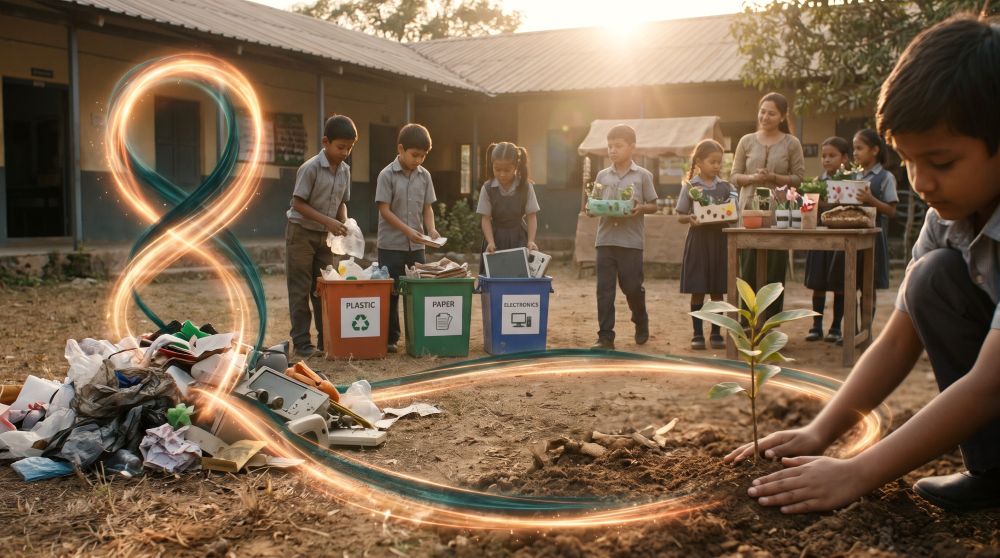
Learners watch what is thrown away in a normal school day: paper, uneaten food, cups, wrappers. The findings become a learner-led plan, with a paper-reuse station, a uniform and stationery exchange, plastic-free lunches and a monthly class-versus-class competition.
MAKE IT PAY
Learners turn dry waste into products and compost that can be sold, so waste earns a return and the habit pays for itself. UNEP reports that sorting and processing recyclables sustains about ten times more jobs per tonne than landfilling or burning.
COMPOST ON CAMPUS
A low-cost micro composter, built by a local fabricator, turns kitchen and garden waste into compost that learners run themselves. It becomes a live lab for science, mathematics and geography, and surplus compost can be sold.

The curriculum link is direct. Experiential learning, skill-based learning, project work, vocational exposure and community engagement are the very ideas India’s National Education Policy 2020 promotes. A programme like this is not an extra burden on teachers. It is the policy, practised.

▼ 08 · EVIDENCE FROM PUBLIC SOURCES

Three places that show the pattern

Programmes that last treat waste as a behaviour and a business, not only a disposal problem. UNEP and the International Solid Waste Association (ISWA) note that managing resources and waste wisely lets countries cut disposal costs and earn from recovered raw materials.

A CITY · INDORE
From 25th to 1st in a year
Indore moved from 25th place in 2016 to first among 471 towns and cities in the 2017 national cleanliness survey. Press reports from 2019 describe about 1,200 tonnes of waste a day, with roughly 550 tonnes of organic waste composted and about 645 tonnes of recyclables sorted daily. Residents were brought in through a 48-hour complaints helpline, NGO outreach, fines for repeat offenders and school campaigns.
A NATION’S PLATE · INDIA
About 68.76 million tonnes
UNEP’s Food Waste Index 2021 puts household food waste in India at about 68.76 million tonnes a year, roughly 50 kg per person. The global finding holds here too: household waste per person is similar across rich and poor countries, so habit and values matter as much as income.
A COUNTRY’S E-WASTE · KENYA
30 tonnes a month, safely handled
UNEP’s 2015 Outlook reports that a non-profit and private firms in Kenya together process up to 30 tonnes of e-waste a month. They sell the recovered materials and dispose of the hazardous parts safely. Small in tonnage, but proof that recovery can be organised locally.

Three scales, one lesson. Where people were brought into the system, waste turned into work.

▼ 09 · LEADERSHIP AND THE MINDSET LENS

Policy is the last step, not the first

This is where the waste story meets the work of Prof. M.M. Ananth, who has served twice as Vice Chancellor, including as Founding Vice Chancellor of a university. AcadNet’s reading of leadership, shaped by that experience, is that institutions do not stall for want of policy. They stall because the mindset at the top has not moved, and a campus quietly copies the habits of whoever runs it.

There is a natural fit with his training. As a materials scientist with a Cambridge PhD, he would call waste what it is: material in the wrong place. The leadership task is to put it back in the right place, and that begins in the mind of the person holding the budget.

His IACT framework (Interpersonal, Adaptability, Cognitive and Technical intelligence clusters) explains why. Research by Academic Network finds that about 75% of professional effectiveness comes from the durable Interpersonal, Adaptability and Cognitive traits, and only 25% from perishable Technical skill. Waste is a perfect test case. Knowing which bin takes which item is the technical 25%. Willing to change a habit is Adaptability. Seeing the loop from extraction to landfill is Cognitive. Holding firm when peers mock you, or inspiring a classroom to follow, is Interpersonal.

THE 75 / 25 PRINCIPLE APPLIED TO WASTE
75% · MINDSET (I · A · C)
25% · TECH
Bins, composters and price charts are the 25%. Need over greed, adaptability and example are the 75%. Source: AcadNet research-validated finding, not an independent peer-reviewed study.
▼ FIVE MOVES FOR A VICE CHANCELLOR, PRINCIPAL OR CAMPUS HEAD
1
AUDIT BEFORE YOU ANNOUNCE
Measure paper, food, cups and power first. Numbers end arguments.
2
LEAD BY PRACTICE
Print less, reuse more, respect shared spaces. Learners remember what they see, not what they hear.
3
PAIR AWARENESS WITH RULES
Motivate first. Back it with clear norms and fair consequences.
4
BUILD THE BUSINESS CASE
Compost, recyclables and crafts that earn keep the effort alive.
5
HAND IT TO LEARNERS
Class monitors, peer trainers, student-run units. Ownership beats instruction.
▼ 10 · WHAT TO CARRY FORWARD

Wasting should vanish from the dictionary

Every figure above says the same thing from a different angle. The earth has one stock of material, one climate and one stretch of time to work with. We can treat them as an inheritance to protect or a supply to burn. The UN gives the targets. The teacher gives the habit. The leader gives the permission.

Start small and start in the mind. Waste less time. Waste less food. Waste less energy. Choose need over greed. The rest, from the bins to the balance sheet, tends to follow.

NEED OVER GREED. EVERY DAY.
DATA NOTE AND SOURCES
All statistics come from UN-system and World Bank publications released before 2023. Reference years are shown with each figure. Figures from different reports use different methods and are compared for pattern, not added together.
UN University, ITU, UNITAR and ISWA, Global E-waste Monitor 2020
W. R. Stahel and G. Reday, report to the European Commission, 1976, published as Jobs for Tomorrow (1982)
Government of India, Solid Waste Management Rules, 2016, as summarised by Citizen Matters
UNEP Food Waste Index 2021, India figures, as reported by Devdiscourse
Design for Sustainability, 2022: AcadNet records (Prof. M.M. Ananth and fellow academics)
UNEP, Towards a Green Economy, 2011 (jobs and market-size figures as cited in a UNEP waste briefing)

M Muruganant

About the Author

Professor M. Muruganant is a distinguished academic and innovator who earned his Doctorate from the University of Cambridge, UK, through prestigious Commonwealth and DAAD fellowships.

Professor Muruganant, with extensive experience in academia and management, formerly served as the Director of Higher Education at Adani Group, where he established Adani University and served as its inaugural Provost. He founded the Global Education Forum, focusing on educational transformation and sustainability. Recognized as an institutional leader, he has initiated several centers to empower faculty and enhance student experiences. His contributions to materials science are notable, and he advocates for STEAM education while emphasizing value education and Bharatiya culture. As the youngest Ministry of Steel Chair Professor, he promotes academic initiatives and engages in significant policy discussions on India’s National Education Policy – 2020.


If you would like to get connected to Dr M Muruganant write to editor@acadnews.com.