





A Century of AIU: Indian Higher Education Confronts Its Next 100 Years
Nearly 800 vice chancellors, five zonal meets, one civilisational question — can the Indian university redesign itself fast enough to deliver a self-reliant Bharat by 2047?
A Milestone That Began Before Independence
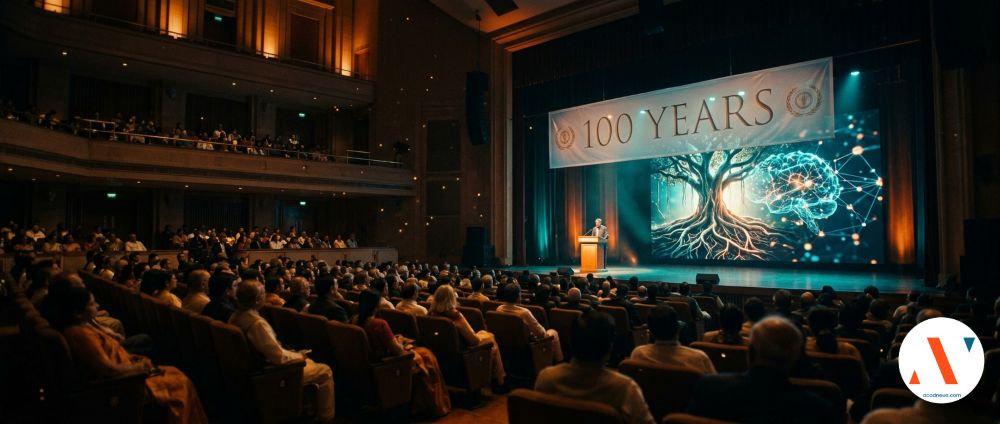
When the Indian University Board — the body that would later become the Association of Indian Universities — was first convened in 1925, India was not yet a free nation. It brought together 11 of the country’s then 14 universities. A century later, AIU stands as the world’s largest university association.
The 100th AGM, themed “Shaping Self-Reliant Bharat through Knowledge and Innovation,” was therefore not a routine convening. Hosted by Dr. D. Y. Patil Vidyapeeth under the leadership of Chancellor Dr. P. D. Patil and Vice Chancellor Prof. (Dr.) N. J. Pawar, the conference was inaugurated by Maharashtra Governor Shri Jishnu Dev Varma, who framed the stakes plainly:
“Viksit Bharat is not merely about becoming the world’s largest economy. It is about ensuring that development reaches the very last person on the socio-economic ladder.”
Jai Kisan
The Quiet Revolution Outside the Metros
Professor Vinay Kumar Pathak, President of AIU, used his presidential address to push back against a narrative that has dominated Indian innovation discourse for too long — that real research and entrepreneurship happen only in five postal codes.
“The deepest form of Atmanirbhar Bharat is capability distributed across the length and breadth of the nation — not concentrated in five postal codes.”
The Five Crises Blocking the Path
The foundation lecture, delivered by Dr. Vinay Sahasrabuddhe — former Rajya Sabha MP, former president of ICCR, and a long-time practitioner of institution-building — offered the conference its sharpest diagnostic frame. Five interlinked crises that universities, more than any other institution, are positioned to confront:
Confusion about who we are as a civilisation — paving the way for distortions and a thinning sense of self.
Institutions without philosophy, teachers without a goal, learners taking degrees without a reason.
A widening gap between what is preached and what is practised in social culture and public life.
Failure to take responsibility for one’s institution, community, and indeed the planet itself.
Breakdown in how we relate to society, to language, to nature, to traditions built over centuries.
Stop relishing the feel-good story of Nalanda and Takshashila. Build new Nalandas and Takshashilas — institutions led by personalities who are non-compromising and deeply value-conscious.
AI-Enabled vs AI-Native: The Strategic Fork
The most provocative technology argument came from Mr. Nick Hutton, VP Global at MasterSoft. His distinction is one that vice chancellors will be wrestling with for the next several years.
“The gap between AI-enabled and AI-native is not technology. It’s institutional will. It’s leadership alignment.”
How Today’s Learner Actually Picks a University
To meet the NEP goal of 50% gross enrolment ratio by 2035, India needs to add 86 million new enrolments — 5% capacity expansion every year. No country has ever attempted human resource mobilisation at this scale. And the learner making that choice has changed.
Internationalisation: From Mobility to Mutuality
The international interface session, chaired by Prof. Vinay Kumar Pathak with Dr. Pankaj Mittal as co-chair, brought together six representatives of major international university and exchange bodies. Prof. Colin Riordan, Secretary General of the Association of Commonwealth Universities, and Prof. Achyut Prasad Wagle, Vice Chancellor of Kathmandu University, framed the cross-border conversation in regional and Commonwealth terms. Prof. Kunal Saigal of IU University, Germany, reframed the central question entirely:
“Let us not only ask how many Indian learners Germany can welcome. Let us ask how much German quality applied learning we can bring to India — with Indians, for Indians, in the service of India’s national goals.”
A pointed question from the audience cut through: why is internationalisation reaching only the top-tier metropolitan institutions? Mr. Arthur Rapp, Director of DAAD, answered candidly that his standing recommendation to German universities is to look beyond Delhi and Mumbai, where institutions already carry 100–200 partnerships. The unmet demand lies in tier-2 and tier-3 institutions. Dr. Vishal Talwar, COO of University of Southampton Delhi, argued that India’s stories deserve to be told back into global academic conversation, not just received from it; Ms. Megha Sunger, Deputy Director of USIEF, urged institutions to start small — faculty-to-faculty exchanges and joint classroom projects rather than rushing to MoUs that often go nowhere.
Sustainability as Civilisational Memory
The sustainability session, chaired by Prof. B. R. Kamboj, Vice Chancellor of Chaudhary Charan Singh Haryana Agricultural University, brought together three institutional perspectives. Prof. Vimala Y of Maa Shakumbhari University, Saharanpur, made the case for aligning campus sustainability goals with the communities each institution actually serves — a tribal university serving tribal communities, a state university its region. Prof. C. Muthamizhchelvan of SRM Institute of Science and Technology argued for treating campuses as living laboratories, where learners participate in energy audits, water audits, and zero-waste experiments with academic credit attached. Prof. B. K. Ravi of Bengaluru North University laid out the global benchmarks unflinchingly. For Indian universities, sustainability is not a borrowed Western framework. It is a return to civilisational form — one that the global discourse is only now catching up with.
“What is our social responsibility but to look at, again, our ancestors? In our childhood there was a river. Today there is no land, no air.”
Entrepreneurship: From Accident to Architecture
Chaired by Prof. (Dr.) Goutam Sutradhar, Director of NIT Jamshedpur, the entrepreneurship session reframed a generational shift. A generation ago, Indian entrepreneurship was largely accidental. Today it’s being made institutional. Dr. Tessy Thomas — Vice Chancellor of Noorul Islam Centre for Higher Education, Kumaracoil, and known nationally as India’s “Missile Woman” — laid out a four-phase architecture that can be embedded into a four-year degree.
Producing AI — or Merely Consuming It?
Chaired by Prof. H. Sudarsana Rao, Vice Chancellor of JNTU Anantapur, the session on creating AI- and quantum-enabled HEIs surfaced a question vice chancellors had been avoiding: are Indian universities producing AI, or merely consuming it?
“Are we working with the applications of AI, or are we working on creating AI? That is the question we need to ask.”
The Civilisational Spine the Curriculum Forgot
The session on integrating traditional wisdom, chaired by Prof. Sat Prakash Bansal, Vice Chancellor of Central University of Himachal Pradesh, was — by his own framing — the session that should have come first. Knowledge is not the same as wisdom. The Indian tradition of Pragya (wisdom) and Satya (truth) frames the aim of education not as preparation for life but as the complete realisation of the self.
Three vice chancellors carried the substantive load. Prof. Shashikala Wanjari, VC of NIEPA, argued that wisdom cannot be added as a unit of information — it must be engaged with as a different mode of knowing entirely. Sr. Prof. Kumar Molugaram, VC of Osmania University, brought the implementation case: Osmania has already operationalised the UGC’s 5% IKS credit mandate, with at least half of those credits required to connect to the learner’s major discipline. Prof. Shrinivasa Varakhedi, VC of Central Sanskrit University, offered the session’s sharpest civilisational provocation.
Wisdom is added as a unit of information — an elective, an optional credit, a footnote.
A different mode of knowing entirely — one that changes the questions the engineering curriculum asks.
“The problem is, we are now searching for Indian knowledge in AI machines. We are dependent on Google to tell us about ourselves.”
Dr. Aloka Krishna, an Additional Secretary of AIU, spoke from the floor about the dichotomy in Indian higher education. Her own children, educated in Delhi’s elite schools, could not read Devanagari fluently. A school principal had taken learners to a remote Uttarakhand village for ten days — no phones, no enforcement — where they cooked their own meals and lived with the villagers.
“Why is food served first to elders, then to animals, then to oneself?” — Because they cannot ask.
“Everything need not be written in books and taught through curriculum transaction. A very powerful bit can sometimes be taught in the class — but the most powerful lessons cannot.”
Three Tensions Left Open for the Second Century
For all the consensus on diagnosis, the conference left several tensions unresolved — and to its credit, did not paper over them.
A NAAC Category-2 institution VC made it explicit: state university VCs, many struggling to disburse salaries on time, simply cannot fund international fellowships or research collaborations from internal resources — however much they would benefit from the NAAC marks attached.
Multiple speakers raised the case for deregulating internationalisation — making it easier for smaller and tier-three institutions to forge foreign partnerships without being crushed by compliance burdens designed for larger players.
A passionate intervention argued that agricultural and ecologically sensitive land — including land owned by educational institutions — is being converted to other uses in violation of older scientific principles about leaving 10% best-quality land for nature.
These are precisely the kinds of questions that AIU, in its second century, will need to translate from conference recommendations into policy submissions to the Government of India.
The Business Session: What AIU Will Actually Do Next
If the technical sessions surfaced the diagnosis, the AGM Business Session on Day 3 — chaired by Prof. Vinay Kumar Pathak with Dr. Pankaj Mittal as co-chair — was where AIU’s second century received its operational instructions. The session moved through more than a dozen agenda items submitted by member vice chancellors. The most consequential threads ran across four issues.
01 · The Research Funding Crisis
An item raised by Prof. Bora exposed a fault line that has been quietly widening for two years: UGC research grants have largely dried up; DST schemes have narrowed; the new Anusandhan National Research Foundation (ANRF) is now the principal channel for both individual and institutional research funding. Many vice chancellors — especially from state and private universities — have not yet adapted their grant pipelines to the new architecture.
AIU’s response was concrete. Dr. Pankaj Mittal committed to a series of online workshops over the next quarter, bringing in officials from ANRF, DST, DBT, the Ministry of Earth Sciences, and selected international funding bodies, to brief member universities on schemes, eligibility, and submission protocols. A list of active funding agencies will be maintained on the AIU website as a continually updated resource.
02 · Restructuring AIU
Prof. Pathak reported that the Ministry of Education has commissioned a full restructuring of AIU — with a significantly larger mandate and a substantially larger funding envelope — to enable the body to contribute more directly to national education policy. A committee has been working on the recommendations, with the report due by 31 May 2026.
As an interim measure, the Ministry has directed AIU to maintain status quo on the President and Vice President positions until the restructuring is approved. Once the report is in, an extraordinary online AGM will be convened to ratify the new structure, with written inputs invited from all members in advance.
03 · Cleaning Up Sports and Cultural Administration
Prof. Pathak addressed openly what had been an open secret in the Indian inter-university sports and culture circuit for years: irregularities in selection, certification, and the awarding of medals. AIU has terminated personnel implicated in irregularities, suspended a Joint Secretary, instituted a software-driven check that prevents universities with overdue subscriptions from participating in any AIU event, and is now moving to blockchain-based certificates and committee-based decisions to remove single-person discretion. A Public Interest Litigation has been filed against the President in connection with these terminations — the matter is sub judice; AIU will abide by the court’s decision.
Senior delegates from the floor congratulated the President personally for taking on what one VC described as “a lobbying nexus that had operated for years.” The participation cost for sports events — raised from ₹2,500 to ₹3,500 per athlete — was clarified as covering food, accommodation, and seven-day hosting borne by the host university.
04 · The Long Tail of Policy Asks
A series of agenda items submitted by Dr. Chhabra and others outlined work that AIU will route to UGC, NITI Aayog, and other bodies as formal policy submissions. The list itself is a useful map of where Indian higher education governance is unsettled:
Day 3: The VBSA Bill, the Best Practices, and Civilisational Memory
The VBSA Bill 2025 · A Single Apex Regulator?
Day 3 opened with an Open Session on the Viksit Bharat Shiksha Adhishthan (VBSA) Bill, 2025. Dr. Pankaj Mittal briefed the gathering on the bill’s central architecture: a single apex regulatory body for higher education that would replace the current patchwork of UGC, AICTE, NCTE, and other professional councils, with the goal of unifying accreditation, regulation, and academic standards under one structure aligned with NEP 2020.
Vice chancellor delegates’ inputs were pointed: increase the research budget allocation; ensure inclusivity by incorporating all professional councils and state universities into the framework; and route AIU’s institutional submission directly to the Joint Parliamentary Committee, which the panel confirmed was already in line.
Best Practices Poster Competition · The Winners
Seventy member universities submitted entries to the AIU Best Practices Poster Competition, evaluated by a jury comprising Prof. Sat Prakash Bansal, Prof. Shashikala Wanjari, and Prof. Shrinivasa Varakhedi. The results — announced during the Valedictory — reflected the geographic and institutional spread that has been the conference’s quiet sub-theme.
The Civilisational Welcome · Pawar’s Frame
In his welcome address to the Valedictory, Prof. (Dr.) N. J. Pawar offered a frame that re-anchored the entire three-day arc. The Indian university’s task, he argued, has to be understood against a 700–800 year background of successive invasions — military, cultural, linguistic, religious, and finally, by the eighteenth century, technological. Each invasion left its imprint not only on institutions but on the very personality of the individual: a long-accumulated loss of self-esteem and self-pride that no economic metric will measure.
“The very purpose of education is to create self-esteem and self-pride — so that the youth of this country can face the outside world with courage and confidence.”
It was the conference’s most direct articulation of why Atmanirbhar Bharat is, at root, an educational project before it is an economic one. Dr. Atul Kothari’s Valedictory Address built on the same frame, distinguishing — in a phrase that has stayed with several delegates — between values in education and values with education: the former a curricular line item, the latter the way an institution lives.
The Frame for the Next Hundred Years
In his closing presidential address, Prof. Pathak made three asks of the assembled vice chancellors:
“The true measure of an institution is not what it preserves — but what it dares to redesign.”
© AcadNews Editorial · AN. All rights reserved.