





The Four Stages of Vāk: From Silent Pulse to Spoken Word
Parā, Paśyantī, Madhyamā, Vaikharī — and the teaching that AUM is Anāhata Dhwani, the unstruck sound that was already ringing before the world was made.
Where Sound Begins Before It Is Heard
Long before a word leaves the lips, it has already travelled a vast distance.
The Indian tradition, with a precision that seems almost impossible for something as fleeting as speech, mapped this journey in four stages — Parā, Paśyantī, Madhyamā, and Vaikharī. Each stage is a descent from silence into sound, from the formless into the formed, from the one into the many. Together they describe nothing less than the architecture of consciousness itself, for in the seers’ understanding, to speak is to re-enact the very coming-into-being of the universe.
At the heart of this map lies a luminous insight: AUM — the praṇava — is Anāhata Dhwani, the unstruck sound. It is the sound that is not produced by any striking, any friction, any collision of surfaces. It is the sound that was already there.
To speak is to re-enact the very coming-into-being of the universe.
The Four Stages: A Descent of Vibration
Reading downward is the cosmos speaking itself into being. Reading upward is the yogin returning home.
Parā — The Transcendent Word
Parā means “the beyond,” “the highest,” “the supreme.” At this stage, Vāk is pure potentiality — speech before it is speech, meaning before it has taken the trouble to distinguish itself from the one who would mean.
The ancient texts locate Parā in the Mūlādhāra, the root — but this is not a geography of the body so much as a geography of being. Parā is sound in its causal form, undifferentiated, unmoving, utterly still, and yet somehow containing within itself every word that has ever been or will ever be uttered. It is speech identical with the Self that would speak.
Here, there is no speaker, no listener, no thing spoken of. There is only the pregnant silence from which all three will, presently, emerge.
Paśyantī — The Seeing Word
Paśyantī derives from dṛś, to see. This is the stage at which Vāk first becomes visible to itself — not yet as language, but as a kind of interior flash. A whole meaning arrives at once, in a single undivided intuition, before it has fractured into the linear sequence of grammar.
Every poet, every mathematician, every seer has known this moment: the insight that lands whole, before one has found the words for it. Ramanujan’s theorems, it is said, arrived this way — fully formed, given, and only afterwards laboriously translated into the idiom of proof. Paśyantī is the stratum at which revelation occurs.
It is still pre-linguistic. The meaning is seen, not yet heard.
Madhyamā — The Middle Word
Madhyamā is the “middle” — speech as it exists in the mind, between the seeing and the saying. This is the stage of inner speech, of the silent monologue that threads through waking consciousness, of thought that has taken on grammatical shape but not yet acoustic form.
Here, subject and predicate separate. The meaning that was a single point in Paśyantī now extends into a line; intuition becomes proposition. One begins, in the famous phrase, to think in words. Madhyamā is the workshop in which the unformed is being fitted to language, but the breath has not yet engaged, the tongue has not yet moved.
Vaikharī — The Manifest Word
Vaikharī is speech in its gross, audible, spoken form — the word that has finally entered air and history. It is the stage at which vibration becomes sound-wave, at which inner life becomes social fact, at which what was mine becomes, through utterance, shareable.
This is the Vāk we normally take to be the whole of language. The tradition’s astonishing claim is that it is only its outermost layer — the visible tip of a vast submerged vibration.
A Scale from the Gross to the Unmanifest
One useful way to hold the four stages together is to notice that they form a gradient of increasing subtlety — or, equivalently, of decreasing manifestation. Reading the table from bottom to top traces the inward journey of the sādhaka.
To still Vaikharī is to enter mauna, outer silence. To still Madhyamā is to enter the silence of thought. To rest in Paśyantī is to know meaning without concept. To rest in Parā is to be the source itself.
AUM as Anāhata Dhwani
Ordinary sound is āhata — “struck.” It requires a cause: vocal cords vibrating, a bell being rung, wind catching a leaf. Every audible sound in the world is āhata dhwani, the product of one thing colliding with another. By its nature, it arises and passes; it belongs to the realm of impermanence.
Anāhata dhwani is sound that has no cause outside itself. It is unstruck. It does not arise, because it never ceased to be; it does not pass, because it never began. The yogic traditions identify this unstruck sound with AUM, the praṇava — the primordial vibration which is not a sound one makes but a sound one hears when every sound one makes has finally gone quiet.
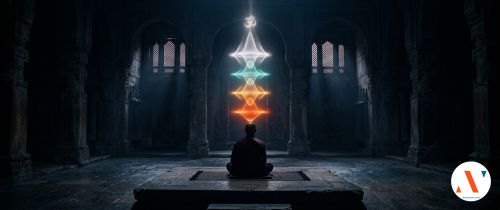
AUM, understood this way, is not pronounced in Vaikharī. It can be chanted there — and the chanting is a ladder — but the AUM that the Upaniṣads call ekākṣaram brahma, “the one syllable that is Brahman,” resides in Parā. It is the signature of the Absolute in the field of vibration. When the four stages are traced inward, the sādhaka does not reach a silence that is the absence of sound; he reaches a silence that is the fullness of sound, an unstruck resonance that was already ringing before the world was made.
This is why the Māṇḍūkya Upaniṣad can say, with complete seriousness, that AUM is all that was, is, and will be.
Why This Map Still Matters
The four stages of Vāk are not a curiosity of ancient grammar. They are a phenomenology — a careful description of what actually happens when a human being means something and then says it. Anyone who has ever searched for a word, or had one arrive unbidden, or felt a thought form itself into a sentence before their inner ear, has already travelled this ladder without knowing its name.
Three implications stand out.
Understanding Lives in Paśyantī, Not Vaikharī
True understanding is not the ability to recite but the whole pattern seen at once, from which articulation follows easily. A learner who can only repeat has not yet reached Paśyantī; a learner who has reached Paśyantī can produce fresh articulations all day long. Assessment traditions that measure only the surface miss, by design, the depth at which learning actually lives.
A Precise Instrument for Silence
Meditation is often described vaguely as “quieting the mind.” The Vāk schema tells us which silence. Stilling Vaikharī is the easy silence of not speaking. Stilling Madhyamā — the inner commentary — is the harder silence taught in most contemplative disciplines. Entering Paśyantī is the silence of seeing without naming. Resting in Parā is the silence which is not the opposite of sound but its source.
Dignity Restored to the Inner Life
In an age that values only what can be said and measured, the tradition insists that the most real speech is the one that has not yet been spoken — that the word on the page is a shadow cast by a light that shines inward.
The Silent Pulse
To know that AUM is Anāhata Dhwani — the unstruck sound — is to know that beneath every word we speak, and beneath the inner words we do not, there is a pulse that was not begun and will not end. The four stages of Vāk are the rungs by which that pulse becomes, by degrees, the world of names and forms; and by which, reversed, the world of names and forms is remembered back into the one vibration from which it came.
Yato vāco nivartante, aprāpya manasā saha.
“From which words turn back, unable to reach, along with the mind.”
The phrase is not a defeat of language. It is language’s final, reverent gesture toward its own source.
That source has a name, which is also not a name.
Inspired by the address of Sh. Prem Anosh from the Sri Sathya Sai Media Centre, 23 April 2026.