







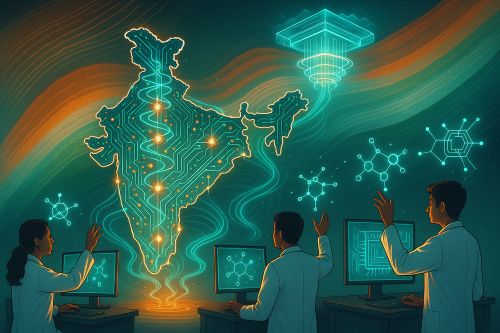
🔬 India’s Quantum & Research Revolution
₹720 Crore for Four Quantum Fabrication Facilities at Premier IITs & IISc
India announces major investment to establish state-of-the-art quantum fabrication centers, reducing dependence on foreign labs for quantum device development.
100 Engineering Colleges to Get ₹1 Crore Each for Quantum Teaching Labs
Government to select 100 institutions from 500+ applications for undergraduate quantum technology programmes; final list pending as fresh proposals invited.
PM Modi Launches ₹1 Lakh Crore RDI Scheme for Private Sector Research
Landmark research fund launched at ESTIC 2025 aims to catalyze private sector participation in deep-tech innovation with zero-interest long-term financing.
National Quantum Mission: Four Thematic Hubs Driving India’s Quantum Future
India’s ₹6,000 crore NQM establishes specialized research hubs across IISc and IITs, with first indigenous 25-qubit quantum computer already operational.
₹720 Crore Investment for Four Quantum Fabrication Facilities Across India’s Premier Institutions
Union Minister of State for Science and Technology Dr. Jitendra Singh announced the establishment of four state-of-the-art Quantum Fabrication and Central Facilities worth ₹720 crore during his visit to IIT Bombay on November 24, 2025. The facilities will be located at IIT Bombay, IISc Bengaluru, IIT Kanpur, and IIT Delhi under the National Quantum Mission (NQM).
• IIT Bombay & IISc Bengaluru: Major fabrication facilities for quantum computing chips and sensors using superconducting, photonic, and spin qubits
• IIT Bombay & IIT Kanpur: Quantum sensing and metrology infrastructure
• IIT Delhi: Quantum materials and device development ecosystem
Until now, India has largely depended on facilities abroad for fabricating quantum devices, creating significant challenges in accelerating technology development. These new facilities aim to indigenize the fabrication of quantum computing chips and quantum sensors entirely within the country.
The facilities will be accessible to academia, science and technology institutions, industry, start-ups, MSMEs, and strategic sectors across the country. Dr. Singh emphasized that these capabilities will create a controlled environment for prototyping indigenous quantum devices, supporting translational research, and training the next generation of quantum hardware experts. The investment represents a decisive leap toward technological sovereignty, positioning India among select global leaders in next-generation quantum technologies.
↑ Back to Top StoriesGovernment to Fund 100 Engineering Colleges with ₹1 Crore Each for Quantum Teaching Labs
In a significant move to build quantum technology capacity at the grassroots level, the Department of Science and Technology (DST) Secretary Prof. Abhay Karandikar announced that 100 engineering colleges across India will receive ₹1 crore each to establish quantum teaching laboratories. The initiative, launched in collaboration with AICTE, received overwhelming response with over 500 proposals submitted from institutions nationwide.
• Funding: ₹1 crore per institution (₹100 crore total investment)
• Purpose: Undergraduate minor programmes in quantum technology
• Focus: Teaching facilities, not advanced research labs
• Coverage: Faculty development, course design, and lab setup
Speaking at IIT Bombay during the inauguration of new quantum facilities, Karandikar clarified that these labs are intended for teaching rather than research and will support colleges in offering minor programmes in quantum technology for BTech students. The initiative aims to create a pipeline of skilled graduates in quantum computing, sensing, and communication.
Additionally, DST is planning to set up a quantum algorithms technical group for capacity building to support start-ups and for the development of research and technology. This complementary initiative will help translate academic learning into practical applications and entrepreneurship in the quantum domain.
The final list of 100 selected colleges has not yet been officially published. DST Secretary Karandikar confirmed that the department is “now finalising a list of 100 institutions” from over 500 proposals received.
Additionally, due to administrative reasons, the earlier call for proposals has been withdrawn, and NQM has issued a fresh call with an updated format. Applicants who submitted proposals under the earlier call (closed 23rd July 2025) are required to reapply.
Official Resources to Monitor:
• DST Call for Proposals Page
• National Quantum Mission Official Page
PM Modi Launches ₹1 Lakh Crore Research, Development and Innovation Scheme at ESTIC 2025
Prime Minister Narendra Modi launched the landmark ₹1 lakh crore Research, Development and Innovation (RDI) Scheme at the Emerging Science, Technology and Innovation Conclave (ESTIC) 2025 held at Bharat Mandapam, New Delhi. The scheme aims to build a private sector-driven research and development ecosystem and accelerate India’s transformation into a global science and technology hub.
• Total Corpus: ₹1 lakh crore over six years
• FY 2025-26 Allocation: ₹20,000 crore
• Nodal Ministry: Department of Science & Technology
• Strategic Direction: Anusandhan National Research Foundation (ANRF)
• Financing: Long-term loans at zero or minimal interest
The scheme offers long-term capital access with flexible, long-duration financing to encourage private R&D in high-risk, deep-tech sectors including AI, semiconductors, quantum technology, and biotechnology. A Deep-Tech Fund of Funds has been established to back start-ups and innovation-driven enterprises working on cutting-edge technologies.
The RDI Scheme can finance up to 50% of assessed project costs for transformative projects at Technology Readiness Levels 4 and above. Funds will flow through a Special Purpose Fund under ANRF to second-level fund managers including Development Finance Institutions, Non-Banking Financial Companies, and research organizations like BIRAC and Technology Development Board. PM Modi emphasized that India is no longer just a consumer of technology but has become a pioneer of transformation through technology.
↑ Back to Top StoriesNational Quantum Mission: Four Thematic Hubs Accelerating India’s Quantum Leadership
India’s National Quantum Mission (NQM), approved with a budget of ₹6,003.65 crore from 2023-24 to 2030-31, has established four specialized Thematic Hubs (T-Hubs) across premier institutions to propel quantum technology research and development. The mission spans 14 Technical Groups across 17 states and 2 Union Territories, creating a truly national quantum ecosystem.
• IISc Bengaluru: Quantum Computing Hub
• IIT Madras: Quantum Communication Hub
• IIT Bombay: Quantum Sensing & Metrology Hub
• IIT Delhi: Quantum Materials & Devices Hub
In a milestone achievement, Indian startup QpiAI unveiled “Indus,” a 25-qubit quantum computer in April 2025—India’s first full-stack quantum computing system selected under NQM. The superconducting quantum computer integrates advanced quantum processors with next-generation Quantum-HPC software platforms and AI-enhanced solutions.
The mission has opened a rolling call for quantum startups since July 2025, offering scientific mentorship, infrastructure access, and academic partnerships. Additionally, Andhra Pradesh has announced plans for a Quantum Valley Tech Park in Amaravati in partnership with IBM, TCS, and IIT Madras—India’s first quantum technology park. Mission deliverables include satellite-based secure quantum communications over 2,000 kilometers, inter-city quantum key distribution, and development of high-sensitivity magnetometers and atomic clocks for precision timing and navigation.
↑ Back to Top Stories🔮 Synthesis: India’s Strategic Leap into the Quantum Era
This week’s announcements collectively represent India’s most significant push toward establishing technological sovereignty in quantum sciences and deep-tech research. The combined investment of over ₹1.08 lakh crore—spanning the RDI Scheme (₹1 lakh crore), quantum fabrication facilities (₹720 crore), quantum teaching labs (₹100 crore), and the broader NQM (₹6,003 crore)—signals a transformative shift from being technology consumers to innovation pioneers.
The strategic architecture is notable: while the RDI Scheme targets private sector R&D participation through zero-interest long-term financing, the quantum initiatives build foundational hardware and human capital. The four fabrication facilities at IITs and IISc address a critical bottleneck—India’s historical dependence on foreign labs for quantum device fabrication. Simultaneously, establishing teaching labs across 100 engineering colleges creates a talent pipeline to staff these advanced facilities within the next decade.
With India’s first indigenous 25-qubit quantum computer operational, Quantum Valley emerging in Andhra Pradesh, and rolling startup support under NQM, the ecosystem is maturing beyond pure research. As PM Modi emphasized at ESTIC 2025: India is positioning itself not merely for incremental advances but for leadership in defining the global quantum future—aligning with the vision of Viksit Bharat 2047.