







🌟 Foundation of Excellence
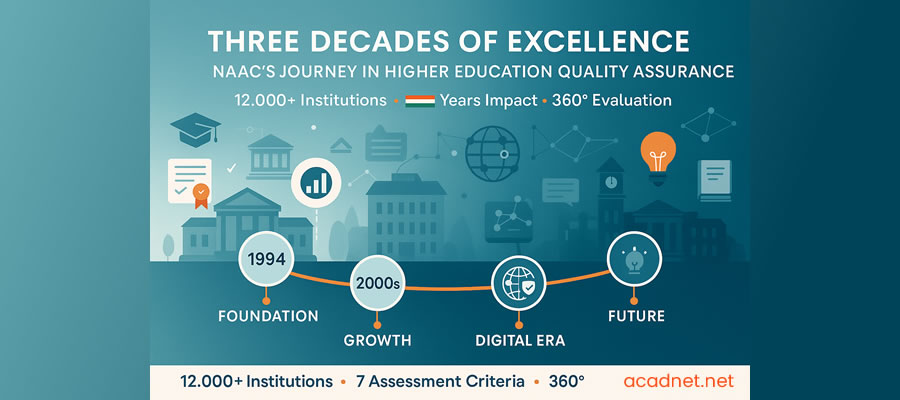
The University Grants Commission took a landmark decision on 16 September 1994, launching NAAC from Bengaluru to address quality concerns in India’s expanding higher education landscape.
Core Vision: Transform quality assurance into a fundamental component of institutional operations across Indian universities and colleges.
Driving Forces: Exponential growth in educational institutions created an urgent need for standardized quality benchmarks and accountability frameworks.
🔨 Pioneering Phase – Laying Strong Foundations
Strategic Priorities:
- Designing comprehensive evaluation methodologies
- Developing expertise among assessment professionals
- Building institutional awareness and voluntary participation
- Establishing paper-based, comprehensive documentation systems
Core Methodology: Institutional Self-Study Reports coupled with expert peer evaluation visits became the cornerstone of quality assessment.
📈 Expansion and Recognition Era
NAAC transformed into a trusted quality benchmark as India’s higher education ecosystem experienced unprecedented growth and diversification.
Milestone Achievements:
- Implementation of comprehensive seven-parameter evaluation model
- Introduction of structured multi-cycle assessment approach
- Significant influence on prospective student decision-making
- Integration with institutional funding mechanisms and academic appointments
💻 Technological Revolution and Process Enhancement
Paradigm Shift to Evidence-Based Evaluation:
- Data Verification Systems: Implementation of rigorous Data Validation and Verification protocols
- Digital Feedback Mechanisms: Web-based Student Satisfaction Survey platforms
- Open Access Information: Complete public disclosure of assessment outcomes through online portals
- Performance-Oriented Metrics: Enhanced emphasis on measurable outcomes including research output, graduate employment, and technological innovation
🚀 Next-Generation Framework – Streamlined and Comprehensive
National Education Policy 2020 Integration:
- Simplified Assessment Model: Binary qualification system for fundamental quality standards
- Advanced Excellence Framework: Sophisticated maturity-based evaluation for institutional leadership
- International Benchmarking: Harmonization with worldwide ranking methodologies and standards
- Contemporary Assessment Parameters: Integration of Sustainable Development Goals, cutting-edge innovation, and environmental responsibility
📊 NAAC’s Transformational Impact
🎯 Strategic Importance of NAAC Certification
🏛️ Academic Legitimacy
Validates institutional quality and builds stakeholder confidence
💰 Resource Mobilization
Gateway to government funding and autonomous operational status
👥 Stakeholder Confidence
Guides student enrollment decisions and enhances graduate employability
🔬 Innovation Catalyst
Stimulates research excellence and technological advancement
🌐 International Standing
Bridges local institutions with global quality benchmarks
📈 Systematic Enhancement
Drives sustained institutional transformation and excellence
🌍 NAAC vs Global Accreditation Systems
🇮🇳 NAAC (India)
- Scope: Comprehensive institutional assessment
- Criteria: 7-criterion framework
- Validity: 5-year cycles
- Focus: Holistic development
- Innovation: DVV, binary system
🇺🇸 ABET (USA)
- Scope: Program-specific accreditation
- Focus: Engineering, Computing, Technology
- Approach: Outcome-based assessment
- Industry: Strong employer recognition
- Global: International reach
🇬🇧 QAA (UK)
- Scope: Quality enhancement focus
- Method: Subject benchmark statements
- Reviews: Institutional reviews
- Standards: Academic quality frameworks
- Public: Transparent reporting
🇦🇺 TEQSA (Australia)
- Role: Regulatory and quality assurance
- Standards: Higher Education Standards Framework
- Risk-based: Proportionate regulation
- Registration: Provider registration
- International: Overseas student protection
🇨🇦 Provincial Systems (Canada)
- Structure: Provincial jurisdiction
- Variety: Different systems per province
- Quality: Quality assurance agencies
- Degree: Degree authorization
- Standards: Ministerial oversight
🌏 NAAC’s Unique Strengths
- Scale: Largest democracy’s HE system
- Diversity: Multiple languages & cultures
- Innovation: Digital transformation leadership
- Holistic: 360-degree institutional view
- Adaptable: Continuous evolution
🔄 NAAC Assessment Criteria Evolution
Current 7-Criterion Framework:
🎓 Advancing Quality Assurance in Higher Education
NAAC remains at the forefront of educational transformation, leveraging cutting-edge technology and international best practices while staying true to its mission of elevating Indian higher education standards. The National Education Policy 2020’s universal accreditation vision positions NAAC as a cornerstone institution in India’s educational renaissance.
📍 Established: September 16, 1994 | 🏢 Headquarters: Bengaluru, India | 🔗 UGC Autonomous Body