







🏭 Bridging the Manufacturing Skills Gap
The Technology Series webinar on Lean Manufacturing Practices, conducted by Academic Network in collaboration with IIM Bangalore, represents a pivotal moment in India’s manufacturing education landscape. This groundbreaking initiative addresses the critical disconnect between academic learning and industry requirements, drawing unprecedented participation from across the nation.
The program’s reach across 103 cities and 55 states demonstrates its national significance, while the concentrated participation from Tamil Nadu (58.3%) and specifically Coimbatore (54.4%) highlights the regional manufacturing hub’s commitment to educational transformation.
The Manufacturing Education Crisis: Setting the Context
As Professor M.M. Ananth, founder of Academic Network, emphasized during his opening remarks, India faces a paradoxical situation that has reached crisis proportions. “We are leaving the next generation high with materialistic comforts but dry with the practical skills they need to succeed,” he stated. This stark disconnect reveals fundamental flaws in how engineering education prepares students for real-world manufacturing challenges.
The webinar’s participant demographics underscore this educational focus, with 65.3% of attendees representing the combined education ecosystem – students, faculty, and academic administrators. This concentration suggests a sector actively seeking solutions to bridge the academia-industry gap.
The CORE Framework for Lean Manufacturing
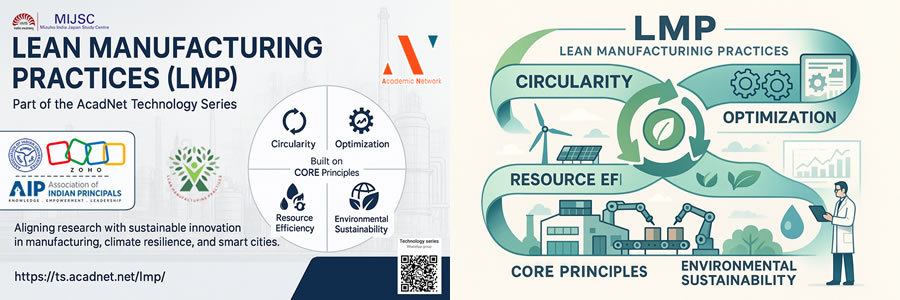
Professor Ananth introduced a compelling framework for lean manufacturing practices built on four sustainability principles, forming the acronym “CORE” – a systematic approach that addresses both economic and environmental imperatives:
Circularity (C)
Designing systems that minimize waste and maximize resource reuse throughout the manufacturing lifecycle
Optimization (O)
Continuous process improvement for maximum efficiency with minimum resource consumption
Resource Efficiency (R)
Strategic utilization of materials, energy, and time to create more value with less input
Environmental Sustainability (E)
Implementing practices that preserve the environment for future generations
The environmental impact potential is significant and measurable. Organizations implementing lean principles typically achieve remarkable results that demonstrate the dual impact of economic and environmental performance:
The IIM Bangalore LMP Program: A Game-Changing Initiative
Professor Saideep Rathnam, Chief Operating Officer of the Mizuho India Japan Study Center at IIM Bangalore, revealed the program’s remarkable origins during his keynote address. Born from a serendipitous meeting between Professor Shoji Shiba of MIT and former President Dr. APJ Abdul Kalam in Japan, the initiative evolved from earlier programs like VFM (Visionary Factory Management) and VME, ultimately developing into the current Lean Manufacturing Practices (LMP) program.
The Revolutionary 30-70 Hybrid Model
What sets the LMP program apart is its innovative framework that challenges traditional educational approaches. The program operates on a carefully calibrated 30-70 model that directly addresses industry concerns identified during the webinar.
This approach directly addresses participant concerns identified through polling, where “inadequate infrastructure for hands-on training” and “students preferring theoretical over practical learning” each represented 27% of respondents’ concerns about industry-academia bridging challenges.
Three-Phase Transformation Strategy
The program operates through a carefully structured three-phase approach designed to create sustainable change across the educational ecosystem:
Phase 1: Faculty Empowerment
18 weeks of structured learning across six modules
Certification as “lean experts”
Industry visits, workshops & expert interactions
Conclave at IIM Bangalore
Phase 2: Student Integration
Three-credit elective course offering
Enhanced industry project components
7th & 8th semester direct application
Real-world problem solving focus
Phase 3: Consultancy Development
Faculty transition to industry consultants
Win-win partnership creation
Practical solutions to industry challenges
Real-world project experience for education
Industry Perspectives: Ground Reality and Challenges
The industry panel featuring Sanjay Khanna (Director, Pyramid Abrasives Pvt Ltd) and Mahesh Birangi (CEO, Pragati Engineering Belgaum) provided stark insights into the manufacturing skills crisis that extends far beyond theoretical knowledge gaps.
Sanjay’s perspective was particularly revealing, highlighting how current engineering curricula focus heavily on theoretical principles that only 20% of graduates (those entering R&D or design roles) will use, while 80% who join shop floor operations receive little relevant preparation.
The strong representation from the education sector (56.8% of participants) demonstrates the academic community’s commitment to change, while the 8.0% participation from technology sectors and 5.3% from manufacturing shows growing cross-industry interest in lean manufacturing applications.
International Best Practices: The French Model
The French model emerged as an interesting contrast during discussions – their six-year engineering programs alternate between two years of classroom study, two years of industry work, and final two years of advanced study. This integration explains why such graduates command higher industry respect and immediate productivity.
Mahesh Birangi emphasized the urgency of the situation: “With such a vast pool of educated but unemployable graduates, we could be facing social unrest. Industry must take four steps forward for every step the academic sector takes.”
The MSME Opportunity and Government Integration
A significant insight emerged regarding government lean manufacturing programs for the MSME sector. Previously limited to individual consultants, these programs now allow consulting organizations to participate, creating unprecedented opportunities for engineering colleges to position themselves as knowledge centers and practical consulting hubs for regional industries.
Key Recommendations from Industry Experts:
- Transform engineering colleges into regional consulting centers for MSME sector within 25-30 km radius
- Establish Board of Studies committees with majority industry representation
- Create “professors of practice” positions for industry veterans
- Develop project-based assessment systems replacing theoretical examinations
- Implement mandatory 5-year industry experience requirement for faculty recruitment
- Leverage existing industry facilities through structured partnerships rather than expensive in-house infrastructure
Success Metrics and Three-Year Transformation Vision
During the panel discussion, experts outlined specific, measurable success metrics for evaluating the program’s impact over a three-year timeline, demonstrating the initiative’s commitment to accountability and results-driven implementation:
🚀 Join the Manufacturing Education Revolution
Be part of the transformation reshaping India’s manufacturing landscape
Register for August 2025 Batch Learn More About LMP WebinarNext Batch Details
Start Date: August 2025 | Duration: 18 weeks | Format: Hybrid Learning
Certification: IIM Bangalore Recognition | Target: Engineering College Faculty
The ultimate measure of success will be evident in three years when graduates enter the manufacturing sector with practical skills, industry-ready competencies, and the ability to contribute immediately to India’s manufacturing excellence. The foundation has been systematically laid through this comprehensive initiative; the execution phase begins now with unprecedented urgency and opportunity.
ts.acadnet.net
lmp-vlci.com
acadnet.net
🤝 Knowledge Partners & Acknowledgments
- Association of Indian Universities (AIU) – Supporting institutional collaboration and policy guidance
- Association of Indian Principals – Facilitating academic leadership engagement
- Mizuho India Japan Study Center, IIM Bangalore – Program development and delivery
- Technology Partners: Zoho Corporation, Samskar Learning Academy, MSME Learning Academy
This comprehensive analysis is based on the Technology Series webinar conducted by Academic Network in collaboration with IIM Bangalore’s Mizuho India Japan Study Center, featuring expert insights from IIM Bangalore, industry leaders, and technology partners, combined with detailed demographic analysis of participant engagement patterns across India’s manufacturing education landscape.
For further reading (click on the title to explore):