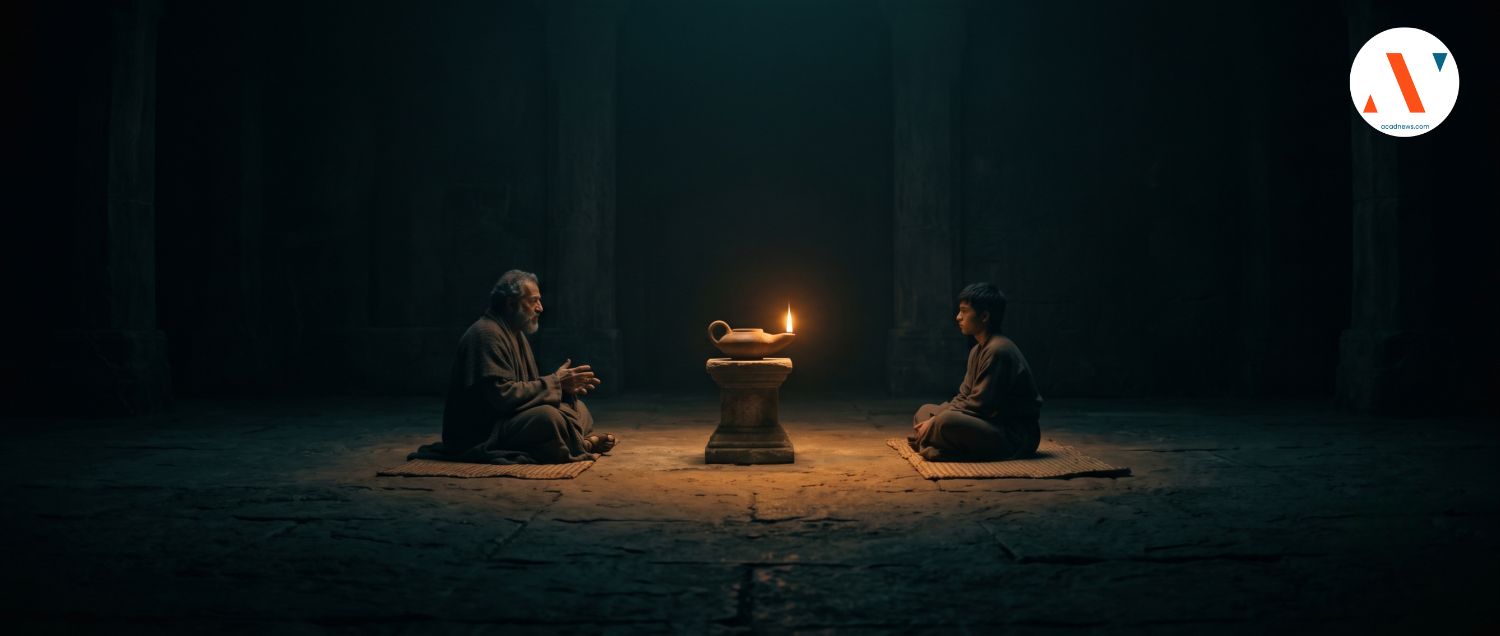







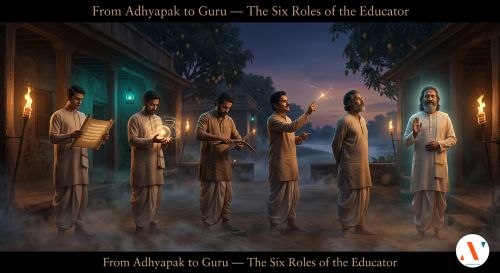
The world originates in the mind. This ancient insight — Mano moolam Idam Jagat — is not poetic flourish. It is the most precise description of how human beings experience reality. Two people can inhabit the same city, the same classroom, the same institution, and live in entirely different worlds — because of how the same data has formed within them.
Data itself is neutral. A raindrop is data. A grade on a report card is data. A disruption in an industry is data. None of it carries inherent meaning. What determines whether data becomes insight or anxiety, growth or paralysis, Wisdom or conditioning — is the quality of consciousness receiving it.
The six roles of the Gurukul tradition address this reality with extraordinary precision. Each role corresponds to a stage in the inner sacred cycle — from Data through IN-formation, INTRO-spection, and TRANS-formation to Wisdom. Each simultaneously produces an outer, observable progression — from Knowing through Learning, Skilling, Innovation, and Implementation to Impact. These two journeys — the inner and the outer — are not separate. They are the two faces of a single process of conscious evolution.
From Data to Wisdom — the inner arc of conscious evolution. Each stage transforms what came before. What remains at the end is not more information — it is freedom from all that is spatio-temporal and conditioned.
FORMATION
SPECTION
(Upavasa)
FORMATION
While the Sacred Cycle describes the inner journey of consciousness, the Applied Progression describes what the Learner becomes capable of producing — the outer, observable manifestation of each stage. These two journeys are inseparable: the inner transformation is what makes the outer progression possible.
The Learner begins by receiving structured data (Knowing) and progressively integrates it into lived understanding (Learning). IQ governs both — accuracy, structure, and the ability to connect new information to what is already known.
As IQ meets EQ, learning becomes embodied capability (Skilling). When the Learner then sits near their own formations with genuine detachment, existing patterns begin to break open — creating the conditions for Innovation: the new that could not have emerged from the old.
Implementation translates vision into purposeful action in the world. But true Impact — the kind that outlasts the individual — emerges only when the actor is free of ego and conditioning. This is Jnana expressed outward: inclusive, constructive, and universal in consequence.
Impact at the Guru level is not merely large-scale achievement. It is contribution that is free of the spatio-temporal — free of ego, free of personal agenda, free of cultural conditioning. It serves a purpose larger than the self. It is Wisdom made visible in the world — and it is therefore genuinely lasting.
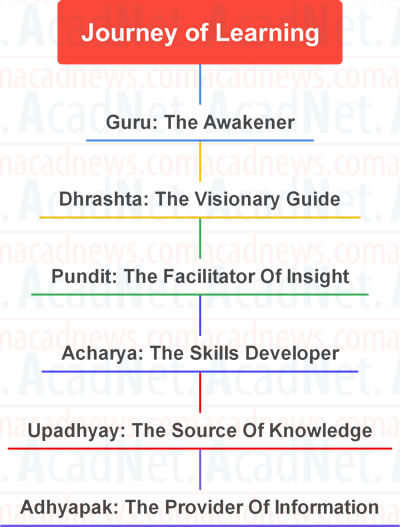
The Journey of Learning · AcadNews
The six roles, the Sacred Cycle, IQ/EQ/SQ, and the Applied Progression — four frameworks, one integrated truth.
Each role is a complete educational function — simultaneously a stage in the Sacred Cycle, a tier of intelligence, and a step in the applied progression from Knowing to Impact.
The Adhyapak works at the threshold where raw data begins to take shape within the Learner. The first act of intelligence is discernment — knowing what data is worth transmitting at all. Knowing is the outcome: the Learner leaves with structured information that forms an accurate inner landscape upon which all further development depends.
The Upadhyay moves information into knowledge — contextualising it, connecting it to significance and application. Learning is the outcome: not mere accumulation, but genuine integration. The Learner who has truly learned does not just know what is true; they understand why it matters and how it connects to everything else they carry within them.
The Acharya is the bridge role — where IQ meets EQ and knowing becomes doing. Skilling is the outcome: technical and interpersonal capability that is not merely learned but embodied. The Acharya ensures that what has been formed within the Learner is not left as inner landscape alone, but expressed as effective action in the world.
The Pundit guides the Learner into Upavasa — the ancient practice of sitting near what has arisen within, with patience and detachment rather than reactivity. Innovation is the outcome: when existing formations are genuinely observed rather than merely repeated, they break open. New patterns emerge. The new that could not have come from the old becomes possible.
The Dhrashta stands at the threshold between EQ and SQ — where introspection begins to open into vision that transcends the merely personal. Implementation is the outcome: not just having insight, but translating it into purposeful, strategic action in the world. The Dhrashta prepares the Learner to lead — not from ambition, but from a clarity of direction that begins to be free of ego.
“A Dhrashta does not teach the destination — they awaken the Learner’s desire to find one worth pursuing.”
SQ is not a higher degree of IQ or EQ. It is a different order of intelligence — governing the relationship between the mind and its own formations. The difference between Implementation and Impact is precisely this difference.
- Acts from fixed frameworks
- Identity attached to role and outcome
- Imprisoned by the spatio-temporal
- Produces achievement — time-bound
- Shaped by data rather than liberated through it
- Responds to context without being defined by it
- Identity rests in awareness, not in role
- Arrives at the universal absolute
- Produces legacy — timeless
- Liberated through data — Wisdom remains
“The one who masters this journey does not merely accumulate knowledge — they cultivate Wisdom. Moving from Knowing to Learning to Skilling to Innovation to Implementation to Impact, they become alchemists of consciousness, turning the lead of raw data into the gold of lived understanding. And in that Wisdom, we find freedom.”
The six roles demand structural institutional embodiment. Three pillars — each encompassing a tier of the complete cycle — must be deliberately built into every learning environment.
Education must journey from awareness of data toward its genuine implementation as competence. Every Learner must move measurably from exposure to demonstrated capability — from Knowing through Learning to Skilling. This is not the ceiling — it is the foundation.
Every institution needs educators who sit near the present moment with genuine discernment and see what is not yet visible. Learners cannot innovate from fixed formations — they need the Upavasa of real introspection and a Dhrashta who shows them where vision meets purposeful action.
The deepest and most neglected pillar. Trans-formation is not about improving the conditioned self — it is enabling the Learner to release formations that limit them, arriving at Jnana: Impact that is ego-free, inclusive, constructive, and universal. The Guru does not build — the Guru liberates. What remains is Wisdom.
The journey from Data to Wisdom, and from Knowing to Impact, are not two journeys — they are the same journey seen from two perspectives. The inner cycle of conscious evolution (Data → In-Formation → Intro-spection → Trans-formation → Wisdom) produces the outer progression of human capability (Knowing → Learning → Skilling → Innovation → Implementation → Impact). One cannot be forced without the other.
This is precisely what is missing from most institutions today. They invest heavily in Knowing and Learning, make some provision for Skilling, and consider their obligation discharged. Innovation, Implementation, and Impact — the outcomes that actually determine whether education has served its purpose — are left to chance, circumstance, and the rare individual who finds their own way through.
India’s National Education Policy 2020, with its emphasis on holistic development and multidisciplinary formation, reaches toward exactly this recalibration. The six roles — and the complete map they provide across the Sacred Cycle, IQ–EQ–SQ, and the applied progression from Knowing to Impact — offer the philosophical depth and structural precision that any serious institutional response requires.
The question before every institution, every educator, and every policymaker is not whether the map is accurate. It plainly is. The question is whether we have the courage to follow it — all the way to Wisdom. All the way to Impact that is free of ego. All the way to the universal absolute. All the way to freedom.
 M Muruganant |
About the Author Professor M. Muruganant (Ananth) is a distinguished academic and innovator who earned his Doctorate from the University of Cambridge, UK, through prestigious Commonwealth and DAAD fellowships. |
| Professor Muruganant, with extensive experience in academia and management, formerly served as the Director of Higher Education at Adani Group, where he established Adani University and served as its inaugural Provost. He founded the Global Education Forum, focusing on educational transformation and sustainability. Recognized as an institutional leader, he has initiated several centers to empower faculty and enhance student experiences. His contributions to materials science are notable, and he advocates for STEAM education while emphasizing value education and Bharatiya culture. As the youngest Ministry of Steel Chair Professor, he promotes academic initiatives and engages in significant policy discussions on India’s National Education Policy – 2020. | |
If you would like to get connected to Dr M Muruganant write to editor@acadnews.com.