





This short article gives the overview of Different Types of Hydrogen as a fuel: Grey, Blue, and Green
Hydrogen is a versatile and clean energy carrier that can play a significant role in the transition to a sustainable and low-carbon economy. As the world focuses on reducing greenhouse gas emissions, several countries are pioneering different types of hydrogen production methods. This note provides a detailed overview of the three main types of hydrogen: blue, black, and green, highlighting the countries that are leading in each category.
Grey Hydrogen
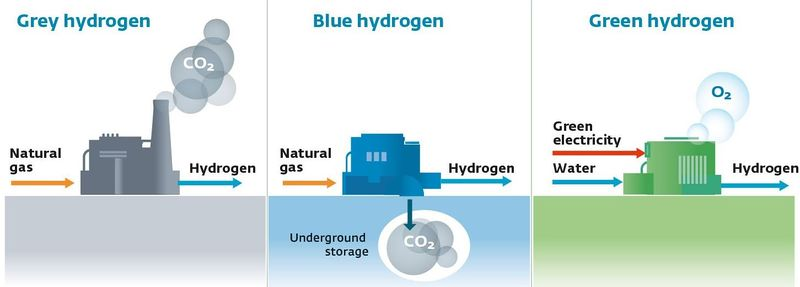
Grey hydrogen refers to hydrogen produced from fossil fuels, primarily natural gas, without carbon capture and storage (CCS) or any emission reduction measures. It is the most widely produced type of hydrogen today but has a significant carbon footprint due to the release of greenhouse gas emissions during production.
Pioneering Countries
Grey hydrogen production is widespread globally, and no specific country can be identified as a pioneer in this type of hydrogen production. Many countries rely on grey hydrogen due to its affordability and availability. Some of the major producers of grey hydrogen include the United States, China, Russia, and Saudi Arabia.
Blue Hydrogen
Blue hydrogen is produced from fossil fuels, primarily natural gas, through a process called steam methane reforming (SMR) or autothermal reforming (ATR). The carbon emissions generated during this process are captured and stored, preventing them from being released into the atmosphere. The stored carbon can be utilized in other applications or permanently stored underground.
Pioneering Countries:
- Norway: Norway is a leading pioneer in blue hydrogen production. Equinor, a Norwegian energy company, is actively involved in developing blue hydrogen projects, including the Northern Lights project, which aims to establish a full-scale value chain for carbon capture and storage (CCS) in Europe.
- Netherlands: The Netherlands is another country pioneering blue hydrogen. The Port of Rotterdam is working on several projects related to blue hydrogen production and infrastructure development, including the H-vision project, aiming to produce hydrogen from natural gas with CCS.
Green Hydrogen
Green hydrogen is produced using renewable energy sources, such as wind, solar, or hydroelectric power, through a process called electrolysis. This method splits water into hydrogen and oxygen, with no carbon emissions involved. Green hydrogen is considered the most sustainable and environmentally friendly form of hydrogen production.
Pioneering Countries:
- Germany: Germany is at the forefront of green hydrogen production. The country has set ambitious targets and launched various initiatives, including the National Hydrogen Strategy, to promote the development and deployment of green hydrogen technologies.
- Australia: With its abundant renewable energy resources, Australia is actively pioneering green hydrogen production. The Australian government has established the National Hydrogen Strategy and is supporting numerous projects, such as the Western Green Energy Hub and the Asian Renewable Energy Hub, to produce and export green hydrogen.
- Japan: Japan, being a significant importer of energy, is actively exploring green hydrogen as an alternative energy source. The country aims to become a global leader in hydrogen technology and has launched the Basic Hydrogen Strategy to promote research, development, and deployment of hydrogen-related technologies.
As the world seeks to decarbonize the energy sector, different types of hydrogen, including blue, black, and green, are being developed and deployed. While countries like Norway and the Netherlands lead in blue hydrogen, Germany, Australia, and Japan are pioneering the production and utilization of green hydrogen. It is crucial for these countries, along with international collaboration, to continue investing in hydrogen technologies to accelerate the transition towards a sustainable energy future.
- European Commission. (2021). Hydrogen Strategy for a Climate-Neutral Europe.
- Equinor. (2021). Northern Lights – Carbon Capture and Storage.
- Port of Rotterdam. (2021). H-vision: Towards a Hydrogen Economy.
- Australian Government. (2021). National Hydrogen Strategy.
- Federal Ministry for Economic Affairs and Energy. (2021). National Hydrogen Strategy.
- Ministry of Economy, Trade and Industry. (2021). Basic Hydrogen Strategy.
- What is hydrogen and how is it made?: The World of Hydrogen.