






Reclaiming Drāviḍa
Why the Sanskrit-internal reading of Tri-vidā (also rendered Tra-vidā), anchored in Sage Agastya, has stronger ground than Caldwell’s Prakrit-detour hypothesis
A hypothesis that has been repeated for a century and a half is not thereby proved. The etymology of Drāviḍa, canonised by Bishop Robert Caldwell in 1856, rests on a chain of inferences that has never been documented. A Sanskrit-internal reading — anchored in the figure of Sage Agastya, the Vedic rishi who carried letters southward — fits the civilisational reality more closely, and deserves to displace the orthodox account.
The Settled Word That Was Never Settled
For more than a century and a half, the etymology of the word Drāviḍa has been treated as a closed question. Bishop Robert Caldwell’s 1856 derivation — Tamiḻ → Damiḷa → Drāviḍa, routed through a Prakrit intermediary — became the standard account in comparative philology and has been repeated, with diminishing scrutiny, in every subsequent textbook. The certainty with which it is restated bears no proportion to the evidence that supports it.
Caldwell did not document this transition. He inferred it. He proposed a chain of sound changes, each individually defensible, none collectively attested. He had no inscription showing the intermediate forms moving in real time. He had a hypothesis — and an institutional moment in which that hypothesis served a larger project of separating the Dravidian linguistic family from the Sanskritic one. The hypothesis hardened into orthodoxy. The orthodoxy hardened into assumption. The assumption is now defended as fact.
This paper proposes that the time has come to reopen the question, and to consider a Sanskrit-internal reading that has been unfairly excluded from serious scholarly engagement: that Drāviḍa derives from Tri-vidā — also written Tra-vidā — meaning the knowers of the three. Its semantic and civilisational anchor is the figure of Sage Agastya, the very rishi to whom the Tamil tradition itself attributes the bringing of letters to the south.
The Caldwell Chain, Examined Honestly
Caldwell’s proposed derivation moves through several stages of sound change across two language families:
Each stage can be defended with reference to general patterns of Indo-Aryan sound change. None of the stages is documented as having actually occurred in this particular word. The Pali and Prakrit form Damiḷa is attested — that much is genuine. But the leap from Damiḷa to Drāviḍa is reconstructed, not observed. The crucial -mi- to -vi- shift, in particular, has been flagged as the weakest joint in the chain even by sympathetic philologists. It is asserted because the chain requires it, not because the evidence demands it.
What Caldwell offered was a plausibility argument. Plausibility is not proof. A chain of inferences, each requiring its own assumptions, multiplies uncertainty rather than resolving it. Caldwell’s account survives not because it is demonstrated but because it became conventional before alternatives were given a hearing.
The Framing Problem in 19th-Century Philology
Caldwell did not approach the etymology of Drāviḍa as a neutral inquiry. His larger project — the establishment of Dravidian as an independent language family separate from Sanskrit — was both a genuine linguistic finding and an instrument of a particular intellectual moment. The independence of Dravidian as a family is a structural fact about grammar and core vocabulary, and it stands. But the etymology of Drāviḍa specifically was deployed in service of a broader argument about civilisational separation, and it inherits the assumptions of that argument.
The default frame of 19th-century European philology held that Sanskrit was a closed corpus to be parsed for inherited meaning, while regional names in Sanskrit texts were typically treated as Sanskritisations of local-language originals. This frame ruled out, almost by reflex, the possibility that Sanskrit had its own native generative capacity to name the south of India from its own roots, in its own grammatical idiom, on the basis of its own civilisational understanding of what the south represented.
Once that frame is suspended — once Sanskrit is restored to its actual status as a generative classical language used by sages, grammarians, and geographers across the subcontinent — the question reopens. What if Drāviḍa is not a Sanskritisation of Damiḷa? What if it is, instead, what it appears on its face to be: a Sanskrit compound, formed by Sanskrit rules, denoting a Sanskrit meaning, applied to a region that Sanskrit civilisation had its own reasons to characterise in a particular way?
Tri-Vidā: The Knowers of the Three
The Sanskrit compound Tri + vidā parses cleanly. The root √vid, meaning to know, to perceive, to realise, is among the most productive in Sanskrit nominal formation. It yields Veda itself. It yields vidvān, the learned one. It yields tattvavid, the knower of essence; brahmavid, the knower of Brahman; trayīvid, the knower of the three Vedas. The suffix -vid attaches to a wide range of preceding elements to designate one who has realised, mastered, or seen through to the truth of what precedes it.
Tri-vidā, then, names those who know the three. The Sanskritic tradition supplies several canonical triads, any of which sustains the reading:
Tri-vidā does not require us to choose a single triad. Sanskrit compounds of this kind characteristically gather multiple resonances simultaneously. The land of Drāviḍa, under this reading, is the land of those who know the three — in any and all of these senses. It is a designation of civilisational quality, not of coastline. It names the south not by its geography but by what its sages had attained.
Sage Agastya as the Civilisational Pivot
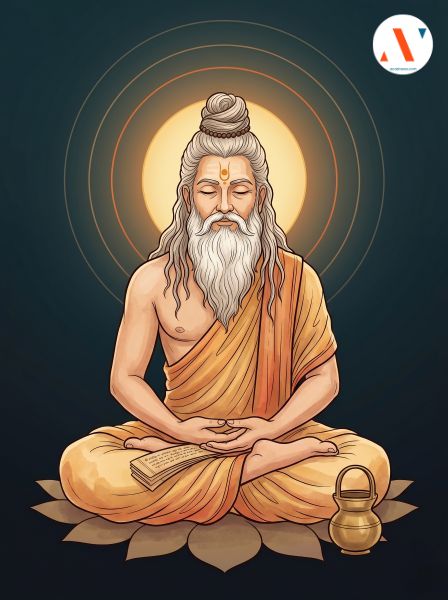
The Tri-vidā reading is not a free-floating philological proposal. It is anchored in a specific civilisational figure whose presence in the south is attested across both the Vedic-Sanskritic and Tamil traditions: Sage Agastya.
Agastya is one of the Saptarishis, the seven seers of the Vedic tradition, and the composer of several hymns in the first maṇḍala of the Ṛgveda. He is, by traditional account, the rishi sent south by Śiva to balance the earth, to teach, to civilise, to bring letters and grammar to the Tamil land. He is the reputed author of the Agattiyam, the foundational Tamil grammar, and the patriarch of the Siddha tradition of southern medicine and yogic realisation. He is among the very few figures jointly claimed by the northern Vedic and southern Tamil civilisational streams as their own — a bridge sage in the most literal sense.
His own composed hymns in the Ṛgveda — including the celebrated dialogue between Agastya and his consort Lopāmudrā in Maṇḍala 1.179, and the suktas attributed to him across 1.165 through 1.191 — are in Vedic Sanskrit. He is not a southern figure who acquired Sanskrit; he is a Vedic rishi of the highest standing whose mission carried him southward.
The civilisational direction of travel, in his case, is from the Sanskritic seership of the Vedic tradition into the Tamil land, not the reverse. When such a figure names a region, or when a region takes its name from his realised attainment, the naming happens in his language — Sanskrit — and according to its civilisational categories. Drāviḍa, as Tri-vidā, is precisely such a Sanskrit naming, attached to a Sanskrit-speaking sage’s presence in the south.
Maṇḍala 1.165–1.191
Speaks Sanskrit
letters & learning
southward
Sanskrit name from the
Tri-vidā who settled it
This is significant for the Caldwell question in a specific way. Caldwell’s entire chain assumes the south was first named in a Dravidian language (Tamiḻ), then borrowed into Prakrit (Damiḷa), then Sanskritised (Drāviḍa). The presence of a Sanskrit-speaking Vedic rishi at the very civilisational founding of the southern tradition collapses that assumption. The naming did not have to wait for Prakrit borrowing; it was available in Sanskrit from the moment Agastya arrived, because Agastya himself embodied what the name designates.
What Agastya represents, in both traditions, is precisely the figure of the trividā — the knower of the three. He is depicted as one who has mastered the three Vedas, perceives the three times, has realised through the three states of consciousness, and stands beyond the three guṇas. The southern land becomes the land of Drāviḍa not because three seas surround it, and not because some Prakrit speakers garbled Tamiḻ into Damiḷa, but because the rishi who established its civilisational character was himself a Tri-vidā.
The Tamil land has always understood itself as a land of sages. The Sangam tradition speaks of generations of poet-seers. The Siddha tradition names its eighteen great realised masters. The figure of Agastya is invoked in both Sanskrit and Tamil ceremonial contexts as the inaugurating presence. A name that captures this self-understanding — Tri-vidā, the land of knowers of the three — fits the civilisational reality. A name reverse-engineered from a phonological garbling of Tamiḻ does not.
Why Tri-Vidā Has Stronger Ground
The case for Tri-vidā over Caldwell’s chain rests on four convergent considerations, taken together rather than singly.
Morphological Transparency
Tri + vidā is a Sanskrit formation that requires no intermediate languages, no inferred sound shifts, no missing inscriptions. It is generated by Sanskrit’s own productive morphology — the same morphology that yields tattvavid, brahmavid, trayīvid. Caldwell’s chain requires three sequential sound changes through two language families.
Semantic Fit With Civilisational Reality
The Tamil land was, and understood itself to be, a land of sages and realised knowers. The Tri-vidā reading captures this self-understanding directly. Caldwell’s reading captures only the linguistic identity of the inhabitants, and only by a chain of phonological accidents.
The Agastya Anchor
A Sanskrit-speaking Vedic rishi, composer of his own Ṛgvedic hymns, went south, established letters, founded the Siddha lineage, and embodied trividic realisation. The naming language and the founding sage share the same medium. Caldwell’s account must invent a borrowing sequence to explain how a Sanskrit name reached a region whose civilisational founder was already speaking Sanskrit.
The Asymmetry of Treatment
When two reconstructions compete and one has morphological transparency, semantic coherence, and a civilisational anchor while the other has none of these, the comparison is not close. The asymmetry in how they have been treated reflects the institutional weight of 19th-century philology rather than evidentiary standing.
The Two Readings, Side by Side
On the Reversibility of Hypotheses
A hypothesis can be proved wrong at a later date. This is not a defect of knowledge; it is its method. The history of comparative philology is itself a history of hypotheses overturned: classifications revised, etymologies abandoned, family trees redrawn as new evidence and clearer reasoning emerged. To insist that Caldwell’s hypothesis must remain in place because it has been in place is to confuse longevity with truth.
The Tri-vidā reading does not require the demolition of comparative Dravidian linguistics. The independence of the Dravidian language family as a structural fact — its grammatical separateness from Indo-Aryan, its core vocabulary, its phonological system — remains intact. What is being reopened is not the family tree but the etymology of one particular word, and with it, a particular framing assumption about the relationship between Sanskrit and the southern civilisational tradition.
What this reopening permits is a more accurate civilisational picture: one in which Sanskrit and Tamil are not adversarial inheritances divided by 19th-century classification but parallel expressions of a single integrated tradition that named itself, in Sanskrit, as the land of those who know the three, and in Tamil, as the land of Agastya’s letters. The two namings are not in competition. They are the same recognition in two registers.
Restoring the Right Reading
Caldwell’s etymology of Drāviḍa is a hypothesis, not a finding. It rests on a chain of inferences that has never been documented, contains a phonological joint that has never been independently demonstrated, and was advanced within a 19th-century framework that systematically treated Sanskrit as a recipient rather than a generator of regional names. It survived not because it was proved but because it was repeated.
The Tri-vidā reading, anchored in the figure of Sage Agastya and grounded in Sanskrit’s own productive morphology, has stronger reasons to be accepted. It is morphologically transparent. It is semantically coherent with the civilisational self-understanding of the southern land. It is anchored in a Sanskrit-speaking rishi whose presence in both traditions is attested. And it does not require the linguistic gymnastics that Caldwell’s chain depends on.
It is time to restore Drāviḍa to its civilisational meaning: the land of those who know the three. The land of Agastya. The land where Sanskrit and Tamil were never adversaries, only voices of the same realisation.