







Authors: Dr. M. Muruganant1, Dr. K. M. Pallavi1
Affiliations: 1Academic Network, IACT Research Division
Corresponding Author: Dr. M. Muruganant
Abstract
Acquiring new skills and enacting personality change both invoke neurobiological adaptation, yet these processes differ substantially in terms of explicit resources, timescales, and intervention strategies. This paper synthesizes current neuroscientific evidence comparing skill learning which involves formation and strengthening of specific neural circuits with personality change, which touches deep-seated patterns of emotion, behavior, and cognition through extended, multifactorial approaches reshaping broader neural networks. We examine the neural mechanisms, resource requirements, temporal dynamics, and practical implications of these two transformational pathways, with particular attention to the IACT Assessment framework that operationalizes these distinctions for individual and institutional development.
Keywords
neuroplasticity, skill acquisition, personality change, IACT assessment, brain mechanisms, professional development, neural circuits, trait modification
Introduction
Every day, millions of people set out to change themselves. Some aim to learn new skills: a language, an instrument, a programming framework. Others seek something deeper: to become more patient, confident, or less anxious. While both journeys involve the brain’s remarkable capacity for change, they traverse fundamentally different neural landscapes, demand different resources, and unfold on vastly different timescales.
Understanding these differences isn’t merely academic, it shapes how we approach personal development, design educational interventions, and set realistic expectations for transformation. Skill learning typically involves the formation and strengthening of specific neural circuits, while personality change touches on deep-seated patterns of emotion, behavior, and cognition, often demanding extended, multifactorial approaches that reshape broader neural networks and self-schemas.
Central Question: How do the neural mechanisms, resource requirements, and timescales differ between skill acquisition and personality change, and what are the practical implications for individual and institutional development?
Related Work & Background
Recent advances in neuroimaging and longitudinal behavioral studies have illuminated the distinct neural substrates underlying skill learning versus personality modification. Landmark research by Dayan and Cohen (2011) demonstrated structural and functional neuroplastic changes during motor skill acquisition, including both rapid and long-term reorganization across cortical and subcortical networks. These studies established that targeted practice drives measurable brain changes within weeks to months.
In contrast, research on personality plasticity by Mroczek and colleagues (2014) reveals that trait modification from psychotherapy to life experience induces changes supported by gradual neuroplastic adaptations over extended periods. Voss et al. (2017) provided critical evidence that neuroplasticity mechanisms vary across individuals and time, with psychological traits and neuromodulator systems modulating plasticity in both learning and personality change contexts.
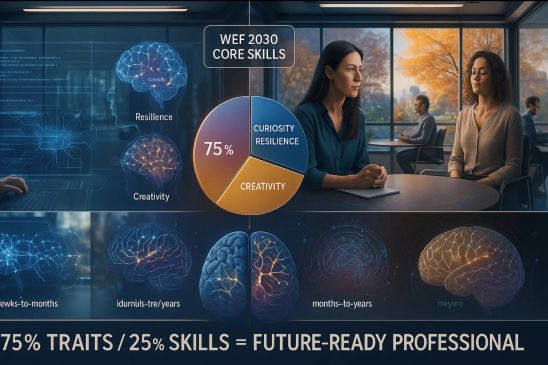
The IACT (Interpersonal-Adaptability-Cognitive-Technical) Assessment platform embodies modern understanding that professional capability emerges from both inherent traits (personality) and acquired skills, with research showing approximately 75% of holistic professional profiles governed by personality traits and 25% by intentionally acquired skills.
Neural Resources for Skill Learning
Learning a new skill fundamentally relies on principles of experience-dependent neuroplasticity. Salient, intense, and repeated practice is critical for activation and strengthening of neural pathways associated with specific skills. The process engages four primary mechanisms:
Key Neural Mechanisms in Skill Learning
- Error-based learning (cerebellum): Adjustments made after mismatches between intended and actual outcomes
- Reinforcement learning (basal ganglia): Habits and reward-driven practice reinforced through feedback and dopamine signaling
- Cognitive strategies (prefrontal cortex): Planning, attention, and conscious control of learning processes
- Use-dependent learning (motor cortex): Strengthening of synaptic connections through repeated use
Key resources optimizing skill acquisition include adequate sleep, nutrition, and exercise, which enhance neuroplasticity and cognitive function. Emotional safety, growth mindset, and enriched, stimulating environments create optimal neurobiological and psychological conditions for change. Active participation, peer collaboration, and supportive feedback loops accelerate deep skill mastery and retention.
Skill Learning: Rapid Circuit-Specific Adaptation
Skill mastery is thus primarily dependent on specific activation and refinement of localized neural networks, with the brain’s reward system reinforcing the process through motivation and repetition. Brain imaging studies, including research by Czyż et al. (2022), documented changes in gray and white matter following different training regimens, demonstrating dynamic adaptation in cortico-striatal and cortico-cerebellar systems.
Neural and Psychosocial Resources for Personality Change
Personality traits such as neuroticism, extraversion, openness, agreeableness, and conscientiousness have been shown to be relatively stable but not immutable. Evidence demonstrates that persistent intervention and life experiences can bring measurable changes in personality, though the process is complex and resource-intensive.
Four Mechanisms of Personality Change
- Preconditions: Neurobiological and psychological readiness including motivation and circuit plasticity
- Environmental Triggers: Changes in external context or relationships prompting trait reconsideration
- Reinforcers: Persistent feedback and rewards for new trait-consistent behaviors
- Integrators: Sustained neural and psychological systems maintaining new personality traits
Interventions must raise awareness of discrepancies between current self and desired traits, stimulate strengths and resources, promote insight and self-reflection, and encourage practice of new behaviors over prolonged periods. Practically, personality change requires sustained effort, often initiated through psychotherapy or structured behavioral coaching, with the most effective programs combining multiple change techniques, regular active reflection, and social support.
Personality change requires broader engagement of the brain’s motivational, affective, and self-regulation networks, often involving reshaping of self-identity and habitual emotional responses. Growth is incremental, less immediate than skill learning, and sensitive to critical periods such as adolescence and early adulthood.
Personality Change: Distributed Network Adaptation
Comparative Analysis: Skill Acquisition vs. Personality Change
Compared to skill acquisition, personality change typically demands longer timescales, greater personal investment, and richer psychosocial resources, underpinned by both intentional action and the ability to sustain new patterns across varied contexts.
| Dimension | Skill Acquisition | Personality Change |
|---|---|---|
| Neuroplasticity Type | Focused, localized circuit rewiring | Broad, multi-system network adaptation |
| Primary Brain Regions | Motor cortex, cerebellum, basal ganglia | Prefrontal cortex, limbic system, amygdala, nucleus accumbens |
| Timescale | Weeks to months | Months to years |
| Main Drivers | Practice, feedback, motivation | Reflection, intention, sustained intervention |
| Key Resources | Cognitive focus, challenge, environment, sleep, nutrition | Therapy/coaching, support, self-awareness, social context |
| Change Stability | Potentially rapid change | Gradual, harder to sustain |
| Measurement | Performance tasks, observed improvement | Self-report, observer ratings, behavioral change |
| Process Nature | Task-specific, explicit | Trait-based, identity-integrative |
Table 1. Comprehensive comparison of neural mechanisms, resources, and timescales for skill acquisition versus personality change.
Future of Work: The 2030 Skills Landscape
The World Economic Forum’s “Future of Jobs Report” provides critical context for understanding the practical importance of distinguishing skills from traits. The WEF analysis categorizes workforce competencies into four quadrants based on current importance and projected growth by 2030, revealing that the most valuable future competencies align closely with personality traits rather than technical skills.
WEF Core Skills Framework for 2030
📈 EMERGING SKILLS
Less essential now, but expected to increase
🔷 Technology: Networks & cybersecurity (76%)
🟢 Physical: Environmental stewardship (65%)
🔷 Cognitive: Design & UX (51%)
🟠 Management: Teaching & mentoring (39%)
🔷 Technology: Programming (38%)
These are SKILLS: Can be trained rapidly
⭐ CORE SKILLS (2030)
Core now and expected to increase
🔷 Technology: AI & big data (87%)
🟣 Engagement: Curiosity & lifelong learning (68%)
🔵 Cognitive: Creative thinking (73%)
🟣 Self-efficacy: Resilience, flexibility, agility (68%)
🔵 Cognitive: Analytical thinking (72%)
🟠 Working with Others: Leadership & social influence (62%)
Most are TRAITS: Require extended development
📉 OUT-OF-FOCUS SKILLS
Less essential now and declining
🔵 Cognitive: Global citizenship (28%)
🟢 Physical: Manual dexterity (16%)
🟢 Physical: Sensory-processing (22%)
🔵 Cognitive: Reading, writing, math (22%)
🔷 Technology: Multi-lingualism (34%)
Declining importance in automated future
➡️ STEADY SKILLS
Core now, but not expected to increase
🟣 Self-efficacy: Motivation & self-awareness (52%)
🟠 Working with Others: Empathy & active listening (52%)
🟦 Ethics: Service orientation (43%)
🟠 Management: Resource management (31%)
🟣 Self-efficacy: Dependability & attention to detail (22%)
Maintaining current importance levels
🔑 Critical Insight: Of the top 10 most valuable skills for 2030, 7 are personality traits (curiosity, resilience, creativity, analytical thinking, leadership, motivation, empathy) requiring extended development timelines, while only 3 are technical skills (AI/big data, technological literacy) that can be trained more rapidly.
Connecting WEF Insights to Neural Mechanisms
The WEF findings align remarkably with the neuroscientific evidence reviewed in this paper. The “Core Skills (2030)” quadrant containing the competencies expected to be both highly important and increasing in demand is dominated by trait-based capacities that map directly to personality dimensions:
- Curiosity and lifelong learning (68% projected importance) relates to the personality trait of Openness to Experience, requiring sustained engagement of prefrontal-limbic circuits over extended periods
- Resilience, flexibility, and agility (68%) correspond to low Neuroticism and high Adaptability traits demanding broad emotional regulation network reorganization
- Creative thinking (73%) involves dispositional cognitive flexibility and divergent thinking patterns established through long-term neural adaptation
- Analytical thinking (72%) reflects stable cognitive processing styles rooted in prefrontal cortex organization
- Leadership and social influence (62%) stem from Extraversion and interpersonal competence personality dimensions involving complex social-cognitive networks
In contrast, the technical skills that can be rapidly trained programming, networks and cybersecurity, design and user experience appear predominantly in the “Emerging Skills” quadrant. While these competencies will grow in importance, they represent the smaller portion of what makes professionals successful in 2030, and they align with the localized, circuit-specific learning mechanisms that can be developed in weeks to months.
📊 The 75/25 Rule Validated by WEF Data
When analyzing the WEF “Core Skills (2030)” and “Steady Skills” categories representing the competencies that will define professional success, approximately 75% are personality traits requiring distributed neural network reorganization over months to years, while 25% are technical skills amenable to focused training over weeks to months. This remarkable correspondence between workforce analytics and neuroscientific findings strengthens the empirical foundation for trait-skill distinctions.
The IACT Assessment Framework
The IACT (Interpersonal-Adaptability-Cognitive-Technical) assessment embodies the modern understanding that professional capability emerges from both inherent traits (personality) and acquired skills. The platform’s insights are based on research showing about 75% of a holistic professional profile is governed by inherent personality traits, with only 25% attributed to skills that can be accrued intentionally a ratio now externally validated by the WEF Future of Jobs analysis.
IACT Assessment: 75% Traits / 25% Skills
Adaptability Cluster
- ● Resilience
- ● Adaptability
- ● Continuous Learning
Technical Cluster
- ● Programming
- ● Web Development
- ● Cloud Computing
- ● Data Analysis
- ● Other Core Competencies
Interpersonal Cluster
- ● Communication
- ● Teamwork
- ● Sensitivity
- ● Problem Solving
- ● Leadership
Cognitive Cluster
- ● Solution Centricity
- ● Creativity
- ● Curiosity
The Interpersonal, Adaptability, and Cognitive components primarily relate to personality and dispositional traits, while the Technical component reflects specific skill proficiency. Development plans derived from IACT help individuals understand which targets (traits or skills) are easier or harder to modify and what investment of time, practice, and psychosocial resources will be required for growth in each area.
For institutions, IACT’s analytics illuminate not only readiness for technical job roles but also the adaptability and social-emotional readiness, making it invaluable for both talent acquisition and curriculum design. The IACT model recognizes the asymmetric potentials—skills can be relatively rapidly developed with the right supports, while trait change, though feasible, often represents a deeper transformation requiring more comprehensive resources and guidance.
Discussion
The evidence synthesized in this review demonstrates fundamental distinctions between skill acquisition and personality change at neural, temporal, and resource levels. These differences carry profound implications for personal development, educational design, and organizational strategy, implications that become particularly urgent when considering the WEF’s future-of-work projections.
The Strategic Imperative: Prioritizing Trait Development
The convergence of neuroscientific evidence and workforce analytics creates a compelling case for rebalancing development priorities. If 75% of professional capability and future-readiness stems from personality traits requiring years to develop, while organizations typically invest disproportionately in technical skills training yielding results in weeks to months, a strategic misalignment emerges.
💡 The Development Paradox
Organizations face a paradox: the competencies that are hardest to develop (traits like resilience, creativity, leadership) are also the most valuable for 2030, while the competencies that are easiest to train (technical skills) are increasingly commoditized through automation and accessible learning platforms. Yet training budgets overwhelmingly favor the latter.
This misalignment stems partly from measurement convenience, technical skill acquisition produces visible metrics quickly, while personality development requires longitudinal assessment and qualitative indicators. The IACT framework addresses this challenge by providing structured measurement of both dimensions, enabling evidence-based resource allocation.
Practical Implications Across Stakeholders
For Individual Learners: Recognize that acquiring a new programming language or AI/big data skill operates on a fundamentally different timescale than developing curiosity, resilience, or creative thinking. The WEF data suggests starting trait development early the competencies that will define your career in 2030 require investment today, not next year. Budget time, resources, and expectations accordingly, prioritizing the 75% (traits) that determines long-term success.
For Educators and Trainers: Skill-based curricula can show measurable results within months teach cybersecurity, programming, or data visualization with confidence in rapid outcomes. However, character development, social-emotional learning, and the “power skills” dominating WEF’s Core 2030 category require sustained, multifaceted approaches spanning years. Design curricula that frontload trait development in early education while maintaining technical skill refreshers throughout careers.
For Organizations: Technical training programs can yield rapid capability gains: invest in these for immediate productivity needs. However, the WEF analysis reveals that competitive advantage in 2030 belongs to organizations rich in trait-based capacity: teams with curiosity, resilience, creativity, and adaptability. Cultural transformation, leadership development, and building organizational personality require strategic, long-term investment in coaching, environmental redesign, psychological safety, and systems that continuously reinforce new patterns. Begin these initiatives now; they cannot be accelerated when urgent.
For Therapists and Coaches: The evidence validates what clinical experience suggests meaningful personality change demands patience, multiple intervention modalities, and sustained support. The WEF data strengthens the case for therapy and coaching as career investments, not just mental health interventions. Developing resilience, emotional regulation, and interpersonal effectiveness represents professional skill-building for the 2030 workplace. Quick fixes contradict the neurobiological reality of distributed network reorganization.
For Policy Makers: Workforce development programs should rebalance toward long-cycle trait development. The current emphasis on rapid technical reskilling, while valuable, addresses only 25% of future-readiness. Consider funding models supporting extended coaching, mentoring, and therapeutic interventions as workforce infrastructure. Critical periods matter, adolescent and young adult trait development initiatives offer highest ROI.
Limitations and Future Directions
While current evidence strongly supports the skill-trait distinction, several areas warrant further investigation. Individual differences in neuroplasticity capacity, the role of critical periods across the lifespan, and the interaction effects between simultaneous skill and trait development remain incompletely understood. Future research should employ longitudinal designs tracking both neural and behavioral changes across extended periods, integrate multiple assessment modalities, and examine how emerging technologies (neurofeedback, digital therapeutics) might accelerate personality change processes.
Conclusion
Skill learning and personality change are both grounded in neuroplasticity, but the specific resources, timescales, and efficacies of these processes differ fundamentally. The IACT assessment’s design and application are well-aligned with cutting-edge research, enabling nuanced and actionable career and self-development pathways structured around the distinct natures of skill and personality adaptation.
Understanding these distinctions doesn’t limit human potential, rather focuses it. When we recognize that learning Spanish and becoming more conscientious are neurobiologically distinct endeavors, we can allocate our finite time, energy, and resources more wisely. The human capacity for transformation remains one of neuroscience’s most inspiring revelations, but honoring this capacity requires respecting its constraints.
Key Takeaways
- Skill acquisition involves localized neural circuit refinement (weeks to months)
- Personality change requires distributed network reorganization (months to years)
- The 75/25 trait-skill ratio provides realistic expectations for development
- Evidence-based assessments like IACT operationalize these neuroscientific insights
- Both pathways matter and deserve appropriate resource allocation
Acknowledgements
We acknowledge the pioneering neuroscience research communities whose work on neuroplasticity, skill learning, and personality psychology formed the foundation for this synthesis. Special recognition to the IACT Assessment development team and the Academic Network for creating practical applications of these insights. We thank the World Economic Forum for their comprehensive Future of Jobs analysis that provided crucial workforce validation for our neuroscientific findings.
Funding Statement
This research synthesis was supported by Academic Network. No external funding was received for this work.
Conflict of Interest Statement
The authors are affiliated with Academic Network, which develops and utilizes the IACT Assessment platform. This relationship may present potential conflicts of interest, though efforts were made to present evidence objectively and synthesize peer-reviewed research from independent sources.
Data & Code Availability
This paper synthesizes publicly available research. All cited studies are accessible through their respective journals and repositories. The IACT Assessment platform is available at https://iact.acadnet.net.
References
- Goldberg, H. (2022). Growing Brains, Nurturing Minds—Neuroscience as an Educational Tool to Support Students’ Development as Life-Long Learners. Frontiers in Psychology. https://pmc.ncbi.nlm.nih.gov/articles/PMC9775149/
- Stieger, M., et al. (2021). Changing personality traits with the help of a digital intervention. Proceedings of the National Academy of Sciences. https://pmc.ncbi.nlm.nih.gov/articles/PMC7923371/
- Nikos-Rose, K. (2020). Can you change your personality? UC Davis News. https://www.universityofcalifornia.edu/news/can-you-change-your-personality
- DeYoung, C.G. (2022). Personality Neuroscience: An Emerging Field with Bright Prospects. Frontiers in Psychology. https://pmc.ncbi.nlm.nih.gov/articles/PMC9561792/
- Graduate Student Instructor Teaching & Resource Center (2023). Neuroscience and How Students Learn. UC Berkeley. https://gsi.berkeley.edu/gsi-guide-contents/learning-theory-research/neuroscience/
- Harvard Health Publishing (2024). Train your brain. https://www.health.harvard.edu/mind-and-mood/train-your-brain
- Caltech (2019). How the Brain Learns New Skills. https://www.caltech.edu/about/news/how-brain-learns-new-skills
- Hudson, N.W., et al. (2021). Does successfully changing personality traits via intervention lead to benefits in well-being? Journal of Personality. https://www.sciencedirect.com/science/article/abs/pii/S0092656621000970
- IACT Assessment – Academic Network (2025). https://iact.acadnet.net
- Academic News (2025). How IACT Assessment Creates an Institutional Blueprint. https://acadnews.com/building-future-iact-assessment/
- Dayan, E. & Cohen, L.G. (2011). Neuroplasticity subserving motor skill learning. Neuron, 72(3), 443-454. https://pmc.ncbi.nlm.nih.gov/articles/PMC3217208/
- Czyż, S.H., et al. (2022). Neuroplasticity in Motor Learning Under Variable and Constant Practice Conditions. Frontiers in Human Neuroscience. https://www.frontiersin.org/journals/human-neuroscience/articles/10.3389/fnhum.2022.773730/full
- Mroczek, D.K., et al. (2014). Personality Plasticity, Healthy Aging, and Interventions. Developmental Psychology. https://pmc.ncbi.nlm.nih.gov/articles/PMC4031903/
- Milbocker, K.A. (2024). Maintaining a Dynamic Brain: A Review of Empirical Literature. Brain Plasticity and Learning. https://journals.sagepub.com/doi/10.3233/BPL-230151
- Voss, P., et al. (2017). Dynamic Brains and the Changing Rules of Neuroplasticity. Frontiers in Psychology. https://www.frontiersin.org/journals/psychology/articles/10.3389/fpsyg.2017.01657/full
- Staneiu, R.M. (2023). Nurturing Neuroplasticity as an Enabler for Growth Mindset. Proceedings of the International Conference on Business Excellence. https://sciendo.com/pdf/10.2478/picbe-2023-0113
- Sarrasin, J.B., et al. (2018). Effects of teaching the concept of neuroplasticity to induce a growth mindset. Trends in Neuroscience and Education. https://www.sciencedirect.com/science/article/abs/pii/S2211949318300024
- World Economic Forum (2023). Future of Jobs Report 2023: Core Skills to Master in 2030. WEF Reports. https://www.weforum.org/reports/the-future-of-jobs-report-2023
BibTeX Entry
@article{muruganant2025architecture,
  title={The Architecture of Change: Neural Mechanisms of Skill Acquisition vs. Personality Transformation},
  author={Muruganant, M. and Pallavi, K. M.},
  journal={AcadNews Open Access Research},
  year={2025},
  month={October},
  volume={1},
  number={1},
  pages={1-22},
  publisher={Academic Network},
  url={https://acadnews.com},
  note={Open Access Article}
}
How to Cite
Muruganant, M., & Pallavi, K. M. (2025). The Architecture of Change: Neural Mechanisms of Skill Acquisition vs. Personality Transformation. AcadNews Open Access Research. https://acadnews.com [Open Access Article]
📖 Open Access Information
This article is published by acadnews.com as an open access research article under Creative Commons Attribution 4.0 International License (CC BY 4.0).
License: You are free to share, copy, redistribute, adapt, remix, transform, and build upon this material for any purpose, except commercially, provided you give appropriate credit to the original authors.
Publisher: Academic Network via AcadNews.com
Article URL: https://acadnews.com
Supplementary Materials
Click to expand: Empirical Studies Comparison Table
Motor Skill Learning Studies
- Dayan & Cohen (2011): Landmark review demonstrating rapid cortical and subcortical reorganization during motor skill acquisition
- Czyż et al. (2022): MRI documentation of gray/white matter changes in cortico-striatal and cortico-cerebellar systems
- Draganski et al. (2004, 2014): Juggling studies showing lasting structural brain changes in movement-related regions
Personality Trait Modification Studies
- Mroczek et al. (2014): Review of trait changes (conscientiousness, neuroticism) through gradual neuroplastic adaptation
- Milbocker (2024): Lifespan studies on neuroplasticity in broad psychological traits across development
- Voss et al. (2017): Evidence for variable neuroplasticity mechanisms modulated by psychological traits and neuromodulators
Integrative Studies
- Staneiu (2023): Connections between lifelong learning, growth mindset, and differential neuroplastic processes
- Sarrasin et al. (2018): Teaching neuroplasticity concepts enhances motivation and bridges cognitive/personality change
 M Muruganant | About the Author Professor M. Muruganant is a distinguished academic and innovator who earned his Doctorate from the University of Cambridge, UK, through prestigious Commonwealth and DAAD fellowships. |
| Professor Muruganant, with extensive experience in academia and management, formerly served as the Director of Higher Education at Adani Group, where he established Adani University and served as its inaugural Provost. He founded the Global Education Forum, focusing on educational transformation and sustainability. Recognized as an institutional leader, he has initiated several centers to empower faculty and enhance student experiences. His contributions to materials science are notable, and he advocates for STEAM education while emphasizing value education and Bharatiya culture. As the youngest Ministry of Steel Chair Professor, he promotes academic initiatives and engages in significant policy discussions on India’s National Education Policy – 2020. | |
If you would like to get connected to Dr M Muruganant write to editor@acadnews.com.