




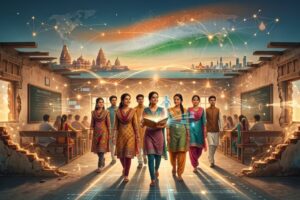
As of July 2023, the educational landscape in India is diverse and dynamic. Here are some key aspects of the current educational scenario in the country:
- School Education: The school education system in India follows a 10+2 structure, with 10 years of primary and secondary education (grades 1-10) followed by two years of higher secondary education (grades 11-12). The Central Board of Secondary Education (CBSE) and the Indian Certificate of Secondary Education (ICSE) are the two major national boards of education, while each state also has its own state board.
- Government Initiatives: The government has implemented several initiatives to improve access and quality of education, such as the Sarva Shiksha Abhiyan (SSA) for universal elementary education, the Mid-Day Meal Scheme for providing free meals to school children, and the Rashtriya Madhyamik Shiksha Abhiyan (RMSA) for secondary education.
- Private Education: Private schools play a significant role in the Indian education system, offering a wide range of educational options. They vary in terms of curriculum, fees, and infrastructure, catering to different segments of society.
- Higher Education: India has a vast and diverse higher education sector, with universities, colleges, and institutions offering undergraduate, postgraduate, and doctoral programs. The University Grants Commission (UGC) is the regulatory body responsible for maintaining the standards of higher education institutions.
- Entrance Examinations: Entrance examinations are a crucial part of the higher education system in India. Popular exams include the Joint Entrance Examination (JEE) for engineering, the National Eligibility cum Entrance Test (NEET) for medical courses, and the Common Admission Test (CAT) for management programs.
- Technical and Professional Education: India has a strong emphasis on technical and professional education. Institutes such as the Indian Institutes of Technology (IITs), National Institutes of Technology (NITs), and Indian Institutes of Management (IIMs) are renowned for their quality education and research.
- Online and Distance Learning: Online and distance learning programs have gained popularity, providing flexibility and accessibility to learners. Several universities and institutions offer online courses and degree programs.
- Skill Development: The government has focused on skill development initiatives to enhance employability. Skill development programs, vocational training centers, and apprenticeship schemes aim to bridge the gap between education and industry requirements.
- Challenges: Despite progress, the Indian education system faces challenges such as inadequate infrastructure, teacher shortages, regional disparities, and a need for curriculum reforms to align with industry needs.
- Digital Education: The COVID-19 pandemic accelerated the adoption of digital education in India. Online classes, e-learning platforms, and digital resources have become integral parts of the education system, enabling remote learning.
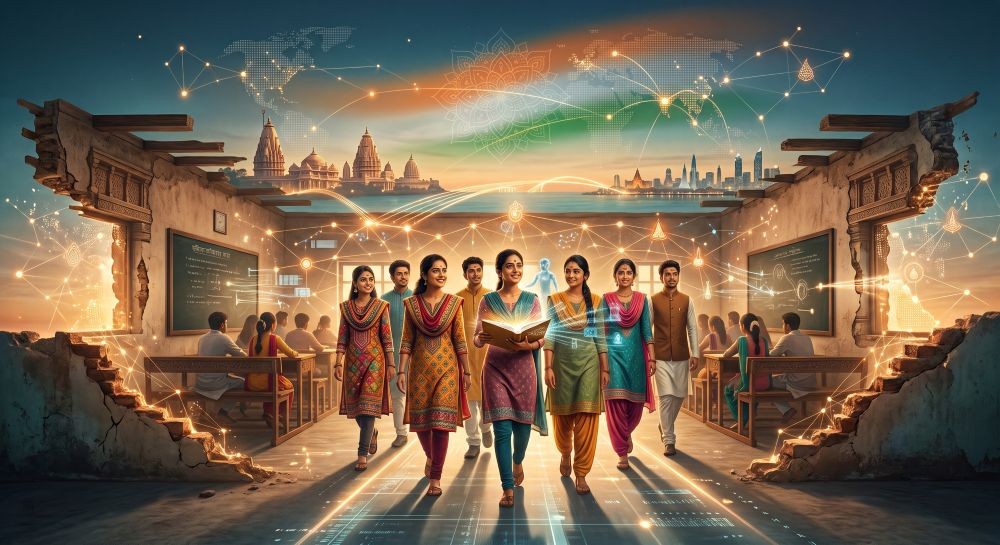
The educational landscape in India is evolving, with efforts to improve access, quality, and relevance of education across different levels, more so with introduction of the National Education Policy.
The National Education Policy (NEP) in India aims to address several aspects of the current educational landscape and bring about transformational changes. Here’s how the NEP intends to address some of the key challenges and areas of improvement:
- School Education:
- The NEP emphasizes a holistic and multidisciplinary approach to education, promoting a flexible curriculum that focuses on critical thinking, creativity, and problem-solving skills.
- It aims to reduce the curriculum load on students and promote vocational education and experiential learning from an early age.
- The policy also emphasizes the use of technology and digital resources to enhance the quality of education and make it more accessible.
- Higher Education:
- The NEP aims to transform higher education by promoting a multidisciplinary and flexible curriculum, allowing students to choose courses across disciplines and encouraging research and innovation.
- It seeks to establish research clusters and centers of excellence to promote collaborative research and enhance the quality of higher education institutions.
- The policy also focuses on internationalization and industry-academia collaboration to provide students with global exposure and improve their employability.
- Skill Development:
- The NEP recognizes the importance of skill development and vocational education. It aims to integrate vocational education into mainstream education and provide multiple entry and exit points for learners.
- The policy emphasizes the establishment of skill development centers and apprenticeship programs to bridge the gap between education and industry requirements.
- Digital Education:
- The NEP recognizes the significance of digital education, especially in the wake of the COVID-19 pandemic. It aims to promote online and distance learning through the use of technology and digital platforms.
- The policy emphasizes the development of a robust digital infrastructure, connectivity, and digital resources to ensure equitable access to quality education.
- Equity and Inclusion:
- The NEP focuses on promoting equity and inclusion in education. It aims to provide equal opportunities for all students, irrespective of their socio-economic background or location.
- The policy emphasizes the provision of financial assistance and scholarships to support students from economically disadvantaged backgrounds.
- It also seeks to incorporate indigenous knowledge systems and practices into the education system, promoting cultural diversity and inclusivity.
Overall, the NEP addresses various aspects of the current educational landscape by emphasizing flexibility, quality, inclusivity, and the integration of technology and vocational education. It aims to bring about comprehensive reforms that cater to the evolving needs of students and the society.