






Global economy grappling with environmental challenges calls for a better goal than ‘growth’ to thrive within planetary limits. The solution lies in needonomics as queen of social sciences for global economy based on Gita guided by principles of needo-consumption (mindfulness in consumption), offers a promising path towards sustainable thriving.
To respond to the question that we are to do what? why? when? where? for whom to face the environmental challenges, the objective of this paper is to develop understanding of needonomics with solutions of prevailing problems caused by Greedonomics (economics of greed) and prove it as queen of social sciences. It is pertinent to mention that economics is the queen of social sciences as called by Paul Samuelson (1957, p Samuelson. 259). It is true that economics was the queen of the social sciences when it consisted of brilliant men revealing surprising truths about the nature of societal interaction. Sadly, we have to accept that we adopt trial-and-error policy experiments, and calling it academic research which brings bad name to the subject.
Economics is the mother science of all the subjects including commerce and management as are in demand today. Even to become politician in power or opposition with any political party in the World knowledge of economics is a must. The contemporary developments in the world economy and consequent policy ethos have only added to the felt-need for trained/professional economists ready to take on the challenges of a globalized ‘knowledge-economy’.
We may like it or not, there is no escape from the reality of goods and services. As long as these goods are to be produced and distributed with reference to the claims made in the present, without losing sight of the future, some kind of ‘rationality’ would be called for, and hence the need for Economics as a discipline. More so, when we are living in a world full of contrasts- plenty coexisting with dehumanizing poverty, one often asks the following set of questions:
Who is to do What?, Why? When? Where? for Whom with Altruism
Why we are where we are and others in a different position?
Can goods and services be different for us?
What can we learn from the experiences of others as consumers, producers, distributors and traders
Can we tap the accumulated knowledge for alleviating poverty of one and all?
Can we ensure needo-governance for inclusive growth?
What are the options, instruments, and institutions available to us?
Additionally, the leaders in all walks of life also require, and play with, strategies to stay at the top. For some it is a question of initiating change and bridging the gap, for others it is the management and sustainability of economic growth that is more important. Both sets are faced with economic questions and seek authentic answers. There is certainly a case for making the present courses of study relevant for catering to the new/emerging demands on the profession and challenges faced by global economy. To serve the society (All minus Myself) with altruism and without traveler’s dilemma, let God provide us tons of opportunities to prove our worth and potential as academics in economics for all times to come. May our soul become compassionate to learn that it is beneficial to save even one soul from Mahamaya’s prison (Greedonomics) and prisoner’s dilemma. This calls for promoting Needonomics as a subject of relevance which is capable of removing the FEAR (False Evidence Appearing Real) of the so called global economic crisis very well diagnosed by former US President Obama as a consequence of greed and irresponsible behavior of some. To ensure sustainable development in the present times of global economic crisis, there is an urgent need of re-writing the theory of finance for which economists are to be motivated to do serious research.
Needonomics prioritize the collective well-being of society and the planet over relentless growth. It emphasizes the concept of “needo-insurance” to ensure the happiness and prosperity of all within the limits of our planetary resources. It proposes a shift towards a more balanced and equitable distribution of wealth and resources.
Contrary to the traditional emphasis on GDP and per capita income as measures of success, Needonomics advocates for needo-happiness as the ultimate goal. The true prosperity lies not in extravagant wealth, but in meeting basic needs while safeguarding our environment for future generations.
To achieve this vision, we must enact policies that promote public provisioning and reduce excessive private spending. Take the case of Barcelona or Paris, where residents embrace smaller living spaces and rely on efficient public utilities, such as transportation systems, parks, and recreational facilities. We can minimize over-consumption and mitigate environmental degradation by prioritizing public infrastructure and services.
As we strive towards a sustainable future, Needonomics offers a practical framework for transforming lifestyles and fostering collective well-being. By embracing this holistic approach, we can build a more resilient and equitable society that thrives within the boundaries of our planet.
To be an economist of present era, accept the role and responsibility to ensure needs be fulfilled ( nothing of market mechanism, pricing). Trusteeship of resources and believe in Needonomics as a queen of social sciences for society as a whole. We must learn patience in pain and humbleness in happiness as necessary skill of becoming developed.
To put principle of needonomics into practice, there is a case of needonomics action lab (NAL) to work without worries (www) as a team of solutions without blame game.
Economics which I learnt and even taught today is misguiding people to be greedy as consumers for enhancing consumption of goods and services not needed.
To prepare our youth (the so called demographic dividend) for knowledge economy, we must provide needo-education of needonomics. No one be short of needs including food, water, health education as performance indicator of developed world.
We must convert minority of tax payers ( 2.2 percent under 21 million of adult people) into majority in India as in France 78.3 percent, UK 59.7 percent and USA 50 percent as performance indicator of Viksit Bharat. We must tax agricultural income (nontaxable presently ) as per their capacity to pay tax. We must ensure happiness in doing nothing (niksen) as meditative lifestyle for needo-peace with calmness. We have to understand and adopt needonomics (economics of needs) flowing from the LIC of India logo ‘Yogakshemam Vahamyaham’ (Your welfare is our responsibility) authenticated in Gita ( 9:22) . The simple solution of the challenges and problems faced by us lies in Gita-based needonomics. We must understand Needonomics in totality including needo-consumption, needo-saving, needo-investment, needo-growth, needo-employability, needo-entrepreneurship, needo-trade for glocalization (think globally and act locally) needo-altruism for needo-health, needo-wealth and needo-happiness. As a needonomics teacher is to teach as role model with mind, body and environment ( MBE) under control as management by exceptional (MBE) to be Street SMART (simple, moral, action-oriented, responsive and transparent) for proving needonomics as queen of social sciences for all times to come.
- M.M. Goel: Impact of Covid-19 on Global Economy: Relevance of Needonomics, Global Research Journal-1 2022, , London WC1N3AX United Kingdom (click here)
- M.M. Goel: Innovative Solutions for Needo-education in Swarnim Bharat, COJ Review & Research USA 4(4) 000591.2022, November , ISSN 2639-0590 DOI: 10.31031/COJRR.2022.04.000591
- M.M. Goel: Relevance of Needonomics for Revival of Global Economy, Dailyworld, July 09,2020
- M.M. Goel & B.B.Tiwari: Rationale of Needo-financing : An analysis of Fiscal Policy of Haryana Varta Vol. XLI ,April 2020,No 1 Peer Reviewed Journal ISSN 09709177,pp 05-15
- M.M. Goel: Challenges and relevance of economics as queen of social sciences in present scenario, European Scientific Journal (ESJ) June 2013 /special/ edition No.1 ISSN: 1857 – 7881 (Print) ISSN: 1857 – 7431 (Online)
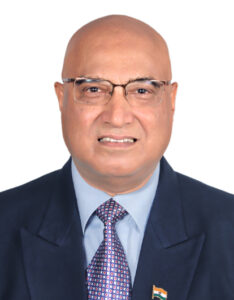 Dr. M M Goel | About the Author Propounder Needonomics, Professor Madan Mohan Goel is a superannuated Professor of Kurukshetra University. He is former Vice-Chancellor, Starex University, Gurugram, Jagannath University Jaipur, RGNIYD (GOI), Pro Vice-Chancellor VKSU Ara, Dean of Colleges & Social Sciences, Chairman, Dept. of Economics & Dept. of Journalism KUK He was the first ICCR Chair Professor in South Korea. Presently he is an Adjunct Professor at the Institute of Advanced Sciences Dartmouth, USA. He is honoured with the London Organization of Skill Development (LOSD) Excellence Award 2023, Professor J.K. Mehta Academic Excellence Award 2023, Rashtrapita Rashtriya Samman 2023 for propounding Needonomics and Gurukul Gyanjyoti Award (2024). His area of research is Economics of HRD & Indian Economy. He has 483 publications and guided 25 PhD and 25 MPhil Scholars. |
If you would like to get connected to Dr M M Goel write to editor@acadnews.com.